
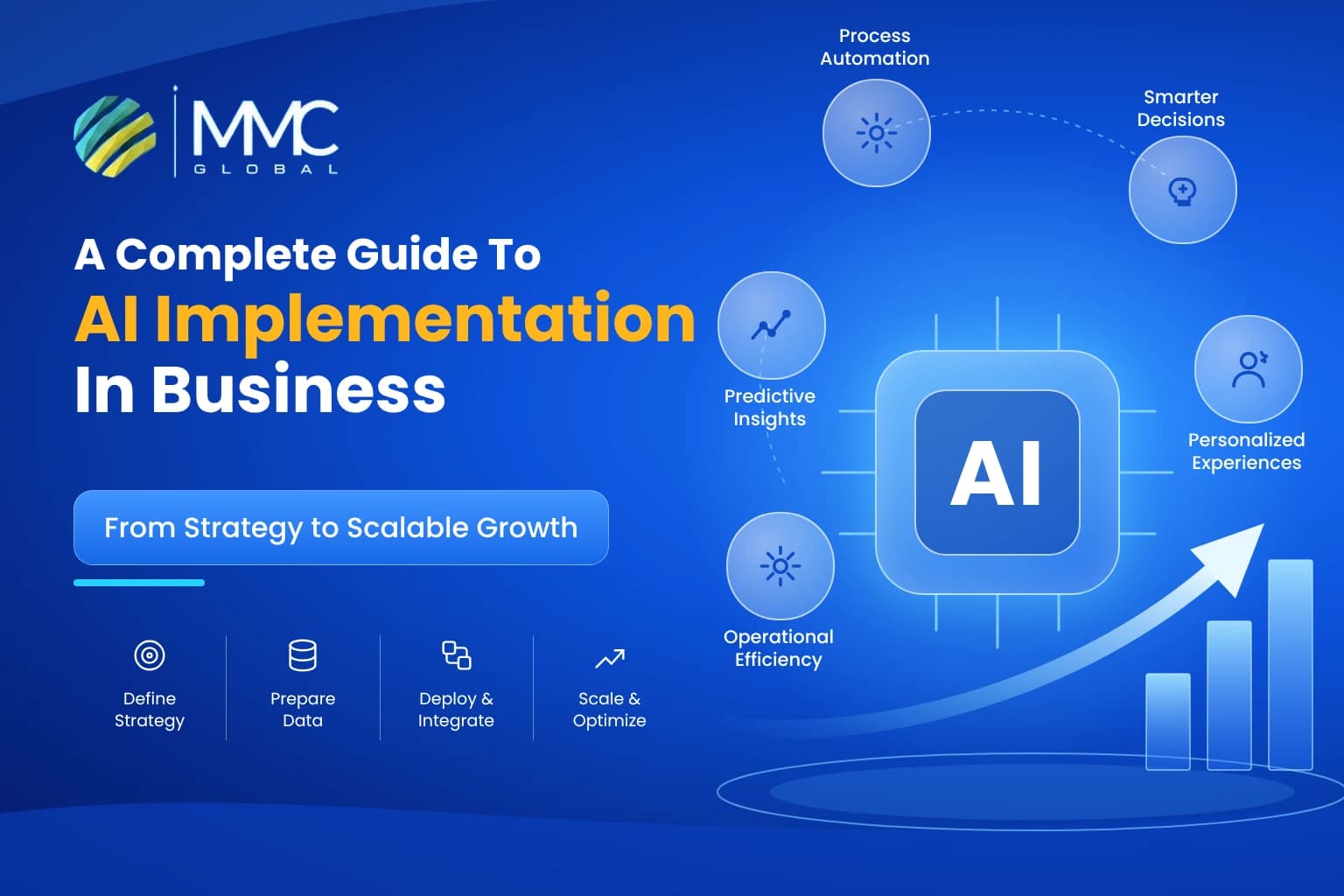
A 40% reduction in energy used for data center cooling. That’s what Google achieved by putting AI to work on its database challenge a decade ago. They took the chance and made it work even when artificial intelligence was not as capable and widely used as it is now.
The key takeaway: to get meaningful and desirable results from AI, all you have to do is to identify the right opportunities and choose the actual solutions that address the workflow needs.
A well-planned AI implementation strategy can help you execute that exactly. But where should you start? Which AI technologies fit your requirements? And how do you integrate them without disrupting existing processes?
Well, that’s what we’re getting into. From finding the right processes to target to choosing AI solutions that actually fit your business, let’s break down how to make implementation work beyond the planning stage.
What Is AI Implementation in Business?
AI implementation in business means introducing artificial intelligence technologies into your business to handle specific tasks. This could mean using machine learning to predict product demand or adding an AI-powered chatbot to handle customer inquiries. The idea is to make daily tasks simpler and help teams get better results from their work.
Businesses are also investing more in these capabilities. According to Grand View Research, the global AI market is projected to reach $9,526.0 billion by 2035, growing at a CAGR of 37.7%.
But simply bringing an AI tool into your business doesn’t guarantee the results you’re looking for. Three things need to come together:
- Technology: Choose AI tools and models that fit the work you want them to handle.
- Data: Give AI systems access to relevant and reliable information so they can produce useful results.
- People: Make sure your employees know how to work with AI and use its outputs in their daily tasks.
When these three elements work together, AI becomes a useful part of your operations rather than just another tool your team has to manage.
Turn 40% AI-driven savings into your next business win. Let’s build solutions that cut manual work and improve operational performance.
Explore Your AI OptionsImportance Of AI Implementation In Businesses
AI is finding its way into more business functions than ever. According to McKinsey’s State of AI report, the share of respondents whose organizations use AI in three or more business functions increased from 51% to 56%. This shows that businesses are finding more ways to use AI in their day-to-day work.
The value becomes clearer when you look at what it can help teams do. Here are some of the biggest benefits.
Automating Repetitive Tasks
AI can reduce the manual effort involved in routine business work. Tasks like document extraction and invoice processing often involve repeating the same steps. Automating them helps teams handle larger workloads in less time. Employees can then focus on exceptions and tasks that require human judgment.
Improving Business Decisions
Business decisions often depend on information spread across different systems. Bringing all that information together can take time. AI can help teams spot changes and understand what the numbers are telling them. This makes it easier to decide what needs attention and where to focus next.
Personalizing Customer Experiences
Customers are more likely to engage with a business when its offerings match their interests. AI helps businesses understand what individual customers prefer based on their past interactions. Businesses can use these insights to present products and offers that better match customer interests, encouraging repeat purchases.
Reducing Operational Costs
Running a business means keeping an eye on where money goes. AI can help businesses avoid spending on things they do not need. For example, predicting when equipment may need repairs can help prevent sudden breakdowns and expensive production delays. Better demand estimates can also help businesses avoid ordering more stock than they can sell.
Managing Business Risks
Business risks are not always obvious until they start affecting operations. AI can help identify unusual patterns in business data that may point to potential issues. This gives teams an opportunity to review concerns before they develop into larger problems. It also makes ongoing risk monitoring easier for businesses handling large volumes of data.
Where Can Businesses Implement AI Across Their Operations?
Almost every department has work that involves handling information, making decisions, or keeping everyday tasks on track. These responsibilities create different opportunities for AI implementation across a business.
Here are six departments where businesses can put AI to work.
1. Sales and Marketing
Sales and marketing teams have one shared goal: bringing in customers and generating revenue. However, they approach it from different sides. Sales teams focus on finding qualified prospects and closing deals, while marketing teams work on attracting the right audience and turning interest into demand.
AI implementation in sales and marketing can support both sides of this process. Sales teams can use customer and CRM data to understand which leads are more likely to convert. Marketing teams can study campaign performance and audience behavior to make better decisions about their messaging and spending.
Some areas where businesses can introduce AI include:
- Lead qualification: Assessing prospect information to help sales reps prioritize potential customers.
- Campaign management: Reviewing campaign performance to identify which channels and messages bring better results.
- Customer insights: Understanding buying patterns and interests to make marketing efforts more relevant.
2. Customer Service
Customer service is one of the business functions seeing strong interest in AI adoption. According to Forbes Advisor, 78% of companies anticipate agentic AI managing at least 50% of their customer service interactions. This points to a growing role for AI in managing customer requests and support activities.
For businesses, AI implementations in customer service mean more than adding an AI chatbot to a website. It can become part of the support process by answering common queries and helping customers complete routine requests. AI agents can also handle certain tasks independently, while more complicated issues go to human representatives.
This gives support teams more room to focus on complaints, technical problems, and customer requests that need individual attention.
3. Finance and Accounting
Finance and accounting offer several opportunities for AI implementation because much of the department’s work revolves around figures, records, and transactions that need to be checked against one another.
Rather than changing the entire finance function, businesses can start with individual processes where employees spend considerable time reviewing information. For example:
- Extract invoice details and match them against purchase orders.
- Review payment records and identify overdue invoices.
- Check expense claims against company policies and flag unusual entries.
- Examine historical revenue and spending to support budget forecasts.
These applications can fit into existing accounting and ERP systems. However, financial approvals and reporting controls should remain in place. AI may flag a mismatch or suggest an adjustment, but the finance team needs to verify the figures before taking action.
4. Human Resources
AI implementation in HR can cover the entire employee journey, not just recruitment. Each stage involves different responsibilities and information, giving businesses several ways to introduce AI without changing how the whole department operates.
Consider how it can fit into these areas:
1. Before hiring: Recruitment teams can use AI to review applications against job requirements and organize candidate information.
2. During onboarding: AI assistants can help new employees find company policies, understand internal procedures, and access training materials.
3. After hiring: HR teams can examine employee feedback and workforce information to identify training needs and understand common workplace concerns.
One important distinction is that AI should support HR professionals rather than make sensitive decisions on their behalf. Hiring, promotions, and performance evaluations still require human judgment.
5. Supply Chain and Logistics
Supply chain management involves decisions that affect one another. This makes supply chain and logistics an important area for businesses looking to introduce AI across connected operations.
AI can bring information from different stages of the supply chain into planning activities. For example, sales history and inventory records can help purchasing teams estimate future stock requirements.
Supplier and shipment updates can give logistics teams a clearer view of potential delays. Businesses can also use delivery information to review routes and adjust schedules.
6. Manufacturing
Unlike customer-facing departments, manufacturing offers opportunities to introduce AI directly into physical production activities. Its applications can vary depending on the type of products a business makes and the equipment used on its production floor.
Three areas stand out:
1. Production planning: Reviewing production data to identify delays and improve scheduling.
2. Equipment maintenance: Using machine readings to detect unusual performance and signs of possible failure.
3. Quality inspection: Applying computer vision to examine products and identify visible defects during production.
10 AI Solutions Businesses Can Implement to Improve Operations
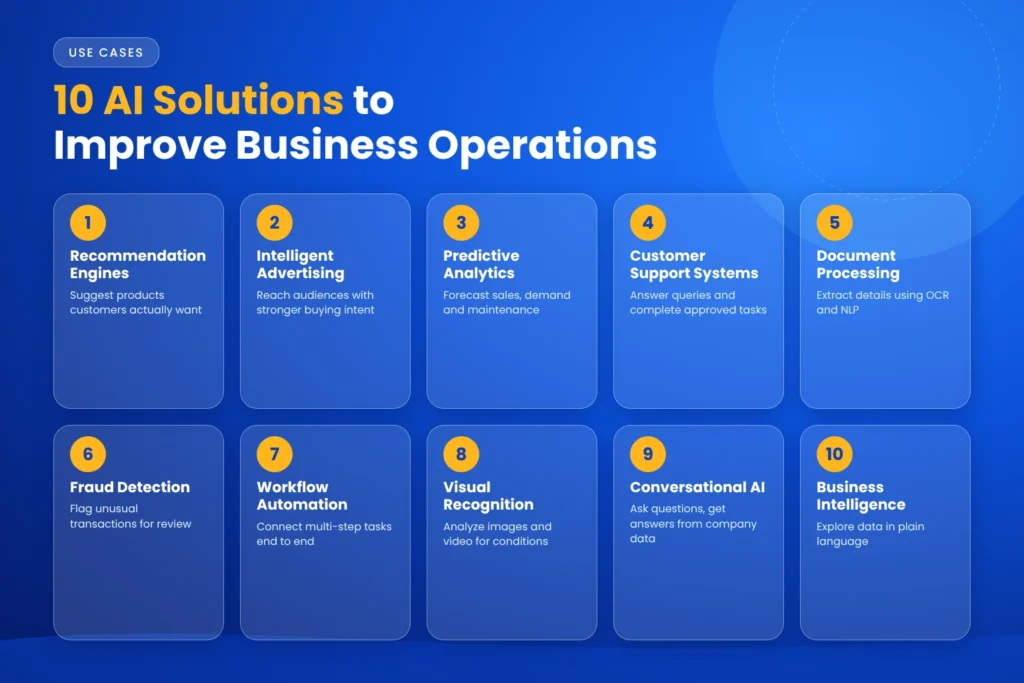
AI implementation in business becomes much more interesting when you look at what companies can actually do with it. From understanding what customers want to predicting what the business will need next, AI implementations can support decisions and activities across the organization.
But which applications are worth considering? And how do they work in practice? Let’s look at ten AI solutions that can make a real difference to business operations.
AI-Powered Recommendation Engines
Showing customers more products isn’t the same as showing them products they actually want. That’s where AI-powered recommendation engines make a difference. These systems study browsing activity and purchase history to understand individual customer preferences. They then use machine learning to suggest products that match those interests.
Intelligent Advertising and Customer Targeting
Getting thousands of clicks feels great. Until you realize very few of them came from people who might actually buy.
Intelligent advertising uses AI to help businesses reach audiences with stronger buying potential. Machine learning models examine customer behavior and campaign performance to identify promising audience segments. They can also help marketers adjust targeting as new campaign data comes in.
For businesses running paid campaigns across multiple platforms, this means making advertising decisions based on audience behavior rather than broad assumptions.
Predictive Analytics and Forecasting
Your sales figures tell you how the business performed last quarter. But what should you expect next quarter? Predictive analytics helps answer that question.
It uses historical records and current business data to identify patterns and estimate future outcomes. Depending on the business requirement, predictive AI can support:
- Sales forecasting: Estimate future revenue using sales history and current pipeline activity.
- Demand forecasting: Predict product demand to guide purchasing and inventory plans.
- Predictive maintenance: Identify signs of equipment failure before they interrupt production.
These forecasts give businesses a better basis for planning. They also help decision-makers prepare for possible changes instead of reacting after they happen.
Customer Support Systems
Customers expect quick answers. AI-powered customer support systems can handle these routine interactions by retrieving information from company knowledge bases and customer records. More advanced AI agents can also complete approved tasks, such as updating account details or checking delivery status.
The interesting part is that these systems can work beyond pre-written chatbot responses. They can understand the customer’s request and take the next appropriate step.
Autonomous agents take off multiple repetitive tasks from a team’s hands. Read our guide to learn how AI agents work in practice.
Document Processing
Invoices aren’t particularly exciting. Neither are purchase orders or piles of application forms. But someone still has to read them, extract the details, and enter everything into the right system.
AI-powered document processing can take much of that work off employees’ hands. It combines optical character recognition (OCR) with natural language processing (NLP) to read documents and extract relevant information.
Fraud Detection and Risk Management
AI in risk management and fraud detection systems examines transaction histories and learns what normal behavior looks like. They can flag unusual payment amounts or sudden changes in transaction frequency for further investigation.
Banks can use these systems to monitor card payments. Other businesses can apply similar AI implementations to payment screening and account security. Instead of relying entirely on manual checks, risk teams get alerts about activity that deserves a closer look.
Workflow Automation
Unlike traditional automation that follows fixed rules, AI-enabled workflows can interpret incoming information and determine what should happen next. Consider an employee expense claim. The system can read the receipt, extract the relevant details, check the claim against company policies, and send it for approval.
Businesses can apply the same approach to purchase requests, customer onboarding, and document approvals. This is one practical way of integrating AI into business operations because it connects multiple steps rather than automating isolated tasks.
Visual Recognition
Visual recognition systems analyze images and video to recognize objects and identify specific visual conditions. The system needs to be trained or configured for the objects it is expected to recognize. This makes the quality and variety of training images important when businesses plan their AI implementation.
Conversational AI and Virtual Assistants
Conversational AI gives people another way to interact with business information. Instead of navigating multiple platforms or searching through lengthy documents, employees can simply ask for what they need.
Powered by LLMs, these systems can understand natural-language requests and generate relevant responses. Businesses can connect virtual assistants to internal documents, databases, and knowledge repositories to make company information easier to access.
RAG is particularly useful here. It allows a system to retrieve relevant information from approved company sources before generating an answer. This helps make responses more relevant to the business rather than relying entirely on the model’s general knowledge
Business Intelligence
Business intelligence gives companies plenty of reports and dashboards. But understanding what those numbers actually mean can still take time.
AI-powered BI platforms let employees explore business data through natural-language questions. Artificial Intelligence can also highlight unusual changes in key metrics and summarize performance trends.
This makes business intelligence more accessible to teams that need answers but don’t necessarily have the technical skills to query databases themselves.
Whether you’re chasing new revenue or better decisions, there’s an AI-powered way to aim higher. Let MMC Global put the right solution to work to move your business further, faster.
Book A Call Now!What Should Businesses Consider Before Implementing AI?
There are certain steps you have to consider before integrating AI into your business. A few important considerations can help you choose the right approach to AI implementation and avoid breaking your bank on technology that does not address your actual organizational needs.
Set Business Goals and Expected ROI
Start with the result. Are you trying to reduce order processing time, improve customer retention, or increase sales conversions? Clear business objectives help you identify where AI fits and what you expect it to accomplish.
You should also establish measurable KPIs to track its performance. These could include processing time, customer acquisition cost, conversion rates, or employee hours saved. Compare these targets against implementation and maintenance expenses to estimate your expected ROI.
Check Your Data and Infrastructure
AI models need relevant and reliable data to produce useful results. Start by reviewing your existing databases and storage systems. Check whether information is consistent, accessible, and properly organized. You should also assess whether your infrastructure has enough computing capacity to support model training or inference workloads.
Assess Technical and Team Readiness
An AI solution might perform well in a controlled test but encounter problems once it becomes part of everyday workflows. That’s why technical and employee readiness need equal attention.
Check whether your existing software supports the required APIs and integrations. Also consider how AI will fit into current processes and whether teams know how to work with its outputs. If you’re introducing AI-powered automation, teams should understand which tasks it can handle and when human intervention is necessary.
Identify Required Skills and Resources
AI implementation involves more than developing or purchasing a model. You need people who can connect it to business systems, manage data, and keep it performing as expected.
Depending on the project, you may need:
- Data engineers to prepare data pipelines and maintain data quality.
- ML engineers to develop, deploy, and maintain machine learning models.
- Software developers to connect AI capabilities with existing applications.
- MLOps specialists to manage model deployment, monitoring, and updates.
Set Security and Governance Standards
AI systems may access sensitive customer records, financial information, and internal business documents. Without proper controls, this can create privacy and security risks.
Before deployment, establish clear policies for:
- Data access: Use role-based access controls (RBAC) to limit who can retrieve sensitive information.
- Data privacy: Apply encryption and define how personal information can be stored and processed.
- Model governance: Set rules for validating AI outputs and reviewing high-impact decisions.
- Monitoring: Track model performance and watch for issues such as data drift or inaccurate outputs.
For businesses operating across multiple regions, regulatory requirements such as GDPR may also influence how AI systems collect and process information.
How to Implement AI in Your Business: A Step-by-Step Process
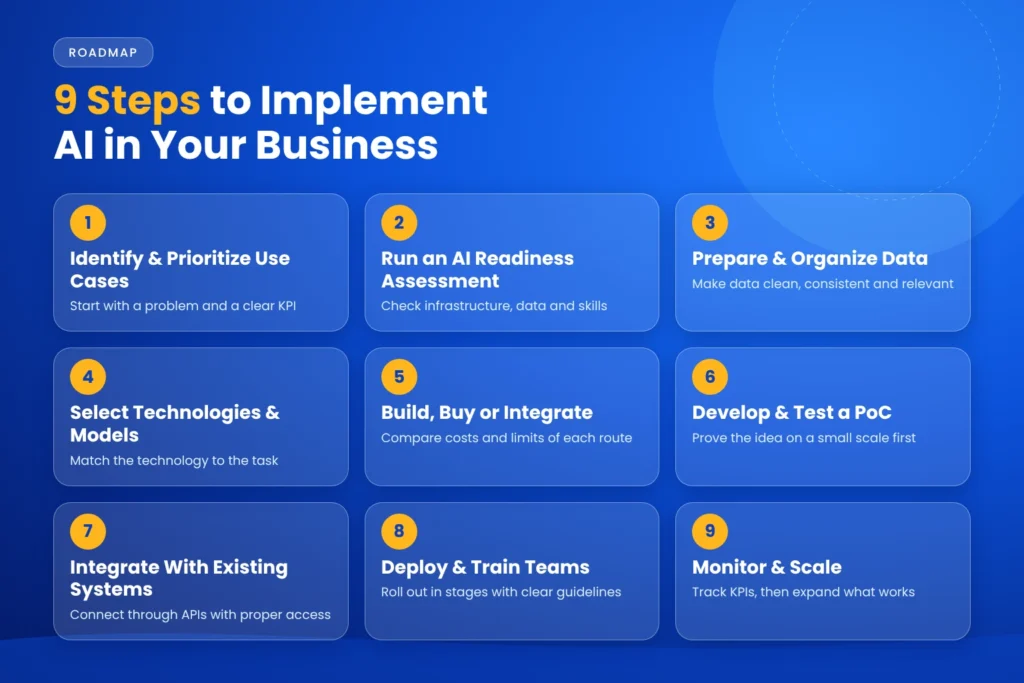
AI implementation involves a structured process, starting off with identifying the right use case. Each step in the process is crucial for integrating AI into business to make sure the solution works perfectly within your current operations. Here’s a 9-step process:
Step 1. Identify and Prioritize AI Use Cases
Start with a business problem. Look at where your current processes fall short and identify the tasks that could benefit from AI.
Shortlist the most relevant opportunities and compare their expected business value against the investment required. Consider your available data and development resources too.
The goal is to find a use case that is worth pursuing and realistic to implement. Set a clear KPI from the beginning so you know what success should look like.
Step 2. Conduct an AI Readiness Assessment
Before development begins, take stock of what your business already has. Check whether your infrastructure can support the application and whether your data is ready to use.
You’ll also need the right people to manage the project. Depending on the project, you may need data engineers, ML engineers, or software developers. Identify any skill gaps before development begins so you can account for the additional resources.
This gives you a realistic picture of the work ahead rather than leaving important requirements until later.
Step 3. Prepare and Organize Business Data
Your existing business data needs a little work before it can be used for AI development. Go through the available datasets and prepare them for the model. Make sure the information is clean, consistent, and relevant to the task you’re building the AI application for.
Step 4. Select the Right AI Technologies and Models
The technology you choose depends on what you want your application to accomplish. Here are some of the main options used in AI implementation:
- Machine Learning (ML): For learning patterns and making predictions.
- Deep Learning: For handling complex patterns in large datasets.
- Generative AI (GenAI): For generating and working with content.
- Natural Language Processing (NLP): For understanding and processing human language.
- Computer Vision: For analyzing images and visual information.
- Reinforcement Learning: For learning through feedback and improving decisions over time.
- Speech Recognition: For converting spoken language into text.
- Retrieval-Augmented Generation (RAG): For retrieving relevant information from business data before generating responses.
- AI Agents: For handling multi-step tasks with limited human intervention.
- Expert Systems: For making decisions based on predefined rules and knowledge.
You’ll also need to decide whether a pre-trained model is enough or whether fine-tuning or custom development is necessary. Keep the choice tied to your actual requirements rather than choosing the most complex option.
Step 5. Choose Between Building, Buying, or Integrating AI
You don’t always need to develop an AI application from scratch. Depending on your requirements, you can choose between three approaches:
| Approach | Best Suited For |
| Build | When you need a custom AI application. |
| Buy | When an existing product covers your requirements. |
| Integrate | When you want to add AI to your current software. |
Compare the costs and limitations of each approach before deciding. If custom development is necessary, professional AI development services can help you take the project from technical planning to deployment.
Step 6. Develop and Test an AI Proof of Concept
A proof of concept (PoC) gives you a chance to test the idea before investing in the complete application.
Build a small version that focuses on the main functionality. Check whether it produces reliable results and meets the performance targets you established earlier.
If something isn’t working as expected, make adjustments before moving into full development. There’s little point in expanding an application that hasn’t proved its value yet.
Step 7. Integrate AI With Existing Business Systems
APIs provide the connection between your AI application and the software your business already uses. They allow the application to retrieve information, process it, and send results back to connected systems.
For instance, an AI-powered sales application might retrieve customer information from a CRM and return lead scores or recommendations to the same platform.
Integration work should account for:
- API compatibility: Check whether the connected platforms support the required endpoints and data formats.
- Data synchronization: Make sure information remains current across connected systems.
- Authentication and permissions: Use appropriate access controls to prevent unauthorized data retrieval or changes.
- Error handling: Define what happens when a connected service is unavailable or a request fails.
Step 8. Deploy AI and Train Your Teams
Once the application is tested and connected to your systems, move it into actual use. A controlled rollout is usually more practical than giving every department access immediately.
Start with the team that will use the application most. For applications that influence important decisions, you can initially run AI recommendations alongside the existing process and compare their results before allowing them to guide live decisions.
Employee training is just as important. Your team needs to understand how the application fits into its daily work and when human review is necessary. Establish clear AI usage guidelines as well. These should cover data privacy and the handling of AI-generated outputs.
Step 9. Monitor Performance and Scale Implementation
Keep tracking your application’s performance after launch. Compare its results against your original KPIs and check whether it continues to deliver the expected business value.
MLOps can help your team manage model monitoring, updates, and retraining. For GenAI applications, regular output evaluations are equally important.
When the application is performing as expected, you can start considering other areas where AI could deliver similar value. Let actual results guide your next implementation.
How To Select The Right AI Tools?
Choosing the right AI tools takes more than comparing features and subscription plans. You need a solution that fits your business requirements and works well with your existing operations. Here are the factors worth considering before making your choice for AI implementation in business:
Ease of Use and User Experience
The platform should be easy for your teams to navigate and use. A complicated interface can make adoption harder, so pay attention to the overall user experience.
Accuracy and Reliability
See how well the AI performs on the tasks you need it for. Consistent and accurate results should matter more than impressive product claims.
Integration Capabilities
Consider how the solution will fit with your existing software. Check its API support and compatibility before integrating AI into your business tech stack.
Customization Options
Your business requirements need specialized features. Look for AI solutions that let you adjust their functionality to suit your workflows.
Scalability and Performance
The software should be able to keep up as your business grows. Consider its ability to handle higher workloads without affecting speed or performance.
Data Security and Privacy
Business data needs proper protection when handled by AI. Review the provider’s security measures, data storage policies, and privacy terms before proceeding.
Pricing and Licensing
Compare subscription plans with the features and usage limits they offer. Account for licensing fees and additional costs to understand what you’re actually paying for.
Vendor Support and Maintenance
Look into the support you’ll receive after deployment. Regular updates and responsive assistance can help keep your AI software running smoothly. For more specific requirements, an AI development company, like MMC Global, can also help assess custom solutions through its end-to-end services.
What Are the Common Challenges of AI Implementation?
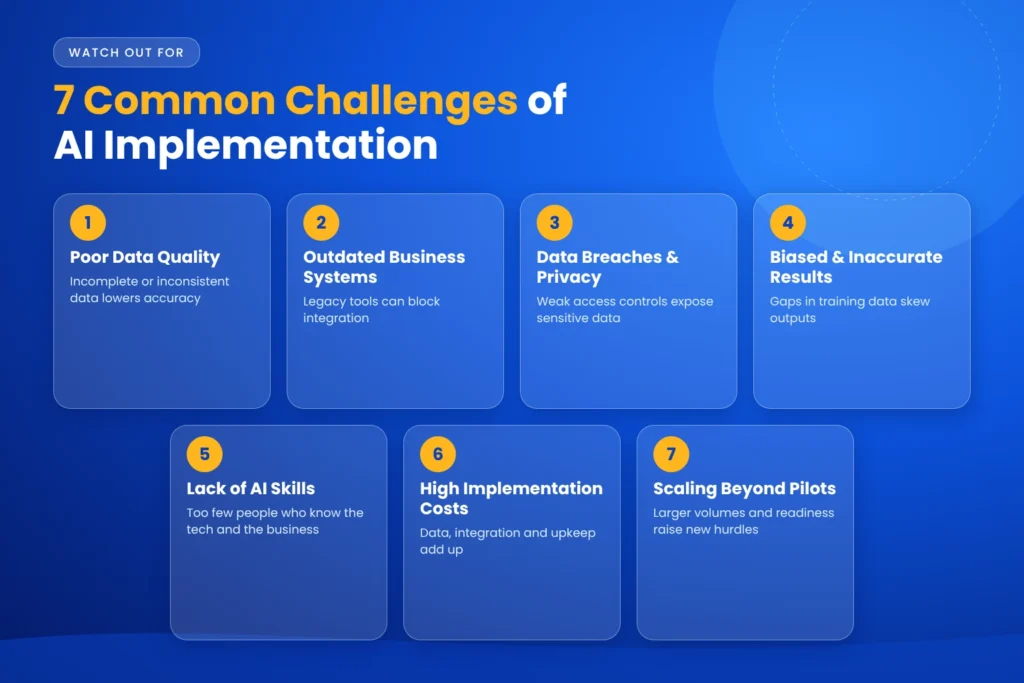
AI implementation in business comes with a few challenges that can affect how well the technology performs and how much value it delivers.
Poor Data Quality
AI models need clean and relevant data to produce useful results. Incomplete, outdated, or inconsistent information can affect their accuracy. Data governance also plays a major role here. Gartner predicts that by 2027, 60% of organizations that overlook data governance challenges may struggle to manage AI successfully.
Outdated Business Systems
Older business systems may not support the integrations or infrastructure required for modern AI solutions. This can make connecting AI with existing applications more difficult and may require businesses to upgrade their technology before moving ahead.
Data Breaches and Privacy Concerns
AI systems often process sensitive business and customer information. Weak access controls or poor data handling practices can expose that information to unauthorized users. Businesses need clear data protection policies before putting AI into daily operations.
Biased and Inaccurate AI Results
AI models can produce biased results when their training data contains gaps or reflects existing biases. These outputs can affect business decisions and customer experiences. Regular testing and model monitoring help identify such issues before they cause further problems.
Lack of AI Skills
Implementing AI requires people who understand both the technology and its business applications. A shortage of skilled professionals can slow development, integration, and ongoing management. Existing employees may also need training to work confidently with AI systems.
High AI Implementation Costs
The initial development or subscription fee is only one part of the investment. Data preparation, system integration, infrastructure, and ongoing maintenance can add to the overall AI implementation cost. Without a clear budget, these expenses can become difficult to manage.
Difficulty Scaling AI Beyond Pilot Projects
An AI pilot may deliver promising results, but expanding it across the business brings new challenges. Larger data volumes, system capacity, integration requirements, and team readiness can all affect deployment. Businesses need a clear plan for moving from successful testing to wider adoption.
Get Your Business Ready For AI Implementation With MMC Global
Your business shouldn’t have to spend more just to get less done. If your teams are still losing hours to repetitive tasks or making decisions without the right information, there’s room for AI to make a real difference.
At MMC Global, we help you turn those gaps into opportunities for better business performance. Our AI implementation services focus on reducing unnecessary manual work, improving operational efficiency, and helping your teams get more value from the data they already have.
And we don’t measure success by how much AI your business uses. We measure it by what actually improves: time saved, work completed faster, better decisions, and stronger returns on your investment.
From choosing your first AI use case to deciding whether to build or buy, MMC Global helps you make the calls that shape your implementation.
Let’s Get Started Today!Frequently Asked Questions
What is an AI implementation?
AI implementation means using artificial intelligence technologies within specific business processes to automate tasks, analyze data, and support decision-making. It lets organizations apply AI to certain functions like customer service, sales, finance, and supply chain management.
How to implement AI into a business?
To implement AI into business, begin by identifying processes that could benefit from automation or better data analysis, followed by these steps:
- Identify and prioritize AI use cases.
- Assess your business’s technical readiness.
- Prepare and organize your data.
- Select suitable AI tools and models.
- Decide whether to build, buy, or integrate AI.
- Build and test a PoC.
- Integrate AI with existing systems.
- Deploy the solution and train the teams.
- Monitor performance and expand implementation.
How much does AI implementation cost?
The cost of AI implementation differs depending on the complexity of the solution, the selected technology, and the required customization level. Other factors like data preparation, development, system integration, and ongoing maintenance also affect the budget.
What are the common challenges in implementing AI?
Common challenges in implementing AI include poor data quality, outdated business systems, and data security concerns. Businesses may also struggle with a lack of skilled professionals and high implementation costs. Scaling AI beyond pilot projects can create further difficulties and delay wider adoption.