
Artificial Intelligence has officially entered its “now make it work in production” era.
The demos are impressive, and the prototypes are also multiplying rapidly. AI agents are getting smarter as well. But getting an AI product to operate with real data and systems is where things take a considerably more interesting turn. What once looked fine in a controlled environment can quickly involve data preparation, model evaluation, system integration, security, and costs that were not even there during the demo.
At this point, AI skills alone are not enough to do much. You need experts who understand what happens when models meet messy data and complicated systems.
Creating all of that internally is not always practical. AI outsourcing lets you gain specialized capabilities without requiring every role to sit on your payroll. The catch? Not every artificial intelligence outsourcing partner can handle the same level of complexity.
Now the thing is, how do you separate genuine capability from a convincing sales pitch? To cut the chase, we are presenting this guide to break down what you need to look for in an AI software outsourcing partner in 2026 and what deserves a closer look before you sign.
AI Outsourcing in 2026: What Businesses Are Actually Buying
AI outsourcing was once a simple answer to a simple problem: “We need AI talent.” That picture has completely changed now.
Today, businesses are dealing with massive AI workloads. McKinsey also reports that 88% of businesses have adopted AI in at least 1 of their functions. However, approximately 1% know how to correctly use it, and nearly two-thirds of organizations have yet to scale AI beyond the pilot stage. The gap between experimenting with AI and making it work is getting harder to ignore.
The outcome of this study is also changing the expectations of businesses from an AI outsourcing partner. They have shifted from looking at AI developers to searching for someone who knows how to handle the moving parts around the model.
AI Outsourcing Goes Beyond Hiring AI Developers
Partnering with an AI developer solves one piece of the puzzle. Artificial Intelligence outsourcing covers a broader technical scope depending on your requirements.
Layer 1 – Data
AI system needs reliable data to generate useful results. A software outsourcing services provider may handle data preparation and pipelines or help align the data environment around the project.
Layer 2 – Intelligence
This is where intelligence is built. The work here can include an LLM application or an ML model. It can also involve RAG or an AI agent as per the organization’s use case.
Layer 3 – Application
AI then has to function within the product or workflow everyone already uses. This is where APIs and system integrations get included so that the AI capability does not remain isolated from the rest of the business.
Layer 4 – Operations
After going live, models need to be evaluated and monitored while the underlying systems require continuous scaling and optimization.
These saturated layers define the real scope of AI outsourcing. You may need one or all four layers. The right partner should be able to support the level of technical involvement your project demands.
What AI Projects Can You Outsource?
The short answer? Quite a lot.
You can outsource AI work at multiple levels. Some businesses may need a customer-facing generative AI application or an LLM-powered feature. Others might need AI agents to handle a few repetitive tasks.
There is so much more than generative AI too. ML and predictive analysis can support forecasting and decision-making. Meanwhile, NLP and computer vision handle language and visuals.
Put the juggling between AI models to an end. Just tell us what’s slowing your business down, and we will find out where AI fits in.
Start The ConversationAI integrations and MLOps help in connecting these capabilities with existing systems and keep them easy to manage after deployment.
The point is really simple: AI outsourcing is not one service with a fixed scope. The right combination depends on the problem you are trying to solve and how far the AI needs to go.
Should You Outsource AI Development or Build In-House?
Artificial intelligence outsourcing vs in-house development: each comes with a different kind of commitment. One brings in an external team inside the development process, and the other means building the people and technical foundation around AI within the business.
There is an interesting part tied to it. Neither approach automatically wins. The best fit changes with the nature of the work, the role AI plays, and what the business expects to do with it after the initial development cycle.
This makes it a business design decision more than a technology decision. And a closer look at the approaches makes the trade-offs simpler to understand.
When AI Outsourcing Makes More Sense
AI outsourcing feels suitable when an organization has a specific AI initiative to deliver without plans to build a permanent team around it.
It often applies to clear projects such as an LLM or an AI-powered application. The business is well aware of what it has to achieve, but the needed AI work sits outside its current development setup.
It also makes sense when hiring an entire team would create more overhead than the project. An external team handles the software creation while the business stays focused on its product and priorities.
When Building an Internal AI Team Makes More Sense
An in-house team becomes the stronger option when AI sits close to the heart of the product.
A business established around proprietary models or unique datasets gains long-term value from keeping that knowledge within the organization. The same applies when AI development services continue across multiple products and business operations.
Moreover, an in-house team also develops familiarity with the company’s data systems and product decisions over time.
When a Hybrid AI Team Is the Better Choice
A hybrid AI setup brings a different dynamic. The organization keeps its core AI direction inside while an external team contributes to selected areas of development.
For instance, your internal team can handle product decisions and organizational requirements while external teams work on AI development or MLOps. This setup provides the room to evolve. Responsibilities can shift as the internal team grows and the AI roadmap becomes clearer.
Choose the AI Outsourcing Model That Fits Your Business
Artificial intelligence comes in multiple forms. Knowing the real difference matters because the wrong engagement model can leave you with either too much vendor involvement for a simple project or too little support for a demanding AI project.
Let’s have a quick look at the snapshot to see where each model fits:
| AI Outsourcing Model | Best For | Partner Involvement | Typical Engagement |
| Project-Based AI Development | A defined AI project with clear deliverables. | Focused on the agreed scope. | Short to mid-term |
| Dedicated AI Development Team | Continuous AI product development. | Works as an extension of your product team. | Long-term |
| AI Staff Augmentation | Existing teams that need additional AI talent. | Adds selected professionals to your team. | Flexible |
| Fully Managed AI Development | End-to-end AI delivery. | Takes responsibility across development and operations. | Full-service |
| AI Consulting and Development Partnership | Businesses shaping their AI strategy. | Advises on direction and supports execution. | Advisory to ongoing |
The model you select also sets the expectations for everything that follows: who owns the delivery, how the team works together, and what you should be expecting from your development partner.
This makes the next decision even more important: who is actually equipped to handle the work?
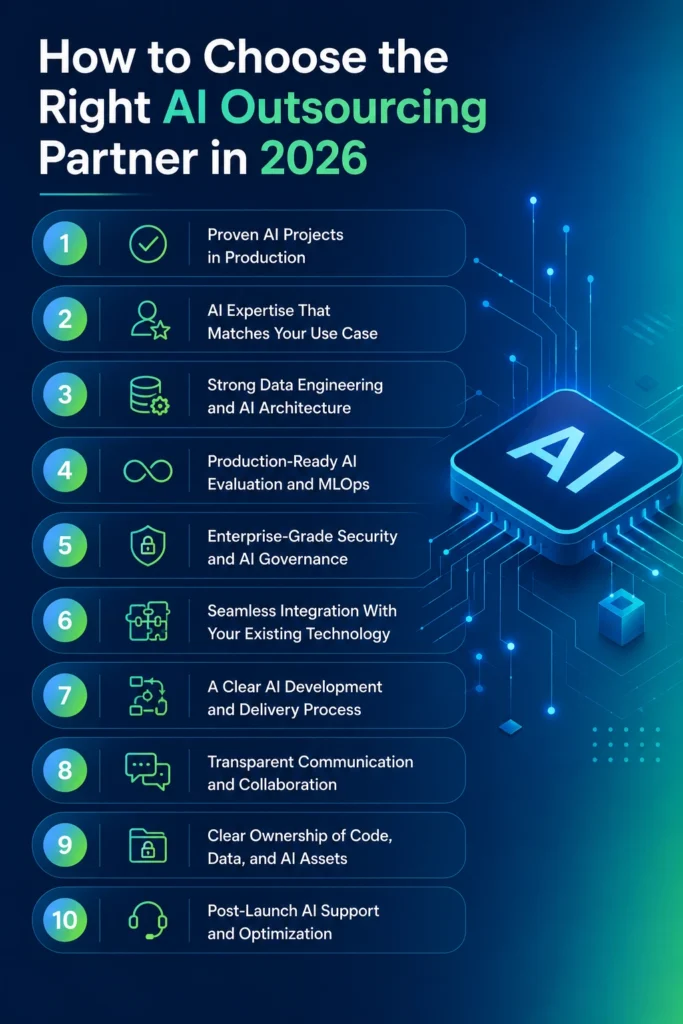
How to Choose the Right AI Outsourcing Partner in 2026
You can learn so much about an AI development company before making a final call. The trick is knowing where to look.
Choosing a partner seems tricky when every other vendor seems to speak the same language. The useful difference mostly appears in the proposal. Instead of scoring agencies on how many AI services they promote, test each one of them through the same evaluation process.
A strong evaluation must reveal three things early: how the team makes technical decisions, how it handles real operating conditions, and how responsibly it treats everything surrounding the AI itself.
1. Proven AI Projects in Production
An outsourcing development company should answer one basic question: have they handled something comparable before?
Thoroughly check production work rather than concept demos. Look for the problem behind the project, the technology they have used, the environment it entered, and the result it provided.
2. AI Expertise That Matches Your Use Case
The right team does not often use abundant AI vocabulary or jargon that just sounds fancy without fulfilling an actual purpose.
You must examine the people who would actually work on your AI project. Their experience must make sense for the workload in front of them. Make sure they are aware of your industry and what relevant capabilities you require to solve complex problems with AI.
The question is less “Do they do AI?” and more about “How will these people solve problems like mine?“
3. Strong Data Engineering and AI Architecture
The technical proposal requires a closer look. Follow the path from your data into the AI model and back into the application. Make sure to look carefully at the model layer, the retrieval layer, APIs, storage infrastructure, and integration points.
After evaluation, ask yourself whether the architecture solves your real problems or simply uses impressive technology.
4. Production-Ready AI Evaluation and MLOps
Something labelled as “Highly accurate” does not act as a useful answer to explain itself.
The evaluation approach must match the system being built. This involves retrieval quality, hallucination rates, latency, model performance, or cost per interaction.
5. Enterprise-Grade Security and AI Governance
Security should not be treated as a mere PDF at the end.
For your relevant industry use case, make sure you discuss data access and regulatory environments while the solution is being designed. Sticking to SOC 2, ISO 27001, CCPA, and GDPR should never be ignored at any point.
Conversations regarding security also help in revealing that the vendor understands the risks created by the architecture itself.
6. Seamless Integration With Your Existing Technology
AI does not work as a standalone product inside an established business. Your partner must know how the system will connect with existing applications, APIs, databases, cloud, CRM platforms, ERP systems, and internal workflows.
Stay focused on authentication, data exchange, and failure handling. Integration experience matters as the AI has to work within the technology environment that already exists.
7. A Clear AI Development and Delivery Process
A clear development process tells you how the project will move forward before you commit to it.
Discovery must set the real requirements while feasibility work identifies what is technically realistic. Structure needs a clear point of review before development takes a step forward. Testing and deployment should follow a defined path that keeps responsibilities and milestones visible.
This entire process should also leave room for changes as AI projects often reveal new information once development begins.
8. Transparent Communication and Collaboration
You get an early peek at how the partnership will proceed during the consultation process.
Pay special attention to how the vendor handles your queries and if the technical team can explain its reasoning without hiding behind jargon. Notice the way they respond once you challenge an assumption or introduce a difficult requirement.
9. Clear Ownership of Code, Data, and AI Assets
Your agreement must cover the source code and data along with models, prompts, workflow, and documentation made during the engagement. It should also explain access rights and what happens if you decide to move the system to another team.
10. Post-Launch AI Support and Optimization
The launch is where the next phase of the project begins. Real usage brings new requirements and performance data that you cannot completely predict during the mobile app development phase. Models may require updates, while infrastructure and operating costs can change as adoption grows.
Your agreement must therefore make post-launch support clear. Each phase should have defined ownership and commercial terms from the beginning.
From model selection to MLOps, let’s examine what your AI needs to work scalably and securely.
Talk To AI ExpertsChoosing an outsourcing partner, whether it is an offshore AI development company or nearshore vendors, ultimately comes down to understanding what you are getting beyond the initial build.
What Startups Should Look for in an AI Outsourcing Partner
For startups, the right AI partner is the one that keeps the product development moving without creating unnecessary cost or long-term dependency.
- Speed From Ideation To Working Product: A quick path from validation to a working product allows startups to test demand without spending months creating an internal AI team first.
- Flexible Engagement And Scalable Teams: AI demands change as the product develops. A flexible team allows increasing or slashing development capacity without carrying a large permanent AI workforce.
- Budget Control: Cost control must come from smarter development and infrastructure decisions. Total cost of ownership (TCO) provides a clearer picture.
- Product and Business Thinking: Technical execution needs to stay linked to product-market fit, user experience, business KPIs, feasibility, and time to market. The partner must understand those priorities alongside the AI work.
- Startup-Friendly Ownership And Exit Terms: If you are a startup owner, you should retain clear ownership of its code, data, and AI assets while keeping a practical route to bring development in-house or change partners as the company grows.
What Enterprises Should Look for in an AI Outsourcing Partner
Enterprise AI has a completely different set of priorities. The right vendor needs to fit into complex technology systems while meeting high standards for security, governance, reliability, and long-term support.
- Enterprise System Integration: The AI solution has to work smoothly with existing ERPs, CRMs, legacy applications, cloud environments, and data platforms without causing hurdles in critical business systems.
- Security and Data Compliance: Enterprise projects need strict control surrounding data access and storage processing along with compliance requirements and clear data residency policies.
- AI Governance and Risk Management: The AI consulting and development company should have clear processes for model governance, explainability, auditability, human oversight, and risk controls throughout the AI lifecycle.
- Scalability and Production Reliability: Enterprise AI has to deal with large user and data volumes while maintaining performance and resilience with suitable disaster recovery measures.
- Long-Term Knowledge Transfer And Operational Support: Documentation, knowledge transfer, ongoing maintenance, and the right mix of managed services, dedicated teams, or hybrid support let operations stay stable as requirements evolve.
How Much Does AI Outsourcing Cost in 2026?
The cost of AI outsourcing starts to make more sense once you stop looking at AI as one type of project. Integrating an AI assistant into an existing product is a very different thing from building a system around private company data or linking AI with multiple business portals.
For 2026, the range begins around $5,000 to $25,000 for a Proof of concept and can go as high as $200,000 to $500,000+ for a complex enterprise AI platform. The difference comes from the efforts it needs to develop the project and how much work sits around the AI itself.
What Determines AI Outsourcing Costs?
The entire budget starts changing once the scope becomes more demanding.
| Cost factor | What it means for your budget |
| AI complexity | A basic AI feature is cheaper than a system with several AI functions working together. |
| Team composition | The budget changes based on the number and experience of people needed for the project. |
| Data requirements | Existing clean data keeps the work simpler. Poor quality or scattered data requires more preparation. |
| Model choice | Existing models are usually cheaper to work with than custom models or fine-tuning. |
| Integration complexity | AI connected to one product takes less work than AI connected to several business systems. |
| Security requirements | Sensitive data and strict security rules add more development work. |
| Cloud and AI usage | Running models and storing data creates costs after development as well. |
| Development timeline | A shorter deadline can require more people working at the same time. |
| Ongoing support | Updates, fixes, monitoring, and improvements continue after the first release. |
A lightweight AI feature and a complete enterprise system can sit worlds apart in cost since the work behind them is completely different.
How to Compare AI Outsourcing Quotes Beyond Hourly Rates
Hourly rates only tell you what you might pay during development. They do not show you the full cost of the project. When you are comparing costs, don’t forget to look at:
- Total Cost of Ownership: Includes development, data work, AI model usage, testing, maintenance, and future updates.
- What the Quote Covers: Check if integrations, testing, deployment, and support are added or charged separately.
- Delivery Timeline: A lower quote means nothing if the project takes longer to launch.
- Expected Quality: Compare what each development partner is delivering rather than comparing prices for different scopes.
- Future Scalability: Make sure the proposed solution will not require a complete rebuild in the future.
- Post-Launch Costs: Check what continuous support costs and which services fall outside the original agreement.
How to Vet an AI Outsourcing Company Before Signing
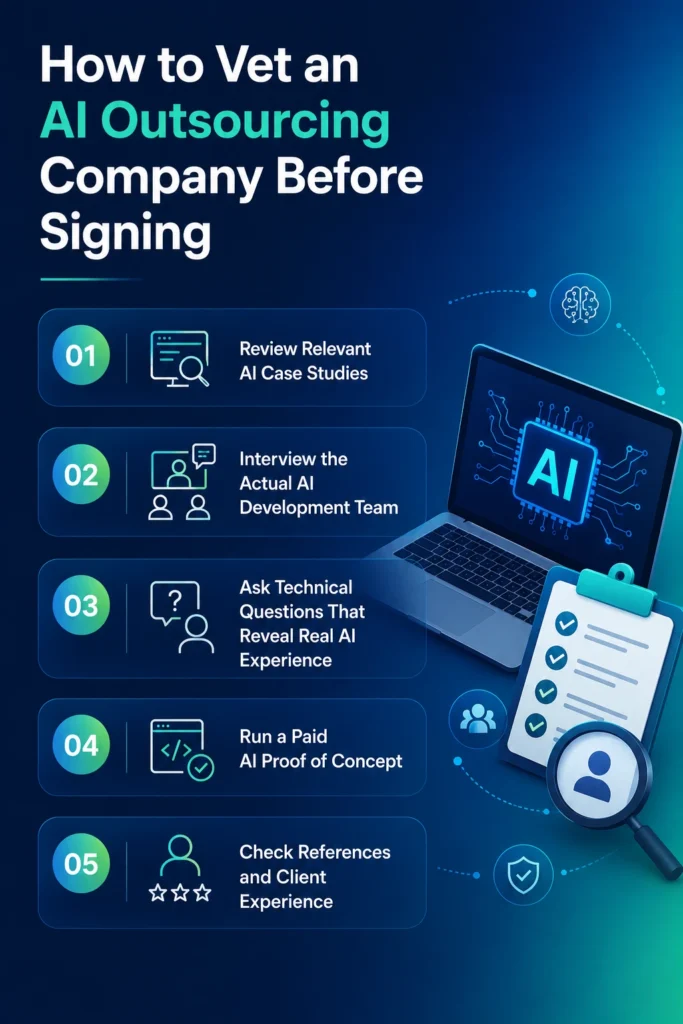
You have compared the AI services providers and narrowed down your options. Now, it’s time to test what you have been told until now. A closer look at their work and technical approach will tell you whether the partnership makes sense or not.
Review Relevant AI Case Studies
Focus on projects that look like yours instead of the most impressive ones on their website. Look at the critical problem they solved, the tech stack they used, and test how they approach a real AI problem.
Interview the Actual AI Development Team
Talk to the individual who will be handling the project. You should be able to discuss the use case with the AI developers and technical leads who will make the key decisions.
Ask Technical Questions That Reveal Real AI Experience
The right questions should make the team’s thinking visible. Make sure to ask:
- Why does a certain use case need RAG instead of fine-tuning?
- How will you evaluate the quality of LLM responses?
- How will you handle hallucinations?
Run a Paid AI Proof of Concept
A small paid PoC lets you see the team in action before committing to a larger engagement. Use it to test the technical approach along with delivery speed, communication, output quality, and the assumptions.
Check References and Client Experience
Check reviews of their previous partner who have actually worked with the team. See if the project stayed on track and what upgrades their platform is getting after the deployment.
AI Outsourcing Red Flags That Should Stop You From Signing
Some warning signs are easy to spot once you know what to look for. A vendor that stays vague about the technical work or makes promises that sound too good to be true deserves a closer look before you commit.
Poor Business Understanding
The conversation stays focused on features and technology while the actual business problem gets little attention. The team should understand what the AI needs to achieve and how success will be measured.
No Production Experience
A portfolio full of demos and prototypes does not tell you how the team handles a live AI system. Limited production experience becomes a serious concern when your project needs real users and ongoing performance.
Weak AI Architecture
The proposal jumps straight to models and tools without explaining how the AI will work with your data and existing systems. That usually points to gaps that surface later during development.
Poor Data and Evaluation
The vendor expects clean data and has little to say about how AI output will be tested. Without a clear approach to data quality and evaluation, it becomes difficult to know whether the system is actually improving.
Unrealistic Accuracy Promises
Be careful when a vendor promises a fixed accuracy level before understanding your data and use case. AI performance depends on the problem being solved and the quality of the information available.
Hidden AI Costs
The development quote may look reasonable until model usage, vector databases, cloud services, or other running costs appear later. Ask what you will continue paying for after development ends.
Unclear IP Ownership
If the agreement does not clearly state who owns the code, data models, prompts, and other AI assets, you are taking an unnecessary risk.
No Post-Launch Support
AI systems need attention after launch. A vendor with no clear plan for maintenance, monitoring updates, and future improvements leaves you with a product and no clear path for keeping it useful.
Build AI The Right Way With MMC Global
Whether you have a business idea worth testing or a product worth improving. What you really need is the right team to turn that opportunity into a useful tool that helps your audience at its core.
MMC Global brings AI development and product thinking together to help startups and multinational enterprises move from concept to production smoothly. Our teams are well equipped with next-generation capabilities to help you overcome the development of an AI feature or a complete AI-powered product.
We build around your goals and your growth plans. No unnecessary complexity and no building technology just because it sounds impressive.
Talk to MMC Global to hop on an optimized next-generation AI adoption journey for your business. We are just a tap away.
Join The Call Today!Frequently Asked Questions
What does AI outsourcing mean?
AI outsourcing means hiring an external team to plan, build, deploy, or maintain AI solutions for your business. The work can include AI applications, LLMs, machine learning AI agents, data work integrations, and ongoing support.
How do you choose the right AI development outsourcing partner?
Choose an AI partner based on relevant production experience, technical expertise, security practices, delivery process, and post-launch support. Review similar projects and speak with the team that will actually work on your project before signing.
What are the common mistakes of AI outsourcing?
Common mistakes include choosing a vendor based only on price, overlooking data requirements, and accepting unclear project scopes. Businesses also run into trouble when ownership, security, ongoing costs, and post-launch support are left unclear.
How much does it cost to outsource AI development?
AI outsourcing can cost from around $5,000 for a focused proof of concept to $500,000+ for complex enterprise systems. The final price depends on AI complexity, data work integrations, team size, security requirements, and ongoing support.
What are the risks of outsourcing AI development?
The main risks include data exposure, poor AI performance, hidden costs, weak integration, and vendor dependency. Clear contracts, strong security controls, defined ownership, and proper testing can reduce these risks.