
“Artificial Intelligence is no match for natural stupidity.” – words of wisdom said by an actual genius. So true, but in 2026, nothing drains a business owner’s sanity faster than making a bold attempt to hire someone who actually knows how to build real AI.
Post an ad for an “AI Engineer,” and you will see your inbox getting flooded with countless matches. Half of them just learned how to prompt ChatGPT last week, and the rest are asking for a fortune an hour to explain why you need a massive neural network for a simple workflow feature.
It is a bit confusing, but you must know the difference between “using AI” and “creating AI“. And when local talent comes with a hefty price tag, offshore can open up more opportunities.
But hiring offshore AI developers is not only about getting “cheap” solutions. Finding the actual specialist who knows how to connect LLMs to your database and prevent models from making up fake facts.
Let’s cut through the tech-hype noise and get on the journey to know what you need, how much offshore AI development actually costs, and how to set the base of a rock-solid offshore partnership. Fasten up, as it’s going to be a detailed ride.
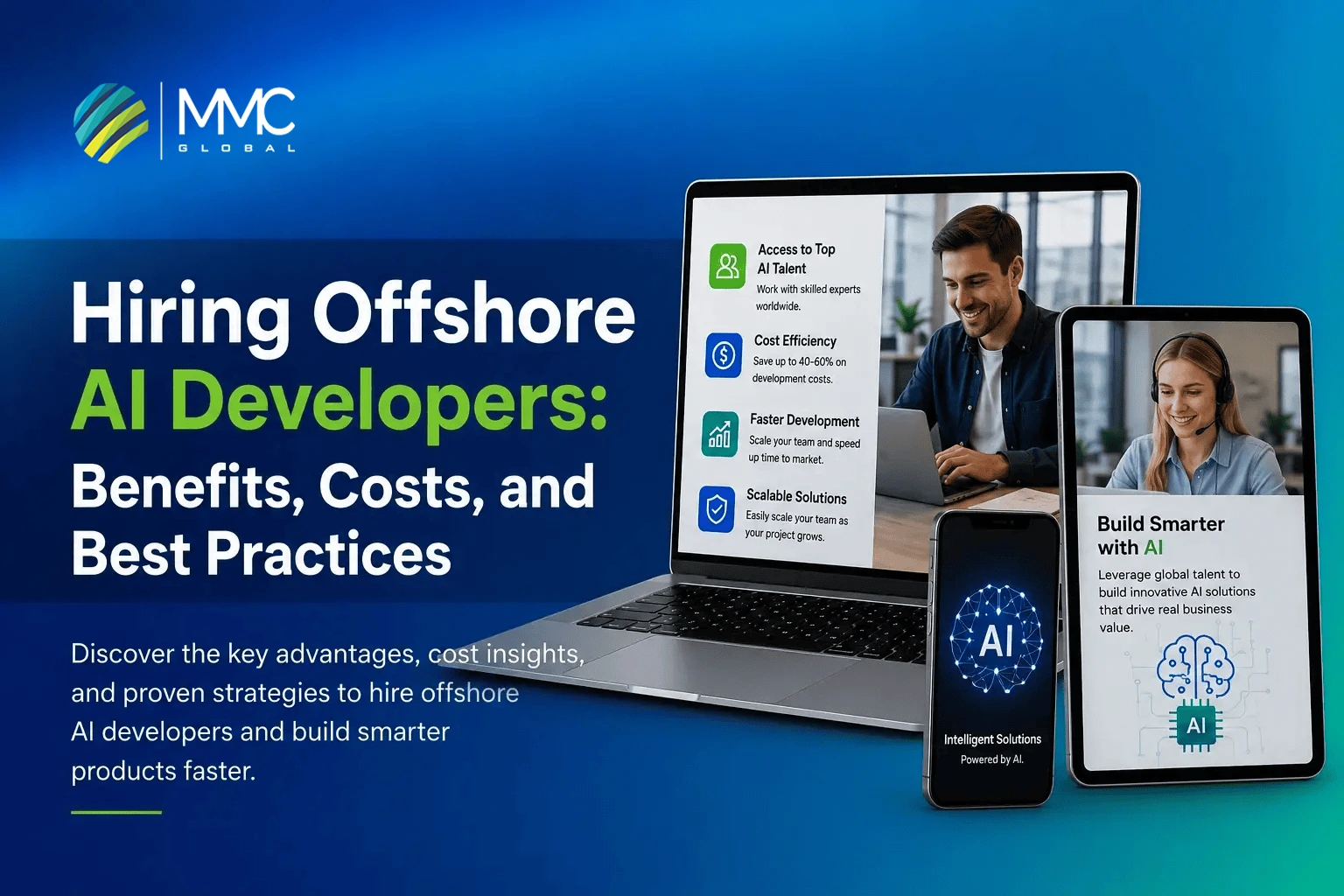
From AI agents and LLMs to machine learning and automation, our offshore developers help you accelerate innovation while reducing development costs.
Hire AI DevelopersWhat Does Hiring Offshore AI Developers Actually Involve?
Hiring offshore AI developers means getting specialized talent from outside your region to create, implement, deploy, or maintain AI capabilities around a real business need. It could be anywhere from adding intelligent functionality to an existing solution to creating an entire AI system from scratch.
More founders are building with AI, but they are also learning that AI talent is not one-size-fits-all. According to Forbes, 72% of businesses are using AI for at least one function. Yet, most are still experimenting or running pilots instead of scaling it across the organization.
What an Offshore AI Developer Actually Builds
An offshore AI engineer takes your requirement from concept to a highly functioning product. Depending on the scope, it can be:
- Integrating AI models and APIs into current software.
- Creating custom AI features like assistants and recommendation engines.
- Connecting AI with business data for search and document intelligence.
- Building predictive systems around proprietary datasets.
- Developing AI-powered SaaS capabilities.
- Automating workflows with AI and connected business tools.
- Deploying and maintaining AI systems.
Which AI Specialists Can You Hire Offshore?
There are multiple types of AI projects. Each one of them needs a different kind of specialist. Have a quick peek at what each developer is best for:
| Specialist | Best suited for |
| LLM Engineer | Language-based and generative AI applications |
| ML Engineer | Predictive models and machine learning systems |
| AI Agent Engineer | Autonomous workflows and tool-based AI |
| Data Scientist | Data analysis and predictive insights |
| Computer Vision Engineer | Image and video-based applications |
| AI-Focused Full-Stack Developer | AI features across frontend and backend |
| MLOps Engineer | Model deployment and AI operations |
Key Takeaway: Do not hire just because their profile mentions “AI.” Get someone for the specific product requirements.
When Offshore AI Development Makes Business Sense
Offshore development becomes extremely useful during times when your business experiences a capacity gap that cannot be easily solved by local hiring.
It is worth considering most when:
- Your in-house team lacks AI expertise.
- You want to accelerate an AI project.
- You are only looking for niche expertise for a specific phase.
- Your current development team needs extra capacity.
- You want to explore AI without overhead.
The goal is simple: hire offshore AI developers when they solve a genuine talent gap instead of only looking at the attractive hourly or fixed prices.
Why Businesses Choose Offshore AI Development
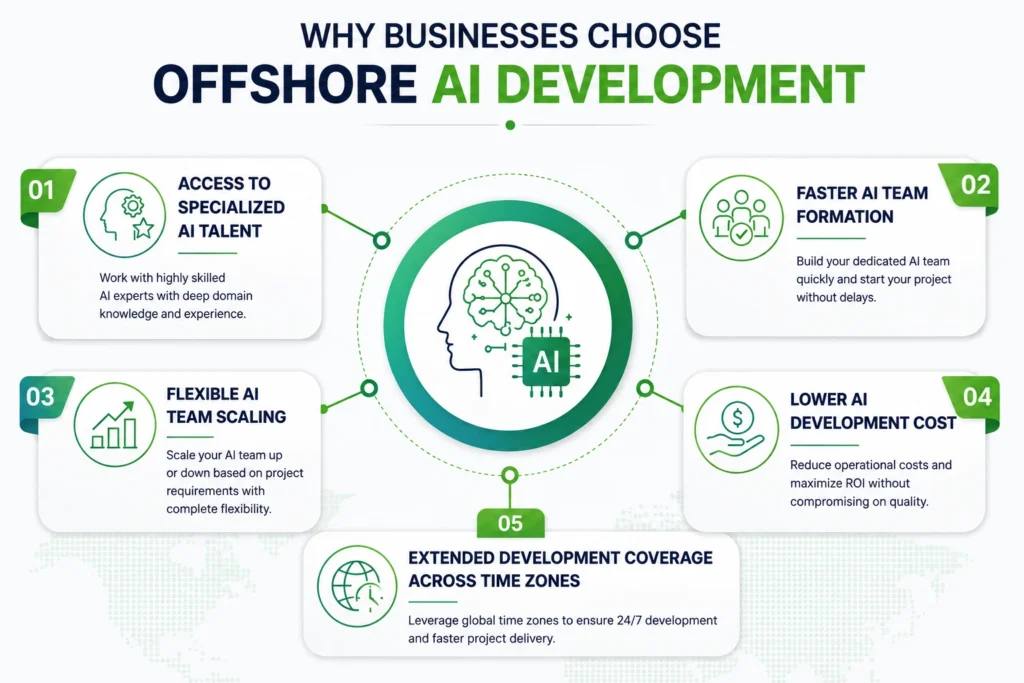
There are indeed many benefits of offshore outsourcing AI and ML development projects to offshore experts. Insights also second it after the impressive value of the offshoref software development market at $204.32 billion in 2026. However, know that there is also a huge reason businesses do not hire just one AI developer and call it a day.
AI projects demand different expertise at very different points. To fulfill it, offshore AI development offers companies a way to bring those skills in without hustling to build each capability internally.
Access to Specialized AI Talent
AI development talent is highly fragmented. Someone exceptionally brilliant at LLM applications might not be the one you require handling model deployment. An AI agent development specialist may not necessarily overlap much with model deployment or computer vision.
That makes the global talent pool particularly available. Instead of limited local availability, you can look to other countries for developers in areas like:
- LLMs.
- Generative AI.
- AI Agents.
- Retrieval-Augmented Generation (RAG).
- Machine Learning
- Computer Vision.
- MLOps.
Faster AI Team Formation
Hiring one developer and building a capable team is different. You may require different technical and product capabilities across development and deployment stages. Hiring an in-house team for these roles can be excessive when AI is just one part of your product strategy.
The main problem is not always development itself. Sometimes it is waiting to gather enough individuals who can start at the right time. Offshore AI development teams can reduce this gap by letting businesses get established specialists.
For a company trying to validate an AI use case, launch a new feature, or speed up an existing roadmap, that time-to-capability can matter more than simply filling a gap quickly.
Flexible AI Team Scaling
AI development needs change once the product starts to grow. The teams required at the stages of prototyping, development, deployment, and optimization differ. Offshore software development services let businesses bring in additional expertise when the project demands it.
Lower AI Development Cost
Offshore development can make AI skills more accessible than building a local team. However, the smarter calculation goes far beyond the hourly rates.
48% of businesses also prefer outsourcing to save on their budget. But a lower quote means nothing if the team produces weak architecture or creates expensive rework.
You will get real value after getting the right expertise, productive delivery, and sustainable AI development.
Extended Development Coverage Across Time Zones
Managing working hours across borders results in a great operational advantage. Your offshore team can make progress in its operating hours while your local team is offline. The next workday will start with updates already in place.
This only works when the basics are handled professionally. You need to checkmark clear communication, defined ownership, and planned overlap hours. Structured handoffs and reliable communication.
This streamlined development cycle keeps moving the production without requiring everyone to work the same hours.
What AI Expertise Might Your Offshore Team Need?
Your project needs one AI expertise or several; it all depends on the job you want the system to perform.
- LLMs and Generative AI: Think AI assistants and applications built around language models. The right developer should know how to work with models beyond basic API integration.
- RAG: A strong fit when your AI needs to work with company documents or proprietary knowledge. It can support grounded answers and smarter internal search.
- AI Agents: Best suited for systems that need to do more than respond. These solutions can use tools and follow workflows to complete defined tasks.
- Machine Learning: The go-to expertise for predictive systems. Common applications include forecasting and recommendation engines.
- Data Science: Your project may need this skill when the real challenge sits inside the data. Data scientists help uncover patterns that can inform models and business decisions.
- Computer Vision: Useful when your product needs to understand visual information. Think image analysis and OCR or video intelligence.
- Multimodal AI: A consideration when the application needs to work across more than one content type. That could mean text alongside images or audio and video.
What Technology Stack Should Your Offshore AI Team Know?
Technologies behind functioning AI solutions are different than other custom software development frameworks. Your offshore AI team should know the right tools to create a solution that keeps running in the future.
| Technology Area | Examples To Look For |
| Programming and AI Development | Python, PyTorch, TensorFlow. |
| AI Libraries and Frameworks | Hugging Face, LangChain, LangGraph, LlamaIndex. |
| Automation and Workflows | n8n, Make, Zapier. |
| Cloud and APIs | AWS, Azure, Google Cloud, AI APIs. |
| Data Infrastructure | Databases, Vector databases, Data pipelines. |
| MLOps and Deployment | CI/CD, Model deployment, Monitoring, Version control. |
The important part is not selecting a team that knows the name of every tool. Your offshore AI developers must know how to choose the right tech stack for your project and explain the reason behind certain choices.
How Much Does It Cost To Hire Offshore AI Developers?
Here’s the part that keeps every founder curious: How much does hiring offshore AI developers really cost?
After working in this industry for over a decade, even our answer is that there is no universal offshore software development cost. Your location, the experience of the team, and technical requirements can move the number up and down.
So, instead of chasing the “affordable” hourly price, look at what you are paying for.
Offshore AI Developer Hourly Rates
In 2026, offshore AI development can be as low as $18 to as high as $100 per hour depending on region, seniority, and specialization. AI and ML developers often quote a premium over standard software developers.
| Region | Estimated AI Developer Rate |
| Asia | $15 to $25/hour |
| Eastern Europe | $50 to $110/hour |
| Latin America | $40 to $90/hour |
| Middle East | $45 to $180/hour |
| North America | $120 to $300/hour |
Treat these numbers as planning ranges rather than fixed market prices.
What Factors Determine The Overall Costs?
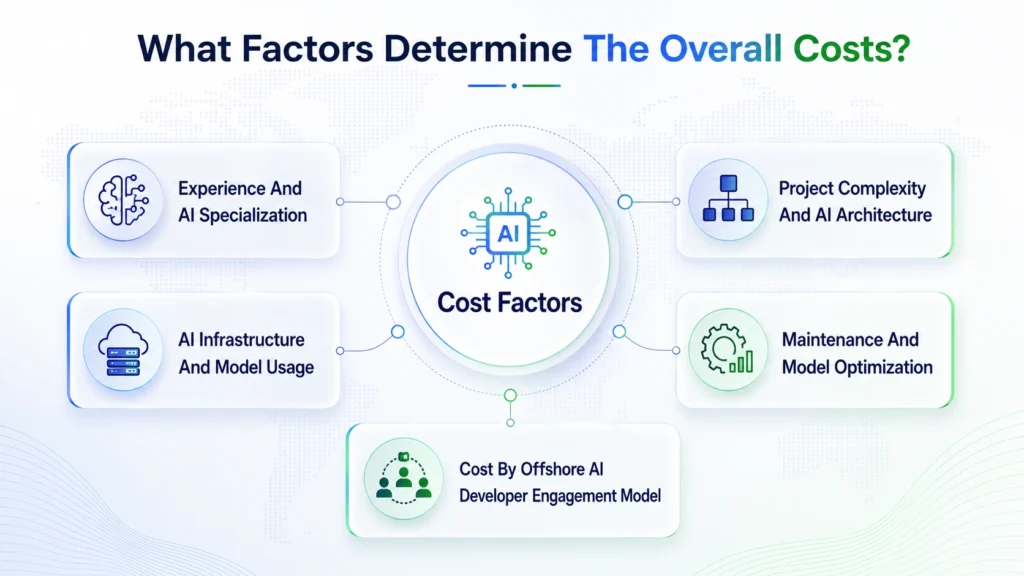
The hourly rate is just a beginning. Your actual AI development investment relies on other critical factors.
Experience And AI Specialization
A junior developer might cost considerably less than a senior LLM engineer. An AI architect or ML engineer with deep production experience can quote even a higher price.
Project Complexity And AI Architecture
An AI chatbot connected to an API differs from a RAG system that operates with proprietary data and supports AI agents. Integrations, monitoring, and production requirements change the engineering efforts.
AI Infrastructure And Model Usage
You are not only paying for the developers, but you may also spend on:
- LLM API usage.
- Token consumption.
- Cloud infrastructure.
- GPU resources.
- Vector databases.
- Model inference.
- Data storage.
This is the reason why the developer rate is not equal to the total AI cost.
Maintenance And Model Optimization
AI solutions need special care after deployment. Models roll out updates, and so do dependencies. The ongoing budget will include:
- Model updates.
- Performance monitoring.
- Prompt optimization.
- Evaluation.
- Cost optimization.
- Dependency updates.
- Security fixes.
Cost By Offshore AI Developer Engagement Model
Costs to hire offshore AI developers also depend on the hiring model. A freelancer, dedicated team, and an offshore software development company all charge differently.
| Engagement Model | Typical Cost Position | Best Fit |
| Freelancer | Lowest initial overhead | Short specialist tasks |
| Dedicated Developer | Moderate | Ongoing individual development |
| Staff Augmentation | Moderate to high | Existing engineering teams |
| Dedicated AI Team | Higher | Complex AI products |
| Full-Service Partner | Project-dependent | End-to-end AI development |
The better question in the picture is how much ownership and capability you need for the project you are building.
How To Evaluate Offshore AI Developers Before You Hire Them?
A portfolio mentioned on the site can tell you the team has built something. It will not necessarily tell you if the same team can build your AI product properly or not. Look beyond big names and impressive screenshots while hiring offshore developers. You need to find evidence of technical depth, production experience, security awareness, and the ability to work through problems when things go south.
Review Relevant AI Case Studies
Search for projects that resemble your actual challenge. For example, if you are creating a RAG app, look for experience with business knowledge and retrieval systems.
Pay attention to:
- The problem they solved.
- The AI approach they used.
- Their role in the project.
- The challenges they faced.
- The outstanding result.
Verify Production AI Experience
A working demo can look exquisite in a presentation. Production is where things get a bit interesting. Ask questions regarding the team’s experience with taking AI systems beyond the prototype stage and dealing with:
- How did they move the system into production?
- How did they track performance and failures?
- What happened once usage increased?
- How will they handle if a model produces a poor response?
- How did they optimize the model?
Test Their AI-Specific Technical Skills
You do not need to conduct a technical interrogation for 3 hours. Well-chosen questions can tell if the team understands the work behind the buzzwords.
Ask them how would they:
- Decide between using an existing LLM and building a custom model?
- Reduce unreliable answers in a RAG application?
- Control what an AI agent can access or change?
- Evaluate whether an AI system is really performing well?
- Manage model usage and infrastructure costs as adoption increases?
Evaluate Their Data and AI Security Knowledge
AI projects include sensitive business information. Be sure to add security at the front in the contract. Ask the team the way they handle sensitive data, API access, third-party models, access controls, and data retention.
Check Communication and Problem-Solving
Good communication is more than speaking fluent English. You want to see the way developers explain why they made a certain technical decision. Watch closely how they respond when requirements are unclear. Notice how they document important decisions and raise problems before they become expensive surprises.
Run a Paid AI Development Pilot
Still unsure after all these questions and answers? Start small then.
A paid pilot gives you and the developers a chance to work together before you commit for the future. Give the team a highly scoped AI task that resembles your exact project slightly.
This approach gives you something valuable that a portfolio cannot: evidence of how the team will work with you.
How To Protect Your AI Project When Working Offshore
Your AI project may know more about your business than you realize. A single wrong access and you can expose far more than source code. This is the part where offshore AI development gets a little more serious. More than the code, it can carry your internal knowledge, business logic, and IP.
Protect Proprietary Data
Your offshore AI development team should only work with the data it really needs. Stronger access controls, encryption, secure development environments, and clear data handling policies secure sensitive information.
Understand Where Your AI Data Goes
Stay aware of what happens to your data when third-party LLM APIs or cloud services process it. Check how providers handle storage, retention, access, and data usage before connecting business information.
Protect AI Intellectual Property
Your contract must clearly state ownership of source code, prompts, datasets, fine-tuned models, workflows, and AI-generated assets. Indeed, an NDA protects confidentiality, but it does not automatically settle ownership of everything created during development.
Prevent Prompt Injection and AI-Specific Attacks
AI systems can be easily manipulated via malicious inputs that push them toward unintended actions. This becomes even more serious once agents can access CRMs, databases, APIs, or internal processes, making permissions essential.
Build AI Compliance Into Development
Identify applicable requirements before development starts. Your offshore AI development team must know relevant obligations like GDPR, HIPAA, industry standards, AI governance, and data security requirements, and build these controls into the project from the beginning.
Practices You Should Follow For Better Offshore AI Development Outcomes
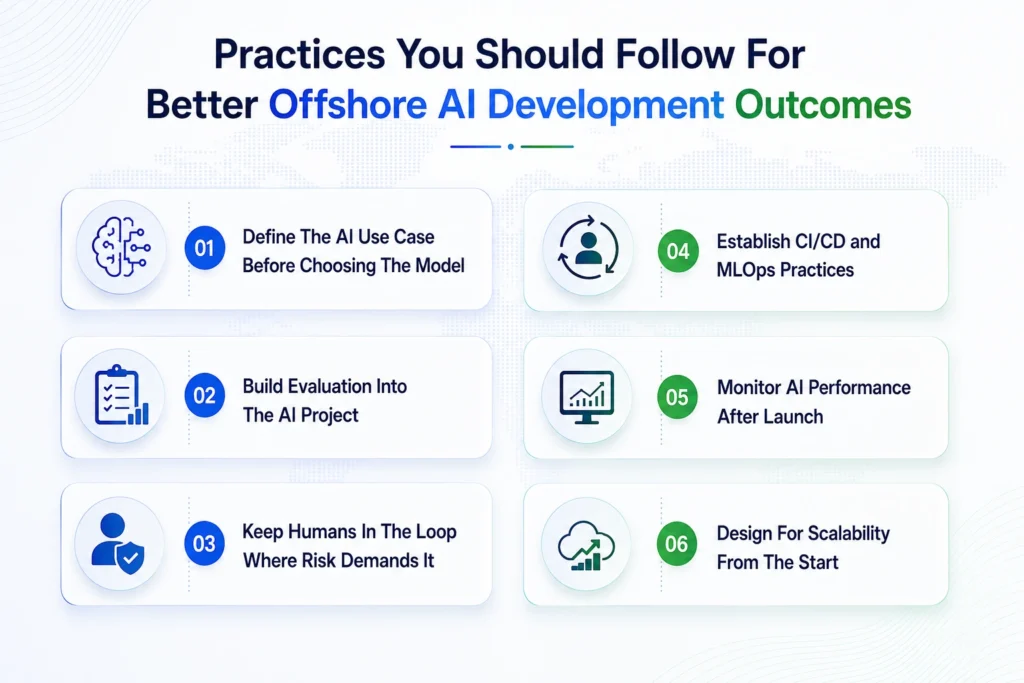
An AI system can be technically functional and still be a bad product. It may produce convincing answers yet struggle with accuracy. It may work perfectly in testing and become expensive at scale. Best practices give your offshore team a framework for avoiding those gaps before they turn into real business problems.
Define The AI Use Case Before Choosing The Model
Don’t start with “Which model should we use?”
Start with “What are we trying to solve?”
Once the outcome is clear, your offshore team can decide whether you actually need an LLM or something simpler. The technology should serve the use case. Not the other way around.
Build Evaluation Into The AI Project
“Looks good” is not an AI quality standard.
Decide what good actually means before launch. Your team should have a way to measure whether responses are accurate and relevant. It should also catch hallucinations and track practical concerns such as speed and cost.
Keep Humans In The Loop Where Risk Demands It
Some decisions deserve a second pair of eyes. AI in automotive, education, fintech, healthcare, and other such data-sensitive industries needs additional supervision.
If AI is helping with a medical recommendation or a financial decision, then human review may need to stay in the loop. The same principle applies to legal and hiring applications where a wrong output can carry serious consequences.
Establish CI/CD and MLOps Practices
AI systems change. Your development process needs to keep up.
Version control helps you know what changed. CI/CD helps you release updates safely. MLOps brings structure to deployment and monitoring, so your team isn’t making production changes blindly.
Monitor AI Performance After Launch
Watch what happens once real users arrive. Are responses getting worse? Are hallucinations creeping up? Is latency rising? Are model costs climbing?
Your offshore team should use those signals to keep improving the system instead of treating deployment as the finish line.
Design For Scalability From The Start
An AI feature that works beautifully for 100 users can behave very differently at 100,000. Your team should account for growing traffic and changing workloads early.
That means thinking about infrastructure capacity and API limits before they become bottlenecks. It also means keeping model and database costs under control as usage grows.
Offshore AI Hiring Mistakes That Can Turn Savings Into Losses
It is true that hiring offshore AI developers comes with its boons for a business. But a single wrong hiring decision can quickly burn into those savings, without you even noticing. A few shortcuts that seem harmless at first can break your bank later.
Choosing The Lowest AI Developer Rate
A low price looks attractive until poor development practices create rework or missed deadlines push the project further out. It’s not just our claim. In 2020, 70% of organizations chose lower cost as their main reason to outsource. However, later in 2024, that number reduced to 34%.
It clearly shows that when you hire offshore AI developers, the cheapest quote should never be your main deciding factor.
Hiring For AI Buzzwords Instead Of Relevant Expertise
A profile can be decorated with every popular AI keyword. Be it ML, ChatGPT, Python, or Automation, and still lack the real expertise. The right offshore AI developers should have experience that connects directly to your product and its technical demands.
Look beyond the profile’s tagline: Relevant project experience tells you more than naming a long list of technologies.
Treating A Working Demo As A Finished Product
A prototype shows that an AI idea is working. Production tells another story. Real users can point out weaknesses in security, reliability, and performance that never appeared during the demo.
Always remember that a successful prototype is just a proof of concept. It does not prove production readiness.
Ignoring Recurring AI Infrastructure Costs
Imagine your offshore AI developers deliver the right feature within the budget. Then come the updates. API calls increase, model consumption rises, and cloud resources expand.
Your development bill may be finished, but your AI operating costs are just getting started.
Make sure to watch the complete picture; account for model usage and infrastructure when evaluating the real cost of your AI application.
Giving An Offshore Team Unrestricted Data Access
Your offshore AI developers require access to organizational data and internal systems to create the digital product. That does not mean everyone has the right to access everything.
Give each individual only the permission required for their role. This limits exposure without causing unnecessary hurdles or creating barriers to development.
Scaling The Team Before Testing The Partnership
It’s tempting to hire offshore AI developers at scale when the project is ambitious and has tight deadlines. But a larger team still cannot compensate for unclear communication or weak ownership.
Take Your AI Development A Notch Up With MMC Global
Now we know that AI development is not limited to simply creating chatbots or connecting OpenAI APIs. It is a vast field. Getting everything right from one individual is nearly impossible.
A serious AI product contains too many requirements. Hallucinations can easily damage trust. Biased outputs can create real problems. And let’s not forget that poor data handling can put sensitive information at risk.
Considering these cases, you need more than someone who can make an AI model respond. You need the right team that understands what happens before the first prompt and long after the deployment.
This is the element MMC Global brings to your table. We have created AI solutions with the engineering depth to handle the messy parts as well. Moreover, we offer model integration to RAG, intelligent automation, and securely handle data to offer production-ready deployment.
Our motive stays the same: we create AI that intelligently works for your business.
Frequently Asked Questions
How much does it cost to hire offshore AI developers?
The cost to hire offshore AI developers falls between $15 and $110 per hour. It highly depends on the developer’s location, expertise, and engagement model. Basic integration work sits at the lower end of the scale. Advanced custom machine learning and LLM architecture require higher rates.
What are the benefits of hiring offshore AI developers?
Hiring offshore AI developers provides you with numerous benefits, such as immediate access to global talent while reducing overhead by up to 70%. It also speeds up the launch time significantly. You also get the flexibility to scale niche technical skills up or down as your project evolves.
How to choose the right offshore AI development partner?
To choose the right offshore AI development partner, you should verify their live production deployments. Always make sure to review their data security practices and cloud-cost optimization protocols. Run a short paid pilot project to test their skills before signing a long-term contract.
What are the risks of partnering with an offshore AI development team?
The risks of partnering with an offshore AI development team include IP theft, data privacy breaches, and unexpected cloud cost overruns. You might also encounter severe hallucination bugs in production. These issues usually happen when choosing vendors based on cheap hourly rates rather than proven safety protocols.
Should I hire offshore AI developers for my enterprise AI development?
Yes, you should hire offshore AI developers for your enterprise AI development if you want to add specialized capabilities quickly without domestic cost inflation. This approach works exceptionally well for RAG systems, AI agents, and MLOps. Just make sure your chosen vendor maintains strict regulatory compliance and robust data governance policies.
How can I safeguard IP and data when outsourcing AI development to offshore teams?
To safeguard IP and data when outsourcing AI development offshore, enforce strict NDAs and zero-data-retention API policies. Restrict team access to sensitive production databases using least-privilege controls. Most importantly, make sure your contract explicitly transfers full legal ownership of all code, prompts, and model weights to your company.