
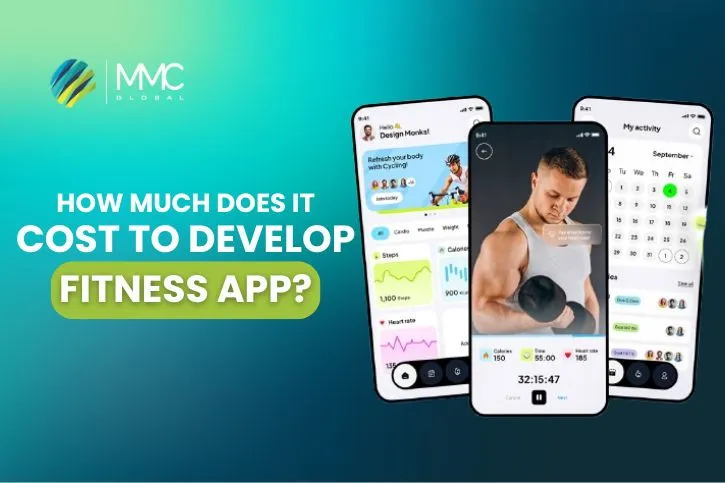
More people are turning to fitness apps in 2026 to stay healthy and active. Whether it’s learning yoga, managing their diet, or tracking steps, users want apps that easily fit into their daily routines. This growing interest makes fitness apps a popular choice for founders and startups to explore.
According to Statista, the global fitness app market is expected to reach $8.30 billion by the end of 2025 and is projected to grow steadily, hitting over $33.58 billion by 2033. As we move through 2026, understanding the cost of building a fitness app has become even more important.
Here, we’ll explore the costs of developing different types of fitness apps in 2026, considering features, platform choices, and other factors that influence pricing.
Average Cost to Build a Fitness App: Real Examples
So, how much does it cost to create a fitness app? The easiest way to estimate is by looking at existing apps in the market. By examining their features, design, and purpose, we can get a rough idea of what fitness companies spend to plan, develop, test, and launch their apps.
Activity Tracking Apps, like MyFitnessPal
These apps track physical activity and health metrics, such as steps, heart rate, and calorie intake. They help users understand their lifestyle and make informed adjustments to stay healthy.
For example, MyFitnessPal is an activity-tracking app that lets users monitor their diet with a calorie tracker. It also connects to wearable devices to track physical metrics and progress over time.
MyFitnessPal’s Key Features
- Personalized calorie goals: Users can set daily calorie targets. As they log their meals, the app automatically updates their remaining calorie limit.
- Sync with fitness trackers: The app connects to devices like Apple Watch and Google Pixel Watch to track calories burned and other fitness data.
- Large food database: MyFitnessPal analyzes nutrition by referencing millions of food items in its database.
- Platforms: Available on Android and iOS.
Estimated Development Cost: $60,000 – $100,000
Fitness & Workout Apps, like Peloton
Workout apps guide users through exercises with video instructions and tips, helping them start and maintain a fitness routine. They often cover activities like yoga, cycling, Tabata, and cross-training.
Peloton is a fitness app that gives users access to hundreds of classes. Users can choose classes based on workout type or instructor.
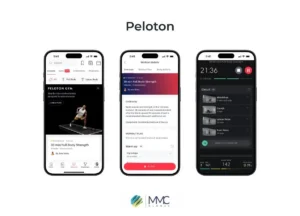
Peloton’s Key Features
- Live workout classes: Users can join live sessions with others, making workouts interactive. The app sends reminders so users don’t miss classes.
- Integration with wearable devices: Modern fitness apps often rely on wearable app development to integrate with devices like Apple Watch and Garmin for monitoring heart rate and calorie expenditure.
- Activity sharing: Users can follow, interact, and share progress with the Peloton community.
- Platforms: Android, iOS, Roku TV, Amazon Fire TV
Estimated Development Cost: $100,000 – $150,000
Health & Wellness Platforms, like BetterMe
Health and wellness apps help users create personalized self-care routines for both physical and mental well-being. Acting like a virtual personal coach, these apps let users set goals, plan routines, and track progress over time.
BetterMe is a wellness app that guides users in balancing diet, exercise, and mental relaxation.
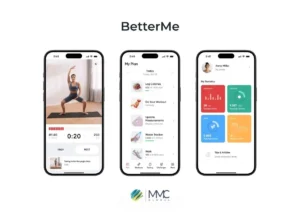
BetterMe’s Key Features
- Wellness tracker: Monitors daily routines, including calories, water intake, and steps.
- Workout routines: Users can select and schedule workouts like yoga, strength training, or mobility exercises. The app also offers a library of home-friendly workouts.
- Mental exercises: Supports mental health with guided meditation, sleep sounds, and breathing exercises.
- Platforms: Android and iOS
Estimated Development Cost:
- MVP (minimum viable product with key features): $100,000 – $150,000
- Full-feature app: $250,000+
These apps may seem expensive because they include many features, integrations, and polished designs. But most successful fitness apps started small with an MVP, including only 2-3 core features to minimize cost.
With careful planning, user research, and the right technology stack, it’s possible to launch an MVP for $50,000 – $70,000. We recommend starting with an MVP to test ideas in the market quickly and cost-effectively.
Average Cost to Develop a Fitness App: Simple, Medium, and Complex
The cost of a fitness app depends on its complexity. A simple workout or diet-tracking app with basic registration and social sharing features is cheaper to build because it requires fewer development hours.
The cost rises as you add more features and integrations. For instance, an app with in-app purchases, geolocation, wearable device integration, and workout tutorials can cost $150,000 – $180,000.
If you want advanced features like AI-based personalization, gamification, or video streaming, expect to pay $200,000 or more. These features take more time and effort to code, integrate, and test.
Here’s a quick look at fitness app costs based on complexity:
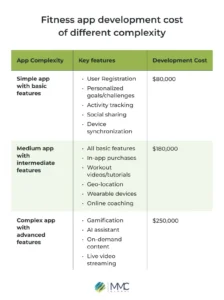
- Simple app: Basic tracking, social sharing, and registration
- Medium app: Workout tutorials, wearable integration, geolocation, and in-app purchases
- Complex app: AI personalization, gamification, live video streaming, and full-featured platform
No matter the complexity, developers follow similar stages to plan, build, test, and launch an app. These stages directly influence the final development cost.
Initial Development Costs
The cost of developing a fitness app depends not just on complexity, but also on key development stages like product discovery, design, coding, testing, and launch.
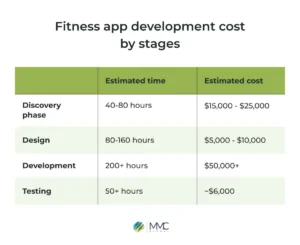
1. Discovery Phase
During discovery, the team works with you to validate your app idea. They interview target users, analyze competitors, and identify core features for the MVP. Developers also select the tech stack, outline challenges, and note compliance requirements.
- Estimated duration: 40–80 hours
- Estimated cost: $15,000 – $25,000
2. Design
Good design attracts users and improves engagement. After finalizing requirements, UI/UX designers create wireframes and user journey maps. Mockups are tested with select users before designing the app’s visuals.
- Estimated duration: 80–160 hours
- Estimated cost: $5,000 – $10,000
3. Development
Developers code the app and integrate components. This includes building backend services like databases, servers, payment gateways, and data encryption.
- Estimated duration: 200+ hours
- Estimated cost: $50,000+
4. Testing
QA engineers test the app throughout development. They perform unit, integration, and performance tests to find and fix bugs. QA also ensures compliance requirements are met.
- Estimated duration: 50+ hours
- Estimated cost: ~$6,000
5. Launch
Once testing is complete, developers prepare the app for release. They submit it to the App Store and Play Store, set up backend servers, and ensure everything runs smoothly. At the same time, you can start marketing your app to attract users and sign-ups.
Ongoing Maintenance and Updates
After your app goes live, it requires continuous maintenance. This includes fixing bugs, implementing feature updates, and responding to user feedback. Maintenance is an ongoing cost as long as your app remains active.
If you hire an in-house support team, costs include salaries, benefits, and other operating expenses. These costs continue even if your app becomes stable and needs only minor updates.
Alternatively, you can outsource maintenance to a software company. This approach offers more flexibility, as you only pay for the time and resources used by the vendor.
Fitness App Cost Estimate for Basic Features
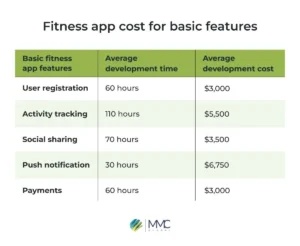
Here’s an approximate time and cost estimate for developing a fitness app with basic features. These estimates are based on typical development tasks for both Android and iOS apps, including backend services.
Also Read: How Much Does It Cost For iOS App Development.
The cost calculations use MMC Global’s average rate of $50 per hour. Keep in mind that hiring developers in the USA or Europe usually costs more. For more details, we have a dedicated guide on developer rates and the factors that affect app development costs.
Also Read: What Is the Android App Development Cost? A Detailed Price Breakdown.
Factors That Influence Fitness App Development Cost
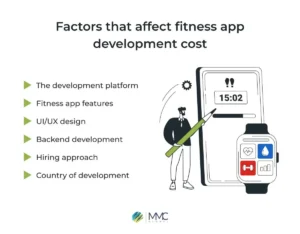
The cost of a fitness app typically ranges from $50,000 to $150,000. Several factors affect the final price, including the app’s complexity, platform, features, and more.
1. Development Platform
The platform you choose impacts the cost significantly. Developing native apps for both Android and iOS requires creating and maintaining two separate codebases, which doubles the effort.
- Native app (Android & iOS): $50,000 – $100,000
- Cross-platform: $25,000 – $70,000
Cross-platform development is more affordable and works well for apps that don’t require platform-specific features or extremely high performance.
2. Fitness App Features
Basic features like user registration, diet tracking, and push notifications are relatively simple to build and don’t add much to the cost. The real cost increase comes from advanced features that require more time and effort.
Basic Feature Estimates:
| Feature | Average Duration | Average Cost |
| User registration | 60 hours | $3,000 |
| Activity tracking | 110 hours | $5,500 |
| Social sharing | 70 hours | $3,500 |
Building, testing, and integrating complex features can take hundreds of hours, which significantly raises the total development cost. Advanced features and their estimated costs will be discussed later in this guide.
UI/UX Design
UI/UX design is crucial for attracting, engaging, and retaining users. Designers begin by researching the target audience and collaborating with product managers to understand user personas, market trends, and app goals.
Design Estimates:
| Design Element | Average Duration | Average Cost |
| Wireframes & Prototypes | 24–40 hours | $1,200 – $2,000 |
| App Design | 80–160 hours | $4,000 – $8,000 |
The design team combines fonts, colors, layouts, and other visual elements to create an app that is appealing and relevant to users. They also optimize the user journey and interactions to make the app intuitive and easy to use.
UI/UX design is a cornerstone of app development. For complex apps, designers may spend more time refining visuals, validating them with users, and ensuring a smooth experience at every touchpoint. This makes design a significant part of the overall fitness app development cost.
Backend Development
Fitness apps rely on backend services to function properly. Backend developers handle server infrastructure, database management, and the creation of backend applications that power the app.
The time and cost for backend development depend on your app’s complexity and requirements. It’s important to get an estimate for backend services before starting your project. When working with an app development company, consider both their pricing and development approach.
At MMC Global, we provide custom backend development services. Depending on your project needs, we can assign a full team or a single backend developer. Share your project details with us to receive a free estimate.
Country Where You Develop Your Fitness App
The cost of app development varies depending on the country of your developers. Hiring developers from the US, UK, or Australia is more expensive, while emerging markets like India, the Philippines, or Argentina offer lower rates.
Hourly Rate Comparison:
| Country | Hourly Rate |
| United States | $100 – $150 |
| United Kingdom | $80 – $100 |
| Ukraine | $50 |
| China | $30 |
| India | $20 |
While low rates may seem attractive, don’t choose developers based on cost alone. Consider factors like quality, language, and cultural differences to ensure smooth collaboration and a successful app.
Hiring Approach for Fitness App Development
The way you hire developers affects the cost of your fitness app.
In-House Hiring:
Hiring an in-house team means covering salaries, training, office infrastructure, and employee benefits. This gives you more control over the development process but reduces flexibility in allocating funds for other business needs.
Outsourcing:
Outsourcing offers more flexibility and can reduce costs. You can hire developers based on time, resources, or a fixed-price model, allowing you to manage your budget more effectively without committing to long-term expenses.
Cost Comparison: DIY vs. Low-Code/No-Code Platforms
The cost of developing a fitness app also depends on whether you build it from scratch or use a low-code/no-code platform.
Traditional Development (DIY):
Developers write the app’s code from the ground up. Even with libraries and frameworks, coding, debugging, and testing take significant time, which increases the cost.
Low-Code/No-Code Platforms:
Platforms like Bubble let developers build apps faster using drag-and-drop interfaces and pre-built modules. For example, a prototype can be created in hours instead of weeks, saving time and money.
However, low-code/no-code solutions are not suitable for all fitness apps. They limit customization, tie your app to the platform’s architecture, and may cause scalability issues as your app grows.
4 Ways to Reduce the Cost of Fitness App Development
Now that we’ve covered how much it costs to build a fitness app, it’s equally important to know how to lower those costs. Here are four practical strategies to help you save money without compromising quality.
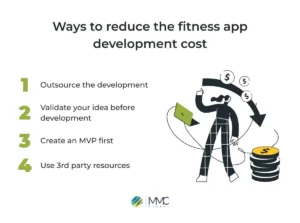
1. Outsource the Development
Hiring outsourced developers can be more cost-effective, especially for startups in expensive regions like the US or UK. For example, a US developer may charge $100 per hour, while outsourcing to a skilled developer in Ukraine costs around $50 per hour—without sacrificing quality.
2. Validate Your Idea
Don’t build the app until you confirm there’s a market for it. Conduct a thorough discovery phase to test your assumptions with target users. Understanding what users want ensures your app has a strong product-market fit and reduces wasted development costs.
3. Create an MVP
Avoid including every feature your competitors have. Instead, focus on core functionalities by building a minimum viable product (MVP). An MVP addresses the user’s main pain points, saves development time and costs, and allows you to launch faster.
4. Use Third-Party Resources
You don’t need to build everything from scratch. Leverage libraries, plugins, frameworks, and third-party services to speed up development. For example, integrating payment systems like PayPal or Stripe via their APIs saves time, letting developers focus on business logic, UX, and other engaging app features.
Why Choose MMC Global to Build Your Fitness App?
MMC Global is an international app development company with a proven track record in creating engaging, high-quality apps. Since 2013, we’ve completed over 500 projects successfully. You can check some of our case studies on our website. Our clients trust us to deliver apps on time, within budget, and meet all functional requirements.
At MMC Global, we focus on building apps that users love. We gather feedback from real users throughout the development process, ensuring our apps are intuitive, purposeful, and functional.
When you develop your fitness app with MMC Global, you can expect:
- Timely delivery and budget adherence
- User-centered design and development
- A functional, scalable, and engaging app
Cost Efficiency
We understand startup budgets and aim to provide cost-effective solutions. By offering flexible collaboration options and using the right tech stacks, automation, and processes, we help you save time and money during development.
Customization
User needs, business goals, and technology trends constantly change. Our team ensures your app adapts to the market, not the other way around. Whether it’s adding in-app messaging or a generative AI assistant, we have the expertise to implement it effectively.
Full-Cycle Development Team
From ideation to launch, MMC Global provides a full development team. Our designers, developers, QA engineers, business analysts, and project managers handle the entire process, so you don’t need to worry about coordination or technical leadership.
Time to Market
MMC Global follows Agile development methods to meet deadlines while staying flexible to changes. We maintain transparent communication to keep your project on track and aligned with your goals. Our prior experience in healthcare and wellness apps also helps us speed up development, allowing you to launch your fitness app faster.
Also Read: Healthcare App Development Cost in 2025.
Ongoing Support and Updates
MMC Global is more than just a developer, we’re your long-term app development partner. We provide continuous support, fix issues, analyze market trends, and implement feature updates. From day one, we focus on ensuring your fitness app’s long-term success.
FAQs
1. What is the average cost to develop a fitness app?
The cost of building a fitness app typically ranges from $50,000 to $150,000 or more. The final price depends on factors like app complexity, design, and the developer’s location.
2. How can I reduce the costs of making a fitness app?
You can lower costs by outsourcing to developers in countries with lower living expenses, validating your app idea before development, and building a minimum viable product (MVP) to focus on core features.
3. How much does it cost to maintain a fitness app?
App maintenance requires ongoing support. Hiring an in-house team involves salaries, benefits, infrastructure, and recurring expenses. Outsourcing maintenance can be more cost-efficient, as you only pay for the time and resources used by the external team.
4. What are the best monetization strategies for fitness apps?
Popular strategies include freemium memberships, where users access basic features for free and pay for premium content, and in-app purchases for workout videos, fitness programs, or on-demand content.