
Curious about the cost of developing a healthcare app?
The healthcare app industry is growing faster than ever and is expected to hit $86.37 billion by 2030. This rapid growth is shaping the overall cost of building apps like Zocdoc and many other healthcare solutions.
The demand comes from multiple factors: more people are using mobile devices, patients are looking for easier access to care, and healthcare providers are relying on digital tools to stay connected. Naturally, when you work with a healthcare application development company, these trends directly influence project costs.
In this guide, we’ll break down everything you need to know about healthcare app development costs from key trends and technologies to the challenges and opportunities that affect pricing in 2025 and beyond.
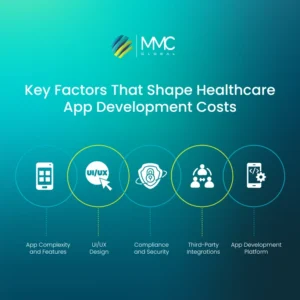
Key Factors That Shape Healthcare App Development Costs
Imagine you’re running a clinic and notice patients facing common issues struggling to book appointments, waiting too long for test results, or missing prescription reminders. A mobile healthcare app can easily solve these challenges.
It’s clear that healthcare apps are shaping the future of patient care. But the real question is how much does it cost to build one? The truth is, there isn’t a one-size-fits-all answer. Every app is different, and the cost depends on its unique features and level of complexity.
Below are the main factors that play a big role in deciding your healthcare app development budget:
1. App Complexity and Features
How advanced your app is will directly affect the time, effort, and budget needed to build it. In healthcare, apps usually fall into three main levels:
| App Type | Estimated Cost | Examples |
| Basic Apps | $20,000 – $60,000 | Symptom checkers, pill reminders, simple appointment booking |
| Medium Apps | $70,000 – $150,000 | Online doctor visits with video, smart chatbots, EHR (Electronic Health Records) connection |
| Advanced Apps | $160,000 – $300,000+ | AI-powered diagnosis, wearable device tracking, blockchain for secure patient data |
2. App Development Platform
Choosing the right platform is a key step in building a healthcare app. It affects not only the cost but also how many people you can reach, the app’s speed, and how easy it is to grow later. The main options are iOS, Android, and cross-platform development.
iOS App Development
iOS apps are made for Apple devices like iPhone, iPad, and Apple Watch. They are usually built with Swift or Objective-C and must follow Apple’s strict rules for security and quality. If you plan to build a healthcare app for iPhone users, you can target a loyal and high-spending audience. The iOS app development cost may vary depending on features, design, and compliance needs.
Benefits of iOS healthcare app development:
- Strong data protection, perfect for HIPAA-compliant medical apps
- Smooth performance and stable user experience
- Apple users spend more on subscriptions and paid apps
- Easier testing since Apple devices have fewer screen sizes
iOS app development cost: $25,000 – $150,000
Android App Development
Android apps run on devices from many brands like Samsung, Google, and OnePlus. They are built using Kotlin or Java. Since Android devices come in many sizes, testing usually takes more effort. The android app development cost depends on factors like features, design, testing, and security requirements.
Benefits of Android healthcare app development:
- Largest market share worldwide, meaning more reach
- Flexible design and features, great for advanced health solutions
- Google Play Store has an easier approval process compared to Apple
Android app development cost: $20,000 – $120,000
Cross-Platform App Development
Cross-platform apps let you build one app that works on both iOS and Android. This option saves time and money. The most popular frameworks are Flutter, React Native, and Xamarin.
| Framework | Cost Estimate | Key Advantages |
| Flutter | $30,000 – $200,000 | Single codebase, faster development, built-in rendering engine, cost savings of 30–40% |
| React Native | $30,000 – $150,000 | Reuse up to 80% of code, strong library support, smooth integration with APIs, health databases, and wearables |
3. UI/UX Design
Design plays a big role in the success of any healthcare app. A good UI/UX design makes the app simple to use, accessible for everyone, and engaging for both patients and medical staff. The design level also affects the total development cost. Features like customization, animations, and compliance with healthcare standards can increase the budget.
Here’s a breakdown of healthcare app design costs:
| Design Element | Estimated Cost |
| Low-Fidelity Wireframes | $1,000 – $3,000 |
| High-Fidelity Prototypes | $5,000 – $10,000 |
| Visual Design & Branding | $3,000 – $20,000 |
| Accessibility Features | $5,000 – $15,000 |
| Interactive Elements & Micro-Animations | $3,000 – $20,000 |
| Personalization & AI-Based UI Enhancements | $10,000 – $30,000 |
4. Compliance and Security
When building a hospital or healthcare app, compliance and security are must-haves. Since these apps deal with private patient data, they need to follow strict rules and include strong protection measures. This not only increases the cost but also affects how quickly the app can launch.
If an app fails to meet compliance standards or has weak security, it can cause legal issues, financial losses, and damage to user trust. That’s why healthcare apps often include advanced data encryption, user authentication, and compliance with global healthcare regulations (like HIPAA, GDPR, or HL7).
Here’s a cost breakdown for common security and compliance features:
| Feature | Estimated Cost |
| Regulatory Compliance Setup | $10,000 – $50,000 |
| AES-256 Data Encryption | $5,000 – $15,000 |
| Cloud Security for EHR Storage | $10,000 – $25,000 |
| Multi-Factor Authentication (MFA) | $8,000 – $20,000 |
| Role-Based Access Control | $10,000 – $30,000 |
| API Security | $5,000 – $35,000 |
| Security Audit | $10,000 – $25,000 (per audit) |
| Penetration Testing | $15,000 – $40,000 (yearly) |
| Cloud Backup & Data Redundancy | $10,000 – $20,000 |
| Automated Disaster Recovery Plan | $20,000 – $50,000 |
5. Third-Party Integrations
Adding third-party integrations can make a healthcare app much more powerful and user-friendly. These integrations connect your app with tools like electronic health records (EHRs), telemedicine platforms, payment gateways, cloud services, or even AI-based analytics.
The total cost depends on the type of integrations you need. Basic features cost less, while advanced technologies like AI and blockchain add more to the budget.
Here’s a cost breakdown by integration type:
| Integration Type | Examples | Estimated Cost |
| Basic | Payment gateways (Stripe, PayPal), email services (SendGrid) | $5,000 – $15,000 |
| Moderate | EHR/EMR integration (Epic, Cerner), telemedicine APIs (Twilio, Zoom) | $15,000 – $40,000 |
| Advanced | AI diagnostics (IBM Watson), blockchain for data protection, wearable syncing (Apple Health, Google Fit) | $40,000 – $100,000+ |
Types of Healthcare Apps
The cost of developing a healthcare app depends on several factors, including the app category, feature list, security requirements, and development method. Below is a detailed breakdown of the most common healthcare apps and their estimated costs:
1. Telemedicine Apps
Telemedicine apps allow doctors and patients to connect remotely through video calls, chat, or voice. These platforms reduce waiting times and make healthcare services more accessible to patients from anywhere. Usually, they come with secure communication, scheduling systems, electronic health record (EHR) access, and payment processing.
💰 Cost Estimate:
- Basic telemedicine app: $40,000 – $80,000
- Advanced telemedicine app: $100,000+
Key Features:
- Encrypted video/audio consultations
- Appointment scheduling with reminders
- Patient medical history and profile management
- Payment gateway integration
- Digital prescriptions and reports
- AI-driven symptom checker (in advanced apps)
2. Electronic Health Record (EHR) Apps
EHR apps are used by healthcare providers to securely manage and share patient records. These apps must follow strict compliance standards such as HIPAA and GDPR to protect patient data.
💰 Cost Estimate:
- Basic EHR app: $50,000 – $100,000
- Advanced EHR app: $150,000+
Key Features:
- Secure and encrypted patient data storage
- Multi-user role access for doctors, patients, and admins
- EHR interoperability with third-party integrations
- Role-based access controls
- AI-powered dashboards for analytics and predictions
3. Remote Patient Monitoring (RPM) Apps
RPM apps connect to wearable devices and medical sensors to track patient health remotely. They are widely used for monitoring chronic illnesses, providing doctors with continuous health updates.
For more detailed insights on pricing, you can check out our latest blog about Generative AI app development cost in 2025.
💰 Cost Estimate:
- Basic RPM app: $50,000 – $120,000
- Advanced RPM app with AI/IoT: $150,000+
Key Features:
- Real-time health tracking
- Wearable device integration
- AI-based health alerts and analysis
- Secure data sharing between patient and provider
- Cloud-based storage for continuous monitoring
4. Mental Health and Wellness Apps
These apps help users improve their mental well-being by offering meditation guides, CBT (Cognitive Behavioral Therapy) exercises, and mood tracking tools. Some apps also provide access to licensed therapists through virtual sessions.
💰 Cost Estimate:
- Basic mental health app: $30,000 – $60,000
- Advanced AI-based wellness app: $200,000+
Key Features:
- Meditation and therapy exercises
- Mood and mental health tracking
- AI-based workout and nutrition plans
- Integration with fitness wearables
- Social engagement and gamification features
5. Medicine Delivery Apps
Medicine delivery apps make it simple to order prescriptions and over-the-counter medicines online. They often verify prescriptions digitally and connect users with local pharmacies for fast delivery.
💰 Cost Estimate:
- Basic medicine delivery app: $40,000 – $80,000
- Advanced pharmacy app with AI: up to $200,000
Key Features:
- Prescription upload and verification
- Medicine catalog with filters and search
- Secure payment system and real-time order tracking
- AI-based recommendations for medicines
- Integration with pharmacies and delivery services
6. AI-Powered Healthcare Apps
AI apps in healthcare are designed to assist with diagnosis, provide chatbot consultations, and offer predictive analytics. They can analyze symptoms, suggest possible conditions, and help medical professionals make better decisions.
If you want to explore the benefits of Augmented Reality in healthcare, our blog shares the newest trends and future possibilities.
💰 Cost Estimate:
- Basic AI chatbot app: $50,000 – $100,000
- Advanced AI diagnostic app: $150,000+
Key Features:
- AI-based symptom analysis and virtual diagnosis
- Machine learning for personalized treatment options
- Access to large medical datasets and research papers
- Natural Language Processing (NLP) for chatbot consultations
- Predictive analytics for preventive healthcare
Features that Influence Healthcare App Development Cost
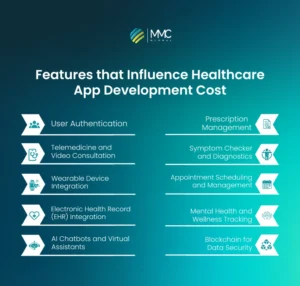
Building a healthcare app requires detailed planning and strict compliance with healthcare rules. Different features can make the app more powerful but also increase the overall development cost. Below are the major features that influence the price of creating a medical app:
1. User Authentication
Patient data security is a top priority in healthcare. A HIPAA Journal report showed over 275 million data breaches in 2024. To protect sensitive data, apps need secure login methods, multi-factor authentication (MFA), and role-based access. These must also comply with HIPAA and GDPR standards.
| Feature | Estimated Cost |
| Basic email/password login | $3,000 – $7,000 |
| Multi-factor authentication (MFA) | $8,000 – $15,000 |
| Role-based access control | $10,000 – $20,000 |
2. Telemedicine and Video Consultation
The popularity of telemedicine continues to grow, with forecasts showing 455 million virtual consultations every year by 2030. This feature includes encrypted video calls, chat, and real-time communication for smooth doctor–patient interactions.
| Feature | Estimated Cost |
| Basic video call | $15,000 – $25,000 |
| HD video + chat | $25,000 – $35,000 |
| AI-powered diagnostics | $40,000 – $60,000 |
3. Electronic Health Record (EHR) Integration
EHR integration makes it possible to access patient medical history, prescriptions, and lab results. But when connecting it with hospital systems, it must follow HL7 and FHIR rules. A report from the Office of the National Coordinator for Health Information Technology showed that back in 2015, 4 out of 5 non-federal acute care hospitals used a basic EHR with clinician notes. Today, the latest figures reveal that EHR adoption has reached 96%.
| Feature | Estimated Cost |
| Basic record storage | $20,000 – $25,000 |
| Integration with hospital EHRs | $30,000 – $35,000 |
| AI-powered health insights | $40,000 – $45,000 |
4. AI Chatbots and Virtual Assistants
AI chatbots can handle routine tasks like scheduling appointments, answering patient questions, and offering guidance. They reduce manual workload and improve engagement.
| Feature | Estimated Cost |
| Basic rule-based chatbot | $10,000 – $20,000 |
| AI-powered chatbot | $25,000 – $40,000 |
| Voice-enabled assistant | $45,000 – $70,000 |
5. Wearable Device Integration
Wearable tech is popular for continuous health monitoring. By syncing devices like smartwatches, healthcare apps can track heart rate, oxygen level, sleep, and physical activity.
| Feature | Estimated Cost |
| Basic wearable data sync | $15,000 – $30,000 |
| Integration with hospital EHRs | $35,000 – $50,000 |
| AI-powered health insights | $55,000 – $80,000 |
6. Blockchain for Data Security
Blockchain technology offers an extra layer of security for storing and sharing medical data. It prevents unauthorized access and helps maintain transparency. According to MarketsandMarkets, the blockchain healthcare industry is expected to reach $14.25 billion by 2028.
| Feature | Estimated Cost |
| Basic blockchain security | $20,000 – $35,000 |
| Smart contract integration | $40,000 – $55,000 |
| Decentralized patient records | $60,000 – $75,000+ |
7. Appointment Scheduling and Management
This feature helps patients easily book doctor visits, get reminders, and check availability. It improves convenience for both patients and providers.
| Feature | Estimated Cost |
| Basic appointment booking | $8,000 – $10,000 |
| Automated reminders | $12,000 – $20,000 |
| AI-powered scheduling | $25,000 – $40,000+ |
8. Prescription Management
Digital prescriptions (e-prescriptions) improve safety by reducing errors and securely sending prescriptions to pharmacies. They can also send automated refill reminders to patients.
| Feature | Estimated Cost |
| Basic prescription tracking | $10,000 – $15,000 |
| Automated refill reminders | $20,000 – $30,000 |
| Pharmacy integration (e-prescribe) | $35,000 – $50,000 |
9. Symptom Checker and Diagnostics
AI-driven symptom checkers let patients enter their symptoms and get preliminary health insights. According to McKinsey, AI in healthcare could cut diagnostic errors by 30% and reduce hospital readmissions. Adding such tools can also inspire new healthcare app ideas that focus on improving patient self-diagnosis and preventive care.
| Feature | Estimated Cost |
| Basic symptom checker | $20,000 – $25,000 |
| AI-based symptom analysis | $30,000 – $40,000 |
| Advanced diagnostics | $35,000 – $50,000 |
10. Mental Health and Wellness Tracking
Mental health apps are growing fast, offering mood tracking, meditation exercises, and stress management tools. Research shows that the global mental wellness app market will hit $4.2 billion by 2027.
| Feature | Estimated Cost |
| Basic mood tracking | $10,000 – $20,000 |
| Meditation & stress management | $25,000 – $40,000 |
Why Invest in Healthcare App Development
The healthcare industry is evolving quickly with the rise of new digital solutions. Developing a healthcare app is no longer just an option – it’s becoming a must-have for hospitals, clinics, startups, and pharmaceutical companies. Curious about how to develop a healthcare app? You can check our detailed blog for a step-by-step process and insights.
According to Statista, the digital health market reached $172 billion in 2024, with over 1.3 billion people using healthcare apps worldwide. This proves how fast the demand is growing. Here’s why investing in healthcare app development is a smart move:
1. Boosts Patient Engagement and Remote Care
Healthcare apps make it easy for patients to stay engaged. From booking appointments to tracking health progress and accessing AI-based reports, everything becomes more accessible. Patients can consult doctors online, manage prescriptions, and even follow personalized care plans.
For instance, Teladoc Health recorded a 38% rise in online consultations in 2023, showing how people now prefer digital healthcare.
2. Cuts Costs and Increases Efficiency
Digital healthcare tools reduce paperwork and improve efficiency. Apps can handle appointment management, billing, and health records. With features like chatbots and EHR systems, doctors save time and focus more on patient care. This automation lowers operational costs significantly.
3. Supports Smarter Medical Decisions
AI and big data analytics are transforming the way healthcare works. Apps can detect diseases earlier, assess risks, and help in drug research. Studies show that AI-powered healthcare can reduce hospital readmissions by 20% and improve treatment success by 40%.
4. Creates New Revenue Streams
Building a healthcare app also opens doors to new income models. Clinics and startups can monetize through subscriptions, pay-per-consultation, in-app services, or even partnerships for data insights. It’s a sustainable investment with multiple revenue opportunities.
5. Growth of Wearables and IoT
Wearable health tech is gaining huge traction. According to IDC, the use of wearable devices will grow by 4.8% in 2025. Apps that connect with smartwatches, trackers, or IoT medical devices allow users to monitor blood pressure, sleep cycles, oxygen levels, and fitness data. Want to know the full cost of building a fitness app like Google Fit? Check our latest blog for all the cost and feature details.
Partner with Healthcare App Experts Today
Investing in healthcare app development helps organizations overcome challenges, expand patient access, and provide personalized care. Patients today expect fast, secure, and convenient access to healthcare. A well-designed mobile app can enhance user experience, reduce costs, and improve overall efficiency.
If you want to create a reliable and scalable healthcare app, partner with MMC Global’s mobile app development firm. Our team ensures your app meets compliance standards, delivers value to users, and helps you grow in the digital healthcare market.
Frequently Asked Questions
How much does it cost to build a healthcare app?
The cost of building a healthcare app depends on different factors like features, complexity, design, platform, and security standards. A simple app with basic features can cost between 20,000 – 60,000 dollars. If you want more advanced features like AI-powered chat or telemedicine, the price may range from 70,000 – 150,000 dollars. For highly complex apps with AI analytics, blockchain security, and wearable integrations, the cost can go above 300,000 dollars.
Other expenses such as compliance with HIPAA or GDPR, cloud hosting, and regular updates also add to the overall budget.
What additional costs are involved in healthcare app development?
Yes, apart from design and coding, there are extra costs to keep in mind. These include compliance certification, server hosting, third-party API integration, advanced security, and testing.
Post-launch expenses like app maintenance, new updates, bug fixes, and marketing also affect the total cost. If you want a clear idea, you can use an app cost calculator to estimate the budget more accurately.
Can I upgrade my app after launch? What should I consider?
Yes, healthcare apps can always be upgraded after launch to improve security, performance, and user experience. Before updating, you should consider three things:
- User feedback and analytics to identify bugs or missing features
- OS and device compatibility to make sure it works on the latest iOS and Android versions
- Scalability and backend support especially if your app is growing and needs better servers, APIs, or database upgrades
Why is HIPAA compliance important in healthcare apps?
HIPAA compliance makes sure that all sensitive health data like patient records is stored and shared securely. Since healthcare apps deal with electronic Protected Health Information, they must follow HIPAA rules to avoid data leaks, lawsuits, and loss of trust.
A HIPAA-compliant app must include data encryption, secure logins, multi-factor authentication, and role-based access control.
How do I hire the right healthcare app developer?
When looking for a healthcare app developer, focus on experience, technical skills, and industry knowledge. Check their portfolio to see if they have worked on healthcare apps before. Review client feedback and case studies to measure their credibility.
Make sure they are skilled in iOS, Android, or cross-platform frameworks like Flutter or React Native. Also, discuss their development process, including UI or UX design, backend architecture, compliance standards, and post-launch support.