
Cloud waste is creeping back again into the conversation. The 2026 State of the Cloud Report published by Flexera revealed that organizations estimate 29% of their IaaS and PaaS cloud spend is wasted. Such a number is not something to shrug off, especially when an organization is dealing with massive monthly cloud bills.
This revelation also points to another bigger challenge: getting value out of the cloud takes more than picking the right platform. As the setup grows, businesses have to keep making thoughtful decisions about the way it is run and where the resources are basically going.
With that being said, the benefits of cloud managed services come into focus at this point. With managed cloud services, you can bring greater consistency to ongoing cloud operations while taking some of that responsibility off your shoulders.
And the payoff is not limited to decreased cloud bills. There is actually more that changes when cloud management is handled with the right support behind it.
In this blog, we are going to talk about what more cloud management can bring to the table. Let’s get started now.
What Are Cloud Managed Services?
Let’s be real now: cloud managed services are not another cloud platform that you have to buy. Managing the cloud refers to the ongoing work that keeps your current cloud setup working properly once it has become part of daily business workloads.
It also means having a managed service provider (MSP) keep watch over the entire system and take care of the work that comes with it. The point is really simple. Cloud resources must not be left to run on autopilot and only get attention when something goes wrong.
This model has also moved well beyond being a niche IT service. The global cloud managed services market in 2026 is valued at $180.90 billion. Moreover, large enterprises are reported to hold the largest market share in 2025.
So, what does this continuous work look like in practice?
- Keeping the cloud performance under watch regularly to spot unusual activity and performance issues.
- Reviewing resources as usage changes to keep the cloud setup aligned with actual business requirements instead of letting resources sit idle.
- More attention to cloud spending. Usage patterns are analyzed daily to support cloud cost optimization.
- Security becomes the top priority to monitor access activity and potential threats.
- Backups and recovery processes are kept ready during unexpected disasters.
- Updates and recurring tasks are handled consistently.
Managing cloud branches out to a broader meaning rather than simply having someone to “manage the cloud”. These routine responsibilities can have a direct impact on what a business spends and how smoothly it operates. This is where the benefits of cloud management services get interesting.
Keep your budget on the safe side. Talk to our consultants to reverse the spending loss and use the cloud according to your workflow requirements.
Speak With Our Cloud ExpertsWhat Are The Benefits Of Cloud Managed Services For Enterprises?
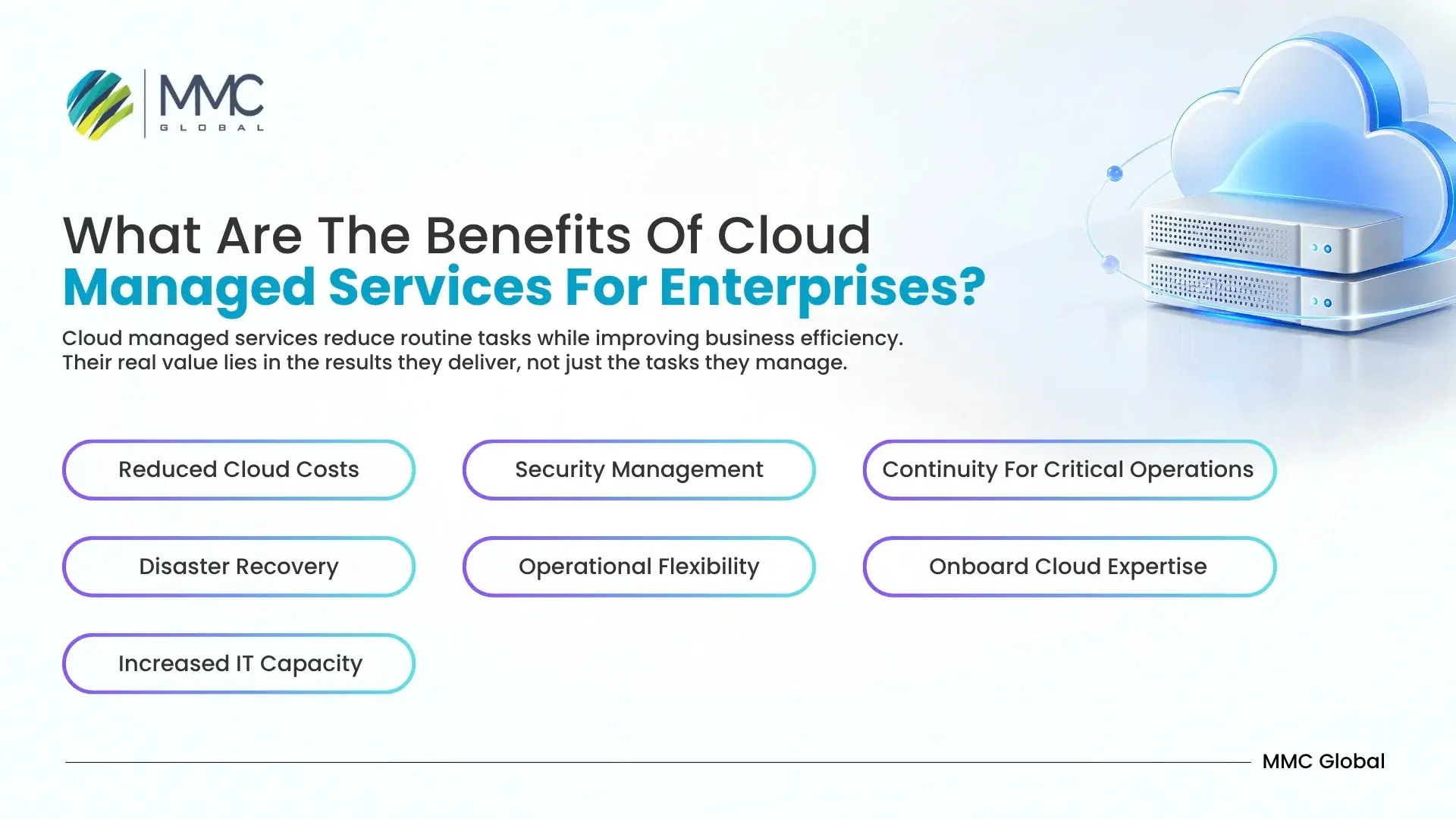
Although investing in cloud management services means having fewer tasks on the calendar, the more interesting part is when that better oversight starts improving the way a business works. Once the basics are in place, the real question arises: what are the benefits of cloud managed services?
The answer becomes clearer when you practically begin to review the results they can create rather than the tasks they can handle.
Reduced Cloud Costs
Reduced expenses do not result from simply cutting down resources. The lower cloud costs come from knowing what the business is paying for and whether the resources are being utilized properly.
A cloud managed service for enterprises ensures regular checks on usage so idle and unnecessary storage do not silently keep adding to your bill. Rightsizing also brings computing capacity closer to actual workload demands.
This is the reason why cloud cost optimization is a proper and continuous process instead of a one-off cleanup. Organizations can avoid paying for excess capacity while keeping enough resources available for critical operations. Over time, cloud management services can make overall spending far more predictable and simpler to handle.
Security Management
Robust cloud security does not depend on someone checking the infrastructure whenever there is time for it. Threats can come up at any point, and even a minor security gap can become the biggest security challenge in the cloud when sensitive data is involved. Managed cloud services keep monitoring security so unusual activity can be identified and addressed sooner.
This practice also brings more consistency to cloud security management. Access control should be reviewed daily, and security patches are required.
Moreover, security policies should also adhere to relevant compliance requirements. Instead of taking action after something goes wrong, enterprises get a more active layer of protection around their cloud resources.
Continuity For Critical Operations
A service going down by a few minutes can be really frustrating. A critical organizational system going down even by some seconds can affect your wallet. Cloud managed services providers help reduce that risk by keeping an eye on the resource health and overall performance of the system.
High availability can also be supported by redundancy and distributed resources where required. In this way, critical enterprise applications stay accessible when individual components fail. For businesses that rely on continuous digital operation, this results in fewer interruptions and disruption to customers and employees.
Disaster Recovery
There is little room to make wild guesses when a major disruption takes a critical system offline. The business should already be aware of how quickly that system has to return and how much recent data can be lost without ending up in serious damage.
A managed setup can establish a Recovery Time Objective (RTO) and Recovery Point Objective (RPO) around these requirements.
This way, backups and replications can be arranged around exact recovery targets. With cloud disaster recovery in place, businesses can have a defined route for restoring critical systems and data during the serious disruption period.
Operational Flexibility
A business’s requirements can be changed quicker than a fixed IT setup can handle. A demand spike out of the blue may require a bit more capacity than usual, while a quieter season may leave those same resources sitting unused.
One of the benefits of cloud managed services for enterprises is that they make these adjustments easier to handle through automation and ongoing resource monitoring.
This flexibility is useful during frequent workload changes. You can easily adjust capacity without making everything into a major operational project.
Increased IT Capacity
Managing cloud platforms can silently consume a great chunk of working time. Monitoring alerts and handling routine maintenance can keep teams occupied even when those tasks are not the highest priority. Handing that workload to a managed service arrangement offers more room for strategic technology work.
Working with a cloud managed services company also reduces the pressure that comes with constantly switching between routine cloud issues and larger initiatives.
Onboard Cloud Expertise
Cloud platforms also come with an increased learning curve that does not magically disappear right after implementation. New services appear, and best practices change; meanwhile, complex processes can bring up problems that are difficult to solve with limited expertise.
A managed service provider (MSP) offers knowledge for such situations without needing to build years of capability from the ground up.
That expertise can support areas like cloud infrastructure management and performance tuning. For businesses working across AWS, Azure, or Google Cloud, this access to specialized knowledge can make complex cloud decisions easier to handle.
Cloud Managed Services Vs In-House Support: What Changes?
Choosing between cloud managed services vs in-house IT translates to deciding how the business wants to handle cloud-related operations. Both approaches can work, but the only difference is what the business is prepared to invest in and how much coverage it expects in return.
The Budget Factor
At first sight, an in-house setup can look easier to budget for. The entire picture changes when cloud operations demand more people and skills over time.
With a managed cloud service provider, the pricing model is mostly created around an agreed level of service. This makes forecasting simpler and easier, as the organization is paying for a defined level of support instead of carrying the complete cost of establishing and maintaining every capability itself. For organizations watching TCO, the difference can be significant.
Skills And Coverage
Cloud platforms rarely stay still. Keeping pace with changing services and security practices becomes difficult when cloud knowledge sits with a few people in an enterprise. A skilled managed cloud service provider brings broader experience across platforms.
Coverage also matters as much as expertise. An in-house team may rely heavily on who is available at a given time. A cloud consultant partner can offer monitoring and support beyond standard working hours.
Shared Responsibility
Managed cloud services do not mean letting the provider handle every cloud decision. The business still owns its cloud applications and data while the MCSP takes responsibility for the areas covered by the agreement.
This is where the shared responsibility model becomes necessary. Roles can be defined around monitoring and security as well as backups and incident handling. Instead of measuring the decision only by who performs the specific task, there is a clearer focus on who owns each responsibility and what level of service the business expects.
When Does Considering Managed Cloud Services Make Sense?
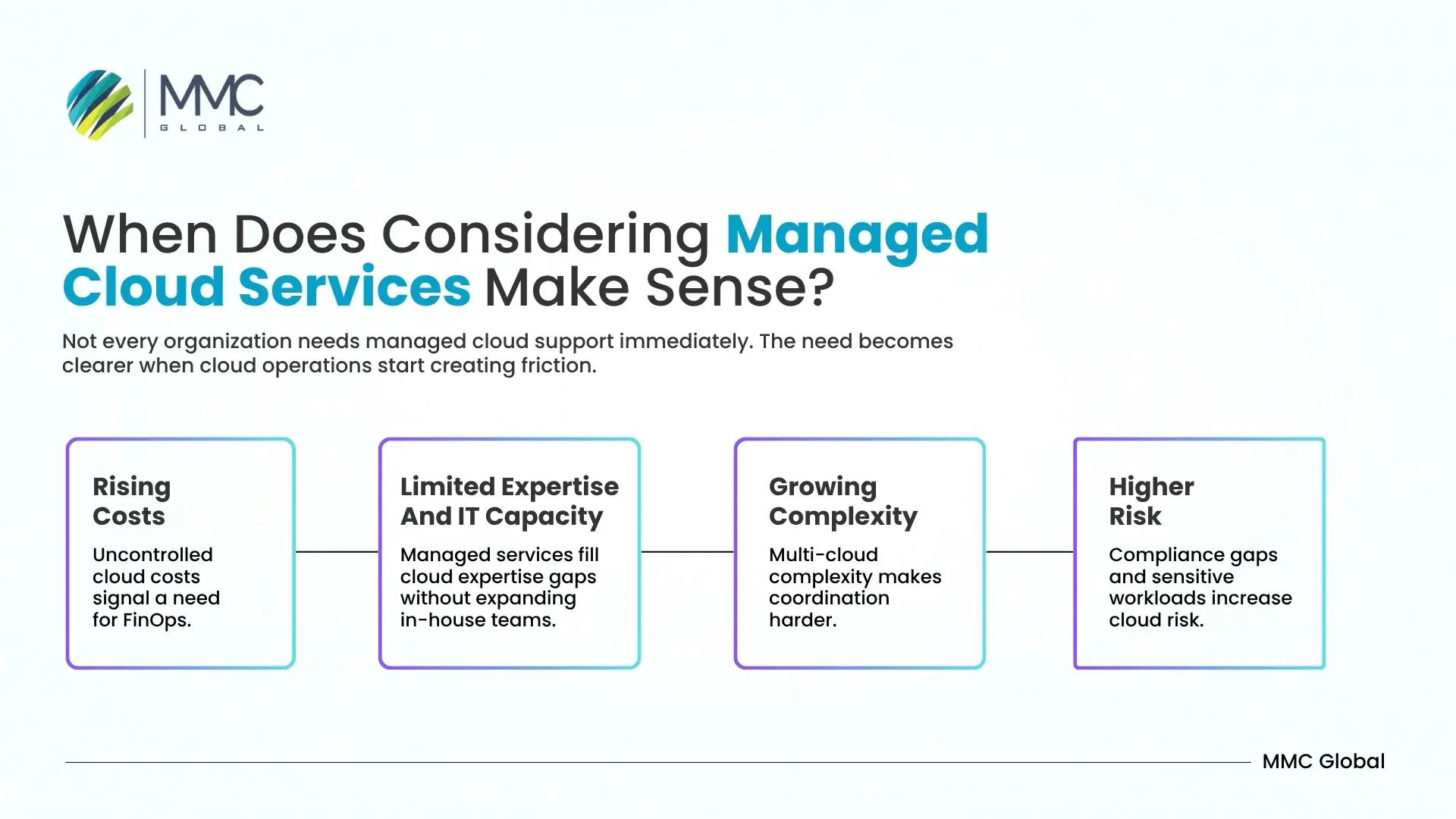
Not every organization requires managed cloud support right away. The decision usually becomes simpler when the current way of handling cloud operations begins building friction. A few signs tend to make that decision a bit clearer.
Rising Costs
Cloud bills become unable to control once utilization increases without transparent cost visibility. FinOps can connect cloud spending with actual consumption and business priorities.
Once forecasting becomes difficult and unexpected costs keep appearing, stronger cloud cost management may be worth bringing into the picture.
Limited Expertise And IT Capacity
Modern cloud workloads can rapidly expose gaps in platform expertise. When crucial tasks depend on a small pool of experts, delays become difficult to ignore. A managed service provider can add targeted knowledge and extra coverage without requiring the company to hire an in-house team.
Growing Complexity
Managing multiple platforms can make even routine cloud decisions difficult to coordinate. Hybrid setups and cross-platform processes can create more dependencies that are harder to track.
Higher Risk
Some companies reach this point after an audit exposes compliance requirement changes or missed security practices. Others face massive risk as critical workloads handle sensitive records.
Looking For Better Cloud Management? Join Hands With MMC Global
Here is the thing about cloud: once it becomes important to an enterprise, there is less room for “we will deal with it later.” It deserves continuous attention from the people who know what they are looking at.
At MMC Global, our skills cover cloud monitoring and infrastructure management alongside cost optimization and security. Additionally, we also offer recovery support to help you stay prepared when disruption emerges.
There is no cookie-cutter cloud setup here. Our every service is brought together around the way your business actually runs. So, when your cloud deserves more than traditional routine maintenance, give it the expertise it deserves.
Bring in the cloud experts to manage your entire cloud platform to keep the chaos away from your business.
Book A Consultation Now!Frequently Asked Questions
What are cloud managed services?
Cloud managed services are hands-on IT support services where a skilled cloud provider manages and runs your cloud setup for you. This includes daily tasks like tracking system health, applying security updates, stopping cyber threats, and fixing technical issues so your cloud stays reliable.
What are the benefits of using cloud managed services?
The benefits of using cloud managed services include lower cloud bills, better security, and smoother daily operations. By letting experts handle daily cloud tasks, businesses save money on unused resources, protect sensitive data, and give their internal IT teams time to work on business growth.
What are the benefits of cloud services?
The benefits of cloud services are flexibility, easy online access, and lower hardware costs. Instead of buying expensive physical servers, businesses rent digital tools and storage online, pay only for what they use, and scale their resources up or down at any time.
What are the 3 main types of cloud services?
The 3 main types of cloud services are IaaS, PaaS, and SaaS. Infrastructure as a Service provides basic digital building blocks like servers and network storage over the internet, while Platform as a Service offers a ready-to-use workspace for developers to build software. Software as a Service delivers complete applications straight through a web browser.
What are the key trends in managed services for 2026?
The key trends in managed services for 2026 are smart AI monitoring tools, stricter zero-trust security systems, and automated cloud cost tracking. Service providers use automated checks to fix technical problems early, reduce extra cloud spending, and keep business data safe across different cloud networks.