
Cloud computing has changed the meaning of “having enough infrastructure.” A business doesn’t need to predict every server it might need years in advance anymore. Computing power can be added as demand picks up, applications can run across locations, and an entire tech stack can sit on infrastructure managed by someone else.
Sounds pretty much convenient, right? Well, there’s also a greater catch. That convenience has also created a bigger market with multiple different ways of delivering the same fundamental resources.
If you’ve recently been evaluating a cloud platform for your business, chances are that you’ve at least once heard the big three names: Amazon AWS, Microsoft Azure, and Google Cloud Platform. These are the common names most businesses encounter in the cloud-related conversation.
Their scale is absolutely enormous, but size alone doesn’t tell you how they actually work. 2 platforms can offer services with almost identical names while handling pricing or integration differently.
A closer look at AWS vs Azure vs Google Cloud reveals differences that are easy to miss until you are running workloads at scale. So let’s dive straight into this guide.
AWS vs Azure vs Google Cloud: A Quick Look At The Big Three
3 names clearly dominate the cloud solutions conversation. The popular competition between AWS vs Azure vs Google Cloud is always about who supports businesses the most. The truth is, they bring different capabilities to the table.
To make it easy to skim through for you, we are presenting you with a quick table to take a look at where AWS, Microsoft Azure, and Google Cloud Platform stand across the services organizations encounter most often.
| Factor | AWS | Microsoft Azure | Google Cloud |
| Core focus | Massive market share and extended catalog of specialized services. | Smooth enterprise integration for Microsoft ecosystem heavy reliance. | Data analytics, cutting-edge AI, and open-source innovations. |
| Compute | Amazon EC2 And AWS Lambda | Azure VM and Azure Functions | Compute Engine and Cloud Run |
| Virtual Network | Amazon VPC | Azure VNet | Google Cloud VPC |
| Object storage | Amazon S3 | Azure Blob Storage | Google Cloud Storage |
| Virtual Machine | EC2 | Azure Virtual Machines | Compute Engine |
| Kubernetes | Amazon EKS | Azure Kubernetes Service (AKS) | Google Kubernetes Engine (GKE) |
| Serverless | AWS Lambda/Fargate | Azure Functions | Cloud Run and Cloud Functions |
| DevOps | AWS CodePipeline and CodeDeploy | Azure DevOps | Google Cloud Developer Tools |
| Data warehouse | Amazon Redshift | Microsoft Fabric and Synapse Analytics | BigQuery |
| RDBMS | Amazon RDS | Azure SQL Database | Cloud SQL and AlloyDB |
| AI platform | Amazon Bedrock and SageMaker | Azure AI Studio | Vertex AI and Gemini |
| IoT | AWS IoT Core | Azure IoT Hub | Partner-Led. Native IoT Core was discontinued. |
| Hybrid Cloud | AWS Outposts | Azure Arc and Azure Stack | Google Distributed Cloud (Formerly Anthos) |
| Pricing Approach | Pay-as-you-go with Savings Plans and Reserved Instances | Pay-as-you-go with Reservations and Azure Hybrid Benefit | Pay-as-you-go with Committed Use Discounts |
AWS has built an exceptionally extensive range of cloud services and solutions. Azure has deep ties with Microsoft technologies, meanwhile Google Cloud carries considerable strength across data-intensive and cloud-native workloads.
So, when you look at the same service in all 3 platforms, you will encounter a very different experience in practice. Let’s make the differences even clearer by looking at what each provider has designed around its core offerings.
Find out which exact platform is built for your actual workload. Let your team pinpoint your fastest cloud setup.
Talk To A Cloud ConsultantHow Do AWS, Microsoft Azure, And Google Cloud Stand Apart?
Cloud computing is powering a massive portion of the technology organizations are using in their daily operations. That makes the platforms behind it far more significant.
The scale of the market is clear in the current numbers. According to research conducted by Statista, in the first quarter of 2026, Amazon Web Services held 28% of the global cloud market share, followed by 21% for Microsoft Azure and 14% for Google Cloud.
Amazon Web Services (AWS)
Amazon Web Services (AWS) has been in the public cloud market since 2006. It has expanded its services greatly in 2 decades and now covers almost every important and major area of cloud computing.
Some of its best-known services include EC2, S3, RDS, and Lambda. Moreover, it has also moved heavily into containers and AI with Amazon EKS and Amazon Bedrock. Its long presence in the market has given it a deep range of deployment options to run different types of workloads on the platform.
Microsoft Azure
The second biggest in the cloud ecosystem, Microsoft Azure arrived in 2010 with a natural advantage: Microsoft’s existing presence in business technology.
For organizations already leveraging Windows Server, SQL, Microsoft 365, or Microsoft Entra ID, it can fit closely with the tools they already know. Microsoft has also continued to expand the platform into areas such as AI, with Azure AI and Azure OpenAI services now forming a major part of its offering.
Google Cloud Platform (GCP)
Google Cloud Platform (GCP) is the youngest among the 3. It entered the market after AWS and Azure; however, it quickly established a strong presence in areas closely linked to Google’s own technology.
BigQuery became a popular name in cloud data analytics, while Google Kubernetes Engine (GKE) built on Google’s early work with Kubernetes. The platform has since grown further into AI, previously with Vertex AI and now known as Gemini Enterprise Agent Platform. Cloud Run also offers mobile app developers a simple way to run apps without managing traditional servers.
How Does Each Cloud Platform Compare Across Core Services?
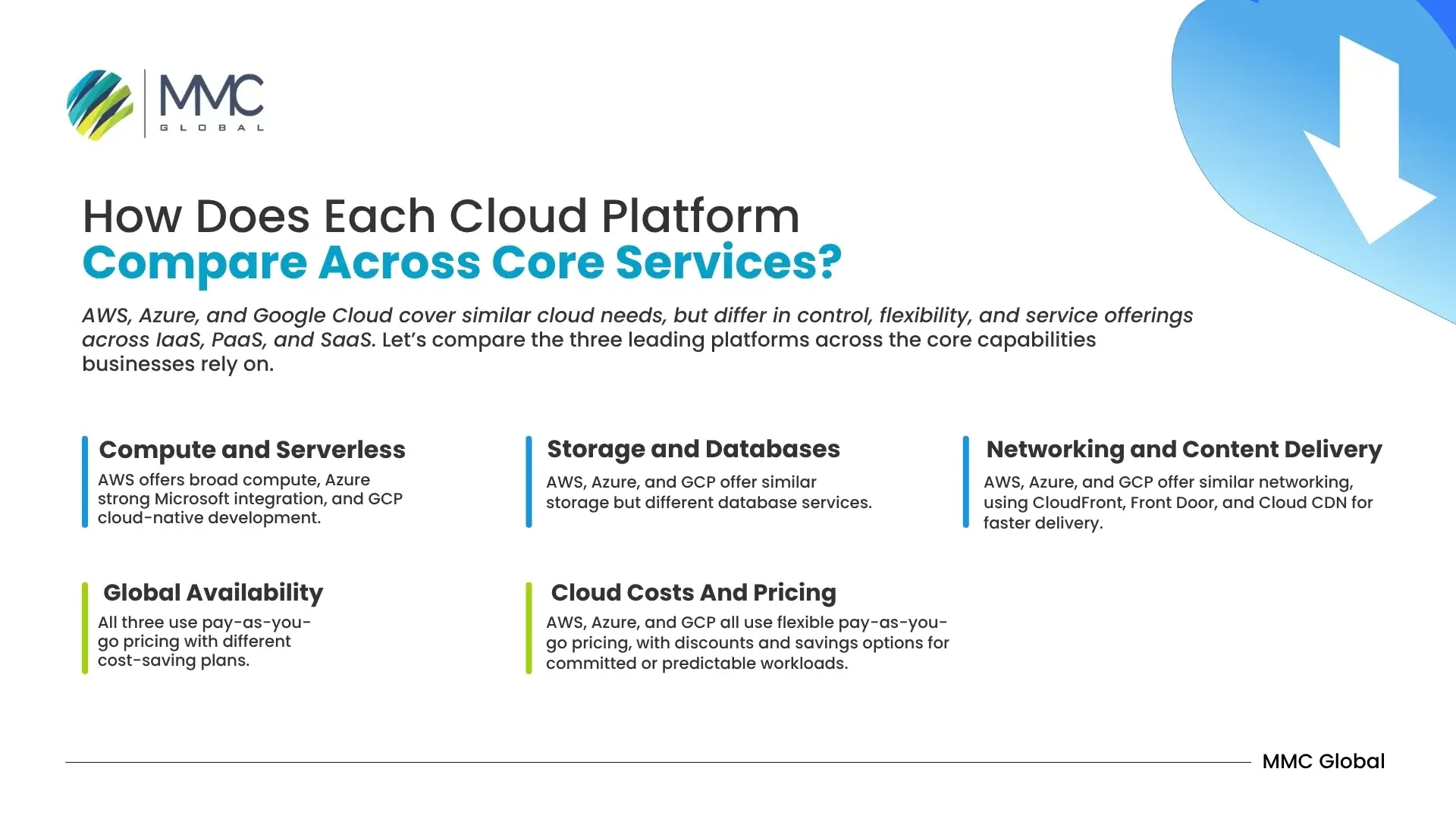
AWS vs Azure vs Google Cloud Platform cover the same cloud needs; however, their core services differ in the way they manage the control levels and range of options.
These services generally categorize into 3 models: IaaS for core computing resources, PaaS for managed application development, and SaaS for ready-to-use software.
The big 3 cloud platforms offer different services across these models. Let’s have a look at the way they compare across the core capabilities businesses rely on.
Compute and Serverless
Compute is where IaaS and PaaS become particularly visible. AWS offers organizations more freedom when it comes to compute. EC2 lets you pick and configure virtual machines around your workload, while Lambda gives a more hands-off option for running app code. So, if you are working with containers, EKS brings managed Kubernetes into the mix.
Similarly, Azure follows the same path but has a robust connection with Microsoft’s expanded range of business technologies. Its VMs offer the control enterprises expect from traditional compute, while AKS and Azure Functions cover containerized and serverless applications.
Google Cloud leans more toward cloud-native development. Compute Engine gives the familiar virtual machine model; however, services like GKE and Cloud Run make it simpler to work with containers and applications that do not require dedicated servers.
While all of them can handle traditional and modern workloads, the emphasis still differs. Features of AWS stand out for the breadth of compute choices, Azure naturally fits into environments that rely heavily on Microsoft, and GCP has a strong focus on modern app development.
Storage and Databases
All three platforms offer fairly similar storage. AWS S3, Azure Blob Storage, and Google Cloud Storage can all keep content, backups, and other files available.
Databases offer more meaningful differences.
- AWS pairs its RDBMS with DynamoDB for NoSQL workloads.
- Azure offers Azure SQL Database and Cosmos DB.
- Google Cloud offers Cloud SQL and Firestore.
A business already utilizing Microsoft databases may approach Azure differently from a team partnering with a reliable Google Cloud consultancy to build a cloud-native application on Google Cloud.
Networking and Content Delivery
Networking can shape the experience users have with an app, especially when those users are from different locations. This makes networking a crucial part of the comparison.
AWS uses Amazon VPC to connect and control cloud resources, with CloudFront helping deliver content closer to users. Microsoft Azure offers Virtual Network and Front Door for similar requirements. On the other hand, Google Cloud combines its VPC with Cloud CDN.
They also cover necessary networking needs like load balancing and private connections. Check the complete potential platform by consulting Microsoft Azure specialists.
Global Availability
Amazon Web Services (AWS) currently operates in 39 regions and 124 availability zones. Its worldwide coverage offers businesses numerous locations for running workloads while keeping apps available across different zones.
Microsoft Azure is establishing its data centers across 36 countries and 163 locations. The regional presence of Azure gives businesses broad coverage for apps that need reliable access across different markets.
In 2026, Google Cloud has 43 regions and 130 zones, with 200+ network edge locations across 200+ countries. Its global infrastructure is designed to keep applications and AI processes closer to end users while supporting low latency and data residency requirements.
Cloud Costs And Pricing
The debate of AWS vs Azure vs Google Cloud comes down to one thing: cost models. AWS and Google Cloud Platform use a pay-as-you-go model, while Azure also follows the same with reservations and Azure Hybrid Benefit to offer ways to reduce costs for eligible workloads.
AWS offers options like Savings Plans and reserved instances for businesses with predictable usage. GCP provides Committed Use Discounts for businesses that commit to a longer usage period.
Which Cloud Platform Fits Your AI And Data Strategy
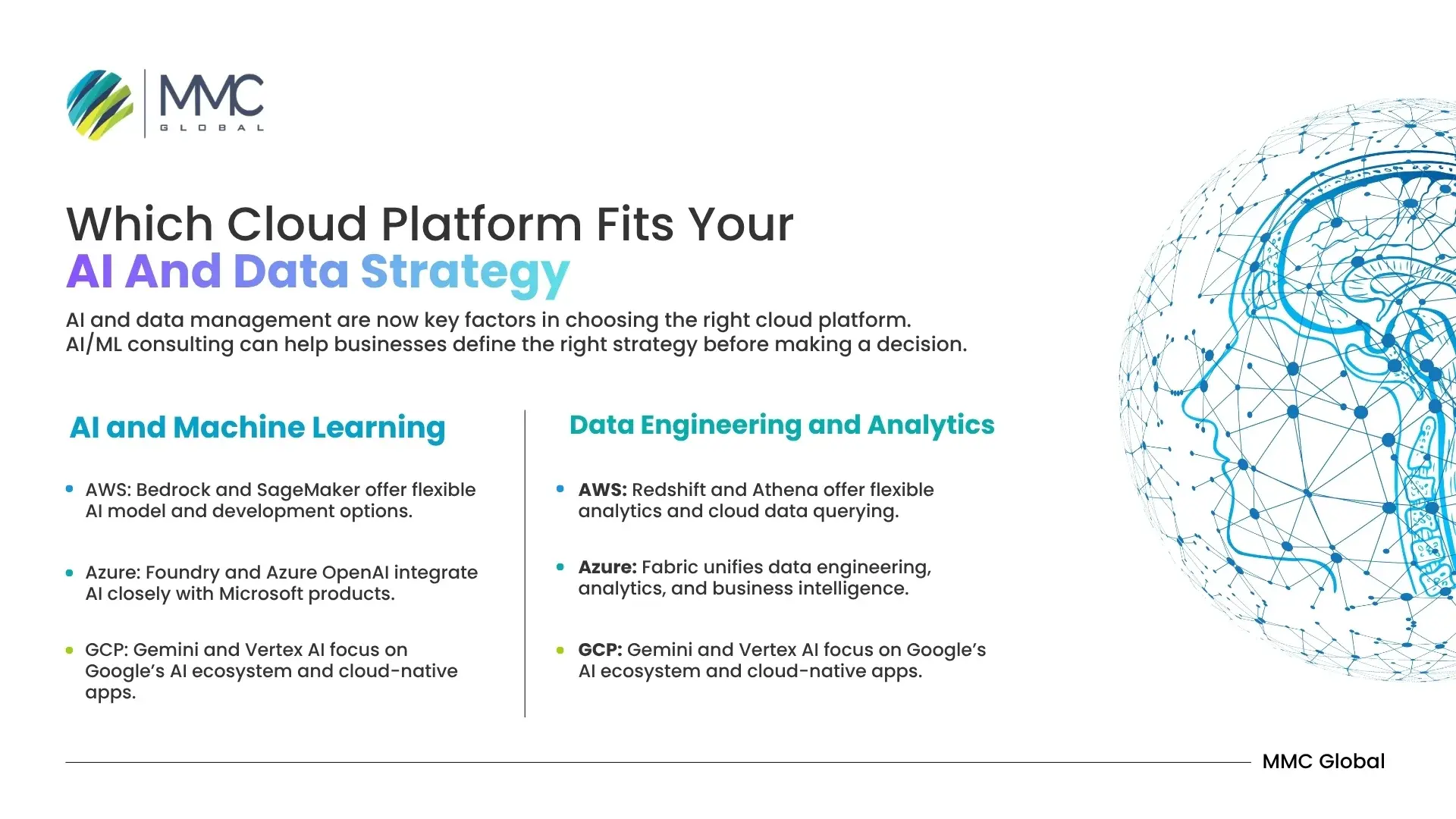
Artificial Intelligence and data management have become a huge part of planning cloud for your business. For organizations exploring what AI can bring to their application, AI and ML consulting services can help shape the correct methodology before finalizing a cloud platform.
AI and Machine Learning
AWS offers plenty of room to add AI services in your organizational software and applications. Its AI services like Amazon Bedrock and SageMaker cover everything from utilizing ready-made AI models to creating more customized AI agents.
With Microsoft, the focus is more tied to its wider range of business products. Microsoft Foundry combines AI models and development tools, while Azure OpenAI offers you access to OpenAI models within Azure.
On the other hand, GCP has a strong connection to Google’s own AI stack. Gemini is at the core of its AI offering, while Vertex AI gives you the toolkit to create and manage AI applications.
Simply put, AWS consulting gives you wider options to choose how you build, Azure connects AI closely with its internal products, and Google Cloud keeps Google’s AI technology front and center.
Data Engineering and Analytics
The same difference also appears when businesses require convenient data management solutions to reliably handle large amounts of information. Amazon Web Services offers a wider range of options, with Amazon Redshift supporting analytics and Amazon Athena making it easier to query information stored in the cloud.
Fabric gives Microsoft a more connected approach. It brings data engineering, analytics, and business intelligence together, offering teams a centralized place to work with their information.
Google Cloud has established a strong reputation in analytics. BigQuery is at the center of its analytics offering, while services like Dataflow support the processing of large datasets.
Get a transparent direction without needing to dig through hundreds of cloud computing services and conflicting platform choices.
Simplify your StrategySecurity And Compliance Across the Three Clouds
Security practices in cloud platforms are embedded at the core, but each one of them approaches identity, threat protection, and compliance through its own set of services.
Identity and Access Management
When it comes to access control, AWS IAM uses roles and permissions to control access to cloud resources. It also supports MFA and least-privilege access.
Microsoft Entra ID handles identity and access. Its RBAC capabilities let organizations assign permissions based on specific roles and responsibilities.
On the Google Cloud side, Cloud IAM manages access to resources and services. RBAC, MFA, and least-privilege permissions help control access to cloud resources and user accounts.
Security Services
For protection against network threats, AWS Shield provides DDoS protection, while Azure combines Microsoft Defender for Cloud with Azure DDoS Protection. Google Cloud uses Cloud Armor for and web application security.
The platforms also provide encryption and key management, although their security tools are packaged differently. AWS uses services such as AWS Key Management Service, Azure provides Key Vault, and Google Cloud offers Cloud KMS for managing encryption keys.
Compliance and Data Sovereignty
AWS, Azure, and Google Cloud all support major compliance standards such as HIPAA, PCI DSS, SOC, ISO, and GDPR, although coverage varies by service, region, and certification. Each platform also provides options for businesses with data residency and sovereignty requirements.
For stricter requirements, AWS offers dedicated sovereign cloud options, Azure provides sovereign cloud offerings, and Google Cloud supports sovereign controls and dedicated environments.
The application still needs appropriate access controls, data handling, configuration, and implementation to meet the requirements of the relevant compliance standard.
Also read our blog to understand security challenges in the cloud.
Developer Experience and Cloud Management
Now it’s time to look at what cloud platforms are offering to developers, as they also spend plenty of time working with their consoles, command-line tools, and deployment services.
Console and CLI Experience
The AWS Management Console offers creators a visual way to create, configure, and manage AWS resources. Since AWS offers a very large number of services, the console gives them a central place to access them. The CLI provides the same control through the command line for scripts and automation.
The Azure Portal provides a central interface for managing Azure resources. Developers can also use the Azure CLI or PowerShell when they want to manage resources directly from the command line instead of using the portal.
The Google Cloud Console follows the same basic idea, giving developers a central place to manage Google Cloud services. The gcloud CLI provides command-line access for developers who prefer working through scripts or terminal commands.
Infrastructure as Code
Infrastructure as Code (IaC) lets developers describe cloud resources in configuration files instead of creating each resource manually. AWS provides CloudFormation for this, while Azure Resource Manager (ARM) handles resource deployment across Azure.
Google Cloud also provides deployment tools for defining and managing its resources through code. Terraform is another popular option as it can manage resources across AWS, Azure, and Google Cloud using one tool.
DevOps and CI/CD
CI/CD tools help developers automate what happens after code is ready. With AWS, CodeBuild can handle building and testing, while CodePipeline connects different stages of the delivery process.
Azure DevOps covers several parts of application development, including source control, testing, and CI/CD. It also works with GitHub, so teams can continue using their existing repositories while connecting them to their Azure deployments.
Google Cloud provides developer tooling for building, testing, and deploying applications. GitHub integration also lets developers connect their repositories to Google Cloud services and deployment processes.
Kubernetes and Containers
For cloud-native development, all three platforms offer managed Kubernetes through Amazon EKS, Azure Kubernetes Service (AKS), and Google Kubernetes Engine (GKE).
- EKS fits naturally with the wider AWS service range, giving teams access to AWS networking, security, compute, and storage services alongside their Kubernetes workloads.
- AKS takes a similar approach within Azure, with close connections to Azure’s monitoring, identity, security, and DevOps services. This can make Kubernetes management feel more connected to the rest of an Azure-based setup.
- GKE has a strong Kubernetes focus, backed by Google’s long involvement with the technology. It also connects with Google Cloud’s data and AI services, giving developers more options when cloud-native applications depend on those workloads.
Cloud Models Across The Leading Platforms
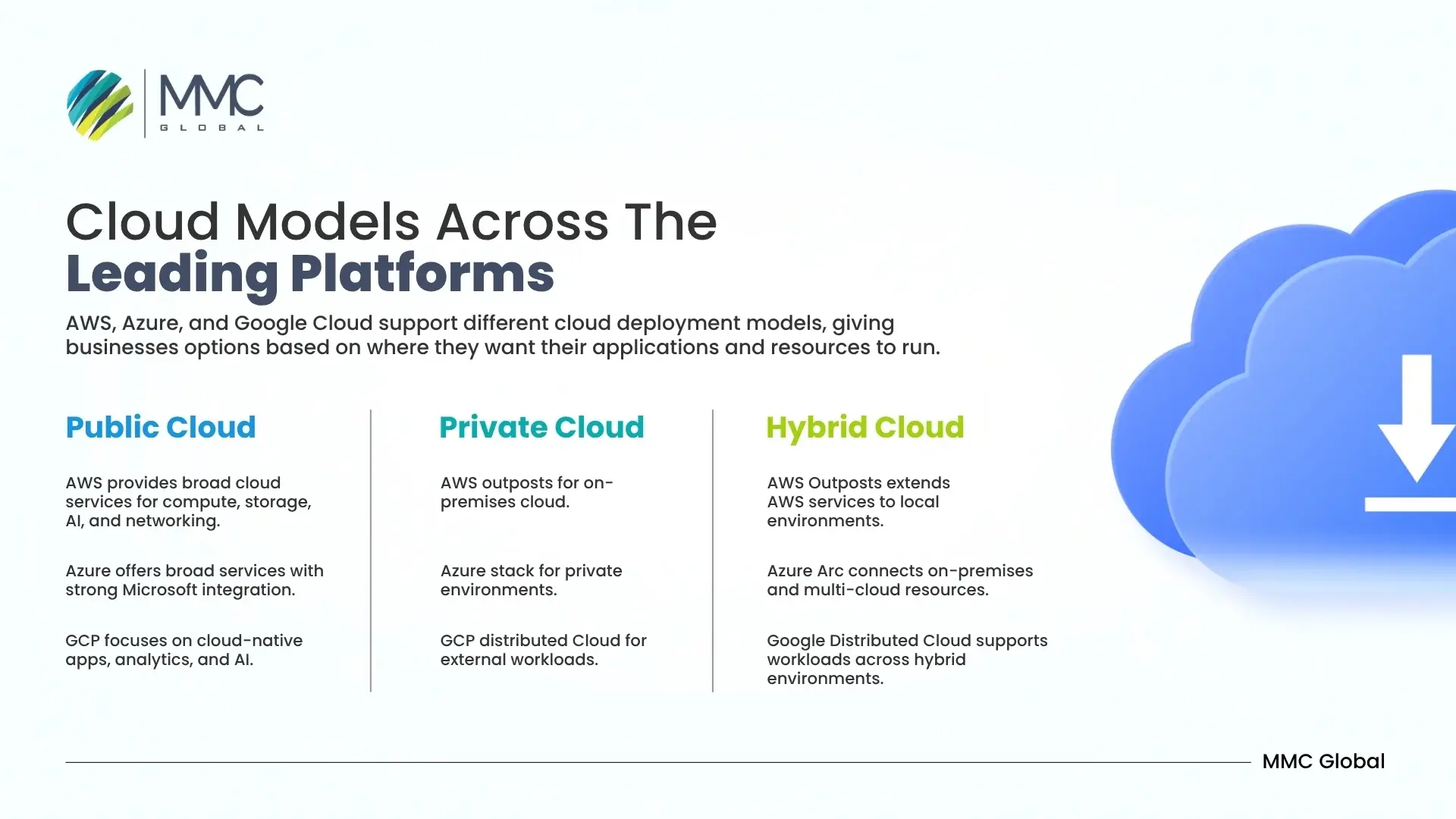
AWS, Azure, and Google Cloud support different cloud deployment models, giving businesses options based on where they want their applications and resources to run.
Public Cloud
The public cloud is where all three providers have their strongest presence. AWS offers services across compute, storage, databases, networking, AI, and more through its public cloud. Azure provides a similar range, with close connections to Microsoft’s business and enterprise services. Google Cloud focuses heavily on cloud-native applications, data analytics, and AI alongside its core public cloud services.
Private Cloud
Private cloud gives businesses dedicated resources with greater control over where and how those resources are managed. AWS supports this through options such as AWS Outposts, which brings AWS infrastructure and services into a business’s own environment.
Azure has a broader private-cloud offering through Azure Stack, allowing selected Azure services to run in a customer’s own data center. Google Cloud also supports private environments through Google Distributed Cloud, designed for workloads that need to run outside Google’s public cloud.
Hybrid Cloud
Hybrid cloud connects public cloud services with on-premises or private environments, making the management layer particularly important. AWS Outposts extends AWS services into local environments, while Azure Arc connects servers and resources across Azure, on-premises, and other cloud environments.
Google Cloud approaches hybrid deployments through Google Distributed Cloud and its management capabilities, allowing workloads to run closer to where they are needed while still connecting with Google Cloud services. The main difference lies in how deeply each provider’s hybrid tools connect the local environment with its public cloud.
Build Better Cloud Solutions With MMC Global
AWS vs Azure vs Google Cloud can answer which platforms are available. The harder question is how to make cloud computing work for the business behind the technology.
That requires the right cloud model for the workload. It also means considering existing systems, costs, security requirements, compliance needs, and the technical expertise available to manage it.
MMC Global helps businesses make those cloud decisions with the technology and business requirements in view. We work across AWS, Microsoft Azure, and Google Cloud to help businesses get the performance they need while keeping cloud costs, security, and management under control.
Have a cloud requirement in mind? Let’s build it with MMC Global.
Handover MMC Global the business problems you want to solve. We will look at what makes your case different and build the cloud approach around it.
Schedule A Cloud ConsultationFrequently Asked Questions
Which cloud is most in demand?
Amazon Web Services (AWS) is the most in-demand cloud platform, holding roughly 28% to 31% of the global cloud infrastructure market. Microsoft Azure sits in second place with about 20% to 25% market share, while Google Cloud Platform (GCP) holds around 12% to 15%.
Does AWS have a difficult learning curve?
AWS does have a steeper learning curve compared to its competitors because it offers over 200 specialized services alongside thousands of configuration settings. While setting up basic virtual servers or simple file storage is straightforward, managing advanced AWS security policies, custom networking, and user permissions requires hands-on training and practice.
Which is the best cloud platform among AWS vs Azure vs GCP?
The best cloud platform among AWS vs Azure vs GCP depends on your specific project needs, as each provider excels in different areas:
AWS is ideal if you want the largest variety of cloud tools, highly flexible app scaling, and a massive developer community. Microsoft Azure is the top option if your business heavily uses software like Windows Server, Office 365, or Active Directory. Google Cloud is the strongest pick if your main priorities are big data analytics, custom machine learning models, or containerized apps built with Kubernetes.
What are the different cloud services available?
Cloud services come in three core models based on how much you manage: Infrastructure as a Service (IaaS) lets you rent raw servers and storage like AWS EC2, Platform as a Service (PaaS) lets you deploy code without managing background infrastructure like Google Cloud Run, and Software as a Service (SaaS) delivers ready-to-use web applications like Microsoft 365.
Is it possible to use AWS, Azure, and Google Cloud at the same time?
Yes, using AWS, Azure, and Google Cloud at the same time is extremely common and is known as a multi-cloud strategy. Many modern companies run their primary application infrastructure on AWS, manage employee company accounts through Azure, and run their big data pipelines or AI models on Google Cloud to avoid relying on a single provider.
Which cloud platform is the best for beginners and small startups?
Google Cloud is generally the best platform for beginners because it provides a clean, user-friendly control panel, simple documentation, and straightforward billing tools.
For small startups, AWS is typically the top choice because of its AWS Activate credit program, which grants early-stage companies up to $100,000 in free cloud credits, along with an unmatched pool of experienced developer talent available to hire.