
Innovation always comes with a cost especially in the financial world, which is expected to grow to USD 652.80 Billion by 2030.
Think about how apps like Revolut, Robinhood, and PayPal completely changed the way people handle money. Now you’re probably wondering what it takes to build something similar.
So, how much does it really cost to create a fintech app?
On average, the cost of a fintech app can range anywhere from $30,000 to $300,000+, depending on the type, complexity, and the app development services you choose.
But unlike regular apps, fintech solutions need strong security, compliance with strict regulations, seamless performance, and a smooth user experience.
That’s why fintech app development is usually more complex and yes, more expensive than building a standard mobile app.
In this guide, we’ll walk you through everything you need to know about fintech app development costs: the key cost drivers, what impacts your budget, and smart tips to plan effectively.
How Much Does It Really Cost to Build a Fintech App?
Building a fintech app usually costs more than creating a regular app, because it demands extra time, effort, and advanced security.
And honestly, there’s no single fixed price for every project.
The actual fintech app development cost depends on many factors like:
- The type of app you’re building
- The features you want to include
- How long the project will take
Still, to give you a clear idea, here’s an estimated breakdown:
| App Complexity | Estimated Cost | Development Time |
| Basic | $30,000 – $60,000 | 2 – 4 months |
| Moderate | $60,000 – $150,000 | 4 – 6 months |
| Advanced | $150,000 – $300,000+ | 6 – 12 months+ |
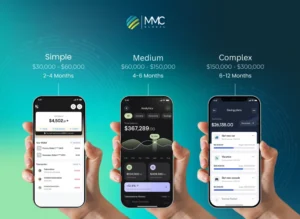
These numbers are only rough estimates and can change depending on your app’s complexity, design, and features.
For a precise quote, try our app development cost calculator and kickstart your next tech project with us.
Fintech App Development Cost – A Complete Breakdown
Building a secure and scalable fintech app takes several steps, and each stage comes with its own technical needs and costs.
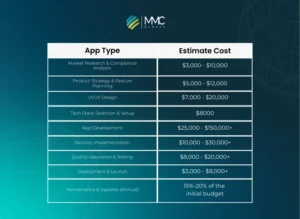
Building a fintech app isn’t just about coding. It’s a journey with different stages, and each stage has its own costs and requirements. Let’s go through them one by one.
1. Market Research & Compliance Check
Every fintech app starts with research and legal groundwork. You need to understand both your audience and the financial rules that apply to your app.
Here’s what usually happens at this stage:
- Identifying your target users, their habits, and pain points.
- Checking competitor apps and finding their strengths and weaknesses.
- Researching rules like GDPR, PCI-DSS, PSD2, and KYC/AML.
- Listing compliance and legal requirements in your region.
Estimated Cost: $3,000 – $10,000
Skipping this can cost you millions later in fines, lawsuits, or even a shutdown. Hiring a legal advisor or compliance consultant is often worth it.
2. Product Strategy & Features
This is where you define your app’s purpose and what features it should include.
The type of app you’re building wallet, P2P payments, trading, or personal finance will decide its complexity and cost.
Key Features That Affect Cost:
Basic Features
- Sign-up & login
- KYC verification
- Dashboard & transaction history
- Fund transfers
- Notifications
- Settings & customer support
- Security & encryption
Advanced Features
- Biometric login
- Real-time analytics
- AI chatbot
- Budgeting & investment tools
- Multi-currency support
- QR payments
- Card management
- Third-party integrations
- Personalized rewards
Estimated Cost: $5,000 – $12,000
Best approach: start with an MVP (Minimum Viable Product) so you don’t waste money on features your users may not even want.
3. UI/UX Design
Design is about trust and simplicity. In fintech, people must feel their money is safe.
The design process includes:
- Wireframing: setting up the app’s structure and user flows.
- Prototyping: clickable mockups for testing navigation.
- Final design: colors, fonts, branding, and interaction.
Estimated Cost: $7,000 – $20,000
Always test designs with real users to remove friction before development starts.
4. Choosing the Tech Stack
Your app’s tech stack affects its speed, security, and scalability.
Here’s a quick look:
| Component | Common Choices | Cost |
| Frontend | React Native, Flutter, Swift, Kotlin | Free |
| Backend | Node.js, Django, Ruby on Rails, Spring | Free |
| Cloud Hosting | AWS, Google Cloud, Azure | $100–$1,000/month |
| Database | PostgreSQL, MongoDB, MySQL, Firebase | Free–$500/month |
| Payment APIs | Stripe, PayPal, Razorpay, etc. | ~2.9% per transaction |
| KYC APIs | Plaid, Jumio, Onfido | $500–$3,000/month |
| DevOps Tools | Docker, Jenkins, Kubernetes | Free–$1,000/month |
| Monitoring Tools | Datadog, Sentry, New Relic | $200–$1,000/month |
Setup Cost: starts at $8,000+
Pick popular, well-supported tools to save money and reduce future maintenance headaches.
5. App Development (Frontend + Backend + APIs)
This is where your app comes to life.
- Frontend: what users see and interact with.
- Backend: the engine that runs your app handling data, business logic, and security.
- APIs: connecting with services like Stripe (payments) or Plaid (bank data).
Estimated Development Costs by App Type:
| App Type | Timeline | Cost |
| Basic Wallet (MVP) | 3–4 months | $25,000 – $40,000 |
| Mid-Level (P2P, Budgeting) | 4–6 months | $40,000 – $80,000 |
| Advanced (Trading, Crypto, Neo-Banking) | 6–9 months | $80,000 – $150,000+ |
6. Security Setup
Fintech apps are a prime target for hackers. Security isn’t optional, it’s a must. A study by the University of Maryland estimates that there are 2,244 cyberattacks per day.
Key protections include:
- Data encryption & tokenization
- Biometric or 2FA login
- Real-time fraud alerts
- Secure session management
Estimated Cost: $10,000 – $30,000
7. Testing & Quality Assurance
Before launch, you need to make sure your app works reliably and safely.
Things to test:
- Does it perform smoothly under heavy use?
- Are user data and transactions fully protected?
- Does it meet legal standards?
Estimated Testing Cost:
- Manual testing: ~$8,000
- Automated testing scripts: ~$16,000
- Full security audit: ~$20,000
8. Launch & Deployment
This step includes:
- Publishing to app stores
- Setting up cloud hosting
- Final security audits
- Legal docs (terms & privacy policy)
Estimated Cost: $5,000 – $8,000
9. Maintenance & Scaling
After launch, your job isn’t over. You’ll need ongoing support to fix bugs, release updates, and add new features.
Estimated Cost: around 15–20% of initial development cost per year
By planning for each stage, you’ll avoid hidden costs and set your fintech app up for long-term success.
Key Factors That Affect Fintech App Development Cost
Fintech apps have completely changed the way people manage money from sending payments and saving to investing and even buying crypto.
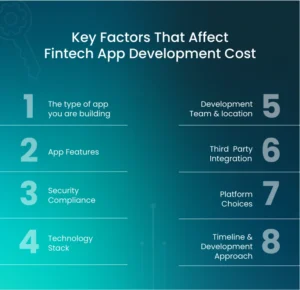
If you’re planning to build one, the first thing you’ll probably ask is: How much does it cost to make a fintech app?
The truth is, the cost depends on many factors. Let’s break it down step by step so it’s easier to understand.
1. Type of App
Not all fintech apps cost the same.
- A simple budgeting app will always be cheaper than a mobile banking app.
- A trading app will need extra tech compared to a digital wallet.
Examples:
- Mobile Banking (e.g., Revolut, Chime) → Expensive, requires strong security and compliance.
- Investment Apps (e.g., Robinhood, Acorns) → Needs trading APIs, real-time data, and advanced algorithms.
- Payment Apps (e.g., PayPal, Venmo) → P2P transfers, QR, and NFC payments.
- Lending Apps → Loan management, credit scoring, and user verification.
- Insurance Tech Apps → Risk assessment and 3rd-party integrations.
- AI-Powered Apps → Machine learning, real-time analytics, and privacy protections.
The more advanced the app, the higher the fintech app development cost.
2. App Features
Features directly affect cost. Every new feature means more time, more effort, and more money.
Here’s an idea of common fintech features:
| Feature | Estimated Cost | Cost Impact |
| Blockchain Integration | $40,000 – $100,000+ | Very High |
| Open Banking API | $20,000 – $50,000 | High |
| Embedded Finance (Lending/Insurance) | $30,000 – $70,000 | High |
| RegTech Tools | $25,000 – $60,000 | High |
| Digital ID Verification | $10,000 – $25,000 | Moderate |
| Voice-Enabled Interface | $15,000 – $35,000 | High |
| AI for Financial Planning | $40,000 – $80,000+ | Very High |
| Neobanking Features | $70,000 – $150,000+ | Very High |
| BNPL (Buy Now Pay Later) | $25,000 – $50,000 | High |
A basic MVP (minimum viable product) will be affordable. A feature-rich app will always cost more.
3. Security & Compliance
Fintech apps deal with sensitive financial data, so strong security is non-negotiable.
Key costs for compliance & security:
- KYC/AML Compliance → $8,000 – $20,000
- GDPR Setup → $5,000 – $15,000
- PCI-DSS Certification → $10,000 – $25,000
- End-to-End Encryption → $5,000 – $12,000
- Secure APIs → $10,000 – $20,000
- Security Audits → $7,000 – $15,000+ per cycle
Cutting costs here can ruin trust and damage your brand.
4. Technology Stack
Your tech choices also affect the budget.
- Mobile Platforms → Android, iOS, or both (dual apps cost 30–50% more).
- Framework → Native (more costly), Cross-platform like Flutter/React Native (cheaper).
- Backend → Node.js, Django, Ruby, etc. (varies with scale).
Enterprise-grade tools = more expensive, but better for scalability.
5. Development Team & Location
Who builds your app and where they’re based matters a lot.
Average hourly rates by region:
- North America → $100–$200/hr
- Western Europe → $80–$150/hr
- Eastern Europe → $40–$80/hr
- South Asia → $20–$60/hr
- Middle East → $40–$80/hr
Options you have:
- In-house team → Best control, highest cost.
- Freelancers → Cheaper, but riskier.
- Agencies/Partners → Balanced option, full-service.
6. Third-Party Services & Integrations
Most fintech apps need integrations with:
- Banks
- Credit bureaus
- Payment systems (like Stripe, Plaid)
These bring setup fees, subscription fees, or per-transaction charges.
Always include them in your cost plan.
7. Platform Choice
Do you want iOS, Android, or both?
- One platform → Cheaper.
- Both platforms (native) → Costly but higher quality.
- Cross-platform → Efficient and affordable.
- Web version → Extra cost, bigger reach.
8. Timeline & Approach
The faster you want your app, the more it costs.
- Tight deadlines = bigger team or overtime = +20–30% extra.
- Agile method = flexible, but can extend costs if not managed well.
- MVP-first approach = cut initial costs by up to 60%.
Unexpected Expenses in Fintech App Development
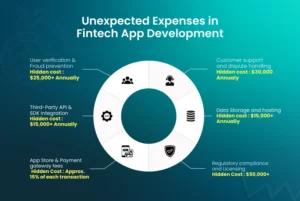
1. App Store & Payment Fees
If you publish your app on the Apple App Store or Google Play, they take a percentage from every purchase, usually between 15–30%.
On top of that, payment providers like Stripe or PayPal also charge a small fee per transaction.
It may look small at first, but the more transactions you have, the bigger the amount becomes.
Hidden Cost: 2.9%–30% per transaction
2. Compliance & Legal Requirements
Fintech is one of the most regulated industries. To stay safe and legal, you need to follow rules like GDPR, PCI DSS, KYC, and AML.
This often means hiring legal experts, buying licenses, or even going through audits if your app handles money or personal data.
Hidden Cost: $20,000 – $100,000+
3. Third-Party APIs & Tools
Most fintech apps rely on external APIs or SDKs to handle things like payments, security checks, or banking connections.
These tools might look free or cheap in the beginning, but costs increase quickly as your app gets more users, since many providers charge per API call or per transaction.
Hidden Cost: $5,000 – $50,000+ per year
4. Cloud Hosting & Data Storage
Your app will need strong and reliable hosting, usually on platforms like AWS or Google Cloud.
While basic plans are affordable, costs rise when you add backups, secure servers, and compliance-ready infrastructure to protect sensitive financial data.
Hidden Cost: $2,000 – $30,000+ per year
5. Identity Verification & Fraud Control
Since fintech apps involve money, you’ll need to verify users and block fraud.
Services like Onfido or Jumio are great, but they charge based on the number of checks or users. With a growing customer base, these costs can scale fast.
Hidden Cost: $5,000 – $50,000+ per year
6. Customer Support & Disputes
People expect instant support when their money is on the line.
This means setting up live chat, phone support, or even outsourcing to call centers. Handling disputes and refunds adds extra expenses too.
Hidden Cost: $8,000 – $60,000+ per year
Why You Should Understand Fintech App Development Costs
A fintech app is more than just software; it solves real financial problems, gives users a smooth experience, and keeps their money and data secure.
To make smart choices, it’s important to understand where most of the development costs come from.
This knowledge helps you save time, money, and avoid surprises later.
Here’s why knowing the cost breakdown matters:
● Smarter Budget Planning
When you know the costs upfront, you can create a realistic budget.
Fintech apps often need advanced features like secure logins, instant payments, and identity checks, which can get expensive fast.
By breaking down the costs, you can decide which features to build first and which to save for later.
It also helps you prepare for hidden costs like compliance, security updates, or third-party services.
● Focus on What Really Matters
The more complex your app, the higher the cost.
Knowing the cost structure helps you separate the “must-have” features from the “nice-to-have” ones.
For example, you may want biometric login or AI-powered investment advice, but your budget may not allow it right away.
This way, you can start with a Minimum Viable Product (MVP) and test your idea without overspending.
● Gain Investor Trust
If you’re raising funds, investors will want to see that you understand the numbers.
A clear cost estimate shows that you’ve done the research and know what it takes to launch your app.
When you present a well-thought-out budget and roadmap, investors are more likely to trust you and invest in your product.
● Better Timeline Planning
Cost isn’t just about money it’s also about time.
Every phase of development, from design to testing, is tied to both cost and schedule.
When you understand this, you can set realistic launch dates and plan your marketing.
This is crucial in fintech, where being first or early can give you a big advantage.
● Compliance & Security Awareness
Fintech apps face stricter rules than regular apps.
From GDPR and PCI-DSS to KYC checks, following these rules is mandatory and it adds to your budget.
Knowing this early means you can plan for legal advice, audits, and strong security features like encryption, without being caught off guard.
● Reduce Risks & Surprises
One of the biggest reasons fintech projects fail is unexpected cost overruns.
By understanding the financial side, you can manage risks better.
It helps you plan for updates, scaling, and long-term maintenance, so your app can grow smoothly as your business expands.
7 Smart Ways to Cut Down Fintech App Development Cost
The demand for fintech apps whether it’s digital wallets, lending platforms, or neobanking solutions is growing fast.
But building one can get expensive, especially if you’re a startup or working with a limited budget.
The good news? You can cut costs without hurting quality, security, or performance if you plan the right way.
Here are some practical tips to help you save money while still building a strong and reliable product.
1. Start with a Clear Vision
One of the main reasons projects run over budget is adding too many features or changing direction mid-way.
To avoid this, start with a simple plan:
- Write down the main problem your app will solve.
- List the “must-have” features.
- Build a Minimum Viable Product (MVP) that covers the essentials.
Focus on solving one big problem first instead of trying to do everything at once. This keeps things lean and manageable.
2. Work with the Right Team
The people you hire can make or break your budget.
- An in-house team gives you control but is often costly.
- Outsourcing can save money but make sure you choose experts with fintech experience.
- A hybrid approach (some roles in-house, some outsourced) often works best.
Most importantly, ensure your development team understands fintech compliance and security requirements.
3. Use Ready-Made APIs and SDKs
There’s no need to build everything from scratch. Reliable third-party services already exist for things like:
- Payments → Stripe, PayPal
- Bank connections → Plaid
- Identity checks → Onfido
Using pre-built APIs and SDKs can speed up development by up to 50% saving both time and money.
4. Choose Cross-Platform Development
Building separate apps for iOS and Android is expensive. Instead, use frameworks like:
- Flutter
- React Native
- Xamarin
These let you reuse up to 90% of your code, cutting development costs and launch time.
5. Automate Testing and Deployment
Manual testing and updates take time and money. Automation makes things smoother.
- Use testing tools like Selenium or Appium.
- Use CI/CD tools like Jenkins, GitHub Actions, or Bitrise.
- Test across devices with BrowserStack or Sauce Labs.
This helps catch bugs early and speeds up releases without extra costs.
6. Keep Launch Simple
Many startups try to make their first version perfect but that’s expensive and unnecessary.
A smarter way is to:
- Launch a lean version of your app.
- Gather real feedback from users.
- Improve step by step.
This way, you don’t waste money on features that users might not even want.
7. Maintain Good Documentation
It may feel boring, but clear documentation saves a lot of time and money in the long run.
Without it, developers spend hours trying to understand code. With it, they can:
- Fix issues faster.
- Add new features easily.
- Onboard new team members smoothly.
Good documentation keeps your project organized and avoids costly delays.
Final Thoughts
Building a fintech app takes a good amount of investment, but with smart planning and the right partner, it can deliver big returns.
The cost of development often depends on things like how complex your app is, what features you want to include, and which development team you work with.
If you’re planning to enter the fintech space, choosing a tech partner who understands both finance and technology is key.
At MMC Global, we bring 10+ years of experience in creating successful apps while keeping client budgets in check.
We understand the fintech landscape and can help you build a secure, scalable solution without wasting time or money.
FAQs on Fintech App Development Cost
1. How much does it cost to build a fintech app in 2025?
On average, fintech app development can cost anywhere between $50,000 to $350,000+. The final price depends on factors like the app’s features, complexity, security standards, and the technology you choose.
2. How long does fintech app development take?
A simple fintech app may take around 3–5 months to build. More advanced solutions like trading apps or digital banks can take 6–12 months or longer, depending on the scope and functionality.
3. What are the steps to develop a fintech app?
Here’s a simple roadmap to get started:
- Research the market and competitors
- List down core features
- Pick the right technology stack
- Create an easy-to-use design (UI/UX)
- Build the backend system
- Connect APIs and third-party tools
- Focus on compliance and data security
- Test everything thoroughly
- Launch the app
- Keep improving with updates
Partnering with an experienced fintech development company like MMC Global makes this journey smoother and ensures compliance at every step.
4. Can I build a fintech app with a no-code platform?
Yes, but only for very basic use cases. For apps handling sensitive data, transactions, or heavy traffic, custom development is the better choice because it gives you more security, scalability, and control.
5. Are there hidden costs in fintech app development?
Yes, beyond development you should plan for compliance checks, API subscription fees, cloud hosting, server costs, and regular maintenance. Post-launch updates and security upgrades are also essential to keep the app safe and reliable.