
At MMC Global, we have been working on AI-based applications for years. From SaaS-driven AI solutions and smart chatbots to advanced AI features integrated into existing software, we have helped businesses turn ideas into practical, high-impact products. During these projects, one question comes up again and again from our clients: how much does AI app development actually cost?
That’s exactly why we decided to explain it in detail.
AI is no longer a future concept. According to market data, the global AI market is expected to reach around $1.84 trillion by 2030, growing at a strong annual rate of over 30%. This clearly shows how much businesses are investing in AI today and how important it will become in the coming years. For entrepreneurs, startups, and enterprises, understanding the cost of building an AI-powered app is now a business necessity, not just a technical concern.
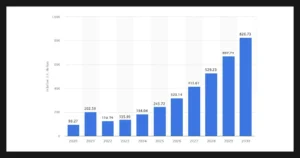
In this blog, we break down the key factors that influence AI app development costs. We also explain practical ways to manage and optimize these costs without compromising quality or performance.
As an AI development Company, MMC Global provides end-to-end services, including AI app development, AI consulting, generative AI solutions, on-demand app development, and reliable post-launch support. Based on our experience across different industries and use cases, we can give a realistic cost range.
On average, AI app development can cost anywhere between $20,000 and $150,000 or more. The final budget depends on factors such as app complexity, data requirements, AI models, integrations, and scalability needs. At MMC Global, we focus on building cost-effective AI solutions tailored to business goals, ensuring clients get maximum value from their investment.
Keep reading to explore detailed cost factors, pricing examples, and smart strategies to plan your AI app budget more effectively.
Why You Should Consider Cost When Developing an AI App
Understanding the cost of AI app development is essential before you start building your product. AI projects often involve advanced technology, data processing, and long-term scaling, which makes cost planning even more important. Below are the key reasons why cost consideration matters from the beginning.
First, it helps you set a realistic development budget. When you know the expected cost range, you can allocate resources wisely and avoid unexpected expenses during development.
Second, it allows you to plan development in phases. Instead of building everything at once, you can focus on high-impact features that deliver real business value and improve ROI. This phased approach reduces risk and ensures better decision-making at each stage.
It’s also important to note that only around 53% of AI projects successfully move from prototype to production. One of the main reasons for failure is poor planning and trying to build a full-scale AI solution too early. Successful AI app development usually follows a structured, step-by-step approach, such as:
- Wireframing to define the app structure and user flow
- Prototyping to visualize functionality and validate ideas
- Developing an MVP (Minimum Viable Product) with core AI features
- Validating the AI app idea through user acceptance testing (UAT)
- Building an MMP (Minimum Marketable Product) ready for real users
- Gradually adding advanced and value-driven features over time
At MMC Global, we help businesses follow this phased development strategy to control costs, reduce risk, and ensure AI solutions are practical, scalable, and aligned with business goals.
Also Read: AI In the Architecture Industry.
Why Now Is the Right Time to Invest in AI App Development
Artificial intelligence is rapidly changing how businesses operate, and this makes now the right time to invest in AI app development. Companies across industries are adopting AI-powered applications to improve efficiency, automate processes, and deliver more personalized user experiences at scale.
Recent market research shows strong growth in the AI app market. In 2024, the global market size reached approximately $2.94 billion and is expected to grow to $5.13 billion by 2025. With a projected CAGR of 38.7% through 2030, AI applications are becoming one of the fastest-growing segments in the digital economy.
This rapid expansion highlights more than just increasing demand. It shows that AI apps are delivering strong returns, turning development costs into long-term strategic investments rather than short-term expenses. Businesses are seeing real value through automation, smarter decision-making, and improved customer engagement.
As a result, startups and enterprises are actively searching for accurate AI app development cost estimates. Understanding the cost helps them plan budgets effectively, reduce risk, and launch AI-driven solutions in high-growth sectors such as healthcare, eCommerce, fintech, logistics, and customer support.
For entrepreneurs, product leaders, and CTOs, investing in AI apps today can provide a strong competitive advantage. With cloud infrastructure, scalable platforms, and pre-trained AI models now widely available, the cost of building intelligent applications has become more accessible than ever. This makes it an ideal time to enter the AI market and build future-ready digital products.
Also Read: How Facebook AI Chatbot Can Help Generate Leads For Businesses.
What Is the Cost of Building an AI App?
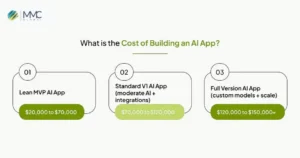
Before going into detailed cost calculations, it’s important to understand the main pricing levels that affect AI app development costs. The total cost depends on factors such as app complexity, the level of AI involved, data requirements, and third-party integrations.
Below is an estimated cost breakdown to help you understand how much it may cost to build an AI app based on different business needs
| Type of AI App | Estimated Cost | Best For | What You Get |
| Lean MVP AI App | $20,000 – $70,000 | Early-stage startups testing ideas or market demand | Basic AI features using APIs, essential mobile app screens, simple user flows, and a lightweight backend |
| Standard V1 AI App (Moderate AI + Integrations) | $70,000 – $120,000 | Growing businesses needing automation and scalability | Moderate AI capabilities, analytics, third-party integrations, polished UI/UX, and scalable architecture |
| Full-Scale AI App (Custom Models + Scale) | $120,000 – $150,000+ | Enterprises building advanced, high-performance AI solutions | Custom AI models, training pipelines, large data processing, multi-platform support, and enterprise-grade security |
This table clearly explains the cost of building an AI app based on complexity and business goals, and helps readers quickly understand how much it costs to develop an AI-powered application.
AI App Development Cost Estimator – Get a Quick Estimate
When businesses plan to build an AI-powered application, one of the first questions they ask is, “How much will an AI app cost?” In most cases, AI app development costs range from $20,000 to $150,000 or more, depending on factors such as app complexity, required features, data volume, and third-party integrations.
To support early planning and faster decision-making, an AI app development cost estimator can be a valuable tool. It allows users to select key requirements and instantly receive a rough cost estimate, helping businesses understand budget expectations before moving into detailed consultations or development phases.
Also Read: How AI Chatbot Integration Within Ecommerce App.
AI App Development Cost Estimator Formula
Estimating the cost of an AI app can be simplified with a basic formula:
Estimated Cost = Base App Type Cost + (AI Feature Costs × Complexity Factor) + Integration Cost + UI/UX Design + Data Management Cost
Where:
- Base App Type Cost – The starting price for the type of app (e.g., chatbot, image recognition, recommendation engine)
- AI Feature Costs – Costs for NLP, ML models, computer vision, sentiment analysis, etc.
- Complexity Factor – Multiplier (1× to 2×) based on project scope and complexity
- Integration Cost – CRM, ERP, or third-party API integrations
- UI/UX Design – Visual design, front-end interaction, and user experience
- Data Management – Data collection, labeling, and AI model training support
Example Cost Breakdown
Suppose a company wants to develop an AI chatbot with CRM integration and sentiment analysis:
- Base App Type (AI Chatbot): $20,000
- AI Features (NLP + Sentiment Analysis): $15,000
- Complexity Factor: 1.2×
- CRM Integration: $10,000
- UI/UX Design: $10,000
- Data Management: $5,000
Estimated Cost:
($20,000 + $15,000) × 1.2 + $10,000 + $10,000 + $5,000 = $67,000
Why Include an AI App Cost Estimator?
Adding a “Get Instant Estimate” tool on your website provides multiple benefits:
- Engages users and boosts lead generation
- Gives transparency on AI app development costs
- Helps businesses visualize how costs vary based on features and complexity
- Increases conversion by offering immediate value
How the Estimator Can Work
A simple cost estimator can use dropdowns or sliders where users select:
- Type of AI app (chatbot, recommendation engine, image recognition, etc.)
- AI capabilities required (NLP, computer vision, predictive analytics)
- Integrations needed (CRM, ERP, third-party APIs)
- Hosting preference (cloud or on-premise)
With AI app demand rising rapidly, offering a dynamic cost estimation tool gives your business a competitive advantage and helps clients plan smarter.
Also Read: 8 Chatbot Types That Can Grow Your Business Exponentially.
AI App Development Cost – Key Factors That Influence Pricing
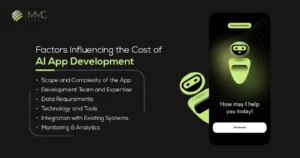
Several factors determine the cost of developing an AI app. Understanding these helps businesses plan budgets and make informed decisions.
1. Scope and Complexity of the App
The complexity and number of features directly affect development costs. Simple AI apps, like chatbots, are less expensive, while advanced apps with image recognition, automation, or natural language processing (NLP) require more resources, sophisticated AI models, and extensive testing.
Example Costs:
- AI travel planner: $20,000 – $80,000
- AI image detection system: $50,000 – $200,000
2. Development Team and Expertise
The experience and size of your development team impact cost. Less experienced teams may charge less but risk project delays, errors, and higher long-term costs due to rework. Experienced AI developers command higher salaries but deliver faster, more reliable solutions.
For AI projects with high failure rates, working with skilled developers is a better investment.
3. Data Requirements
High-quality, structured data is the backbone of AI apps. Data is required for training models, improving accuracy, and ensuring reliable predictions. Each stage of data management adds to the overall cost:
- Gathering raw data: $5,000 – $20,000
- Cleaning and formatting: $10,000 – $30,000
- Labeling for supervised learning: $15,000 – $50,000
- Secure and scalable storage: $5,000 – $20,000 per year
- Regular updates for relevance: $10,000 – $40,000 per year
- Compliance with legal and ethical standards: $5,000 – $15,000
4. Technology and Tools
The choice of programming languages (Python, R), AI libraries (TensorFlow, Pandas), cloud platforms (AWS, Google Cloud), and DevOps tools influences cost. Typical ranges: $10,000 – $50,000 depending on tools, infrastructure, and deployment requirements.
5. Integration with Existing Systems
Integrating AI apps with existing software requires custom interfaces, APIs, and rigorous testing. For example, adding AI-powered resume parsing to an existing HRMS system can cost $20,000 – $100,000 depending on complexity.
6. Monitoring and Analytics
Ongoing monitoring and analytics are essential for performance optimization, user engagement tracking, and issue resolution. Post-development support ensures the AI app runs smoothly over time. Estimated annual costs: $5,000 – $20,000.
Also Read: How Much Does It Cost to Build a Chatbot Like Ask AI.
Use-Case Wise Cost of AI App Development
Understanding the cost of developing an AI app depends largely on the type of application and its features. The table below provides a clear breakdown of estimated costs for different AI app use-cases, helping businesses plan budgets and make informed decisions.
| App Type | Estimated Cost | Key Features | Example Use Case |
| AI Chatbots | $20,000 – $80,000 | NLP, sentiment analysis, real-time responses | Virtual AI customer service agents |
| Resume Parsing Software | $40,000 – $120,000 | Automated candidate screening, keyword matching, data extraction | AI-powered applicant tracking systems for recruitment |
| Predictive Analytics Tools | $30,000 – $100,000 | Data analysis, forecasting, pattern detection | Sales forecasting for retail businesses |
| Healthcare AI Apps | $80,000 – $200,000 | Diagnostics, patient monitoring, personalized medicine | AI-powered radiology and patient care tools |
| AI-Powered CRM | $70,000 – $150,000 | Lead scoring, customer insights, personalized communication | CRM tools with AI-based recommendations |
| AI Image Detection System | $50,000 – $200,000 | Real-time image detection, IoT automation, body measurement | Fitness apps with real-time body measurement using mobile cameras |
Cost to Build an AI App: Timeline and Phase-Wise Breakdown
Estimating the cost of an AI app goes beyond a simple figure; it requires understanding how your investment is distributed across each development phase. Whether you are building a basic AI chatbot or a sophisticated machine learning platform, working with a skilled ChatGPT application developer can help you know the timeline and costs per phase, optimizing both your budget and expectations.
1. Planning & Discovery – $5,000 to $10,000
This initial phase defines your business goals, target users, required AI features, and project scope.
Key Activities:
- Market research and competitor analysis
- AI feasibility assessment
- Gathering project requirements
- Rough timeline and budget planning
Purpose: Sets a strong foundation before major investments.
2. UI/UX Design – $8,000 to $15,000
Design ensures the app is intuitive and user-friendly while accommodating AI-driven interactions.
Key Activities:
- Wireframing and user flows
- High-fidelity design mockups
- Designing AI interaction points (chat windows, visual outputs, dashboards)
Purpose: Reduces friction and builds trust in AI features.
3. MVP Development – $15,000 to $35,000
The Minimum Viable Product (MVP) is the first functional version of your app, including essential features without full AI complexity.
Key Activities:
- Core front-end and back-end development
- Basic API and database integrations
- Initial deployment on staging environments
Purpose: Validates the product concept before scaling AI capabilities.
4. AI Model Development & Training – $20,000 to $50,000
This phase is the most critical, focusing on creating or integrating AI models. Costs vary depending on custom model training versus using pre-trained APIs.
Key Activities:
- Data collection and preprocessing
- AI model selection or creation
- Model training, testing, and optimization
- Integrating AI logic into the app
Purpose: Power intelligent features like NLP, image recognition, or recommendation engines.
5. Testing & QA – $5,000 to $15,000
Testing ensures your AI app performs accurately, reliably, and securely.
Key Activities:
- Unit and integration testing
- User Acceptance Testing (UAT)
- AI model performance validation
- Bug fixing and optimization
Purpose: Validates real-world accuracy and ensures a smooth user experience.
6. Deployment & Post-Launch Support – $7,000 to $25,000
The final phase includes launching the app and providing ongoing support, updates, and AI model retraining.
Key Activities:
- Deployment on App Store, cloud, or enterprise systems
- Monitoring and analytics integration
- Maintenance and model updates
- Incorporating post-launch user feedback
Purpose: Keeps AI models accurate, relevant, and high-performing.
Phase-Wise Breakdown of AI App Development Cost
| Development Phase | Estimated Cost Range | Purpose / Notes |
| Planning & Discovery | $5,000 – $10,000 | Define goals, target users, AI features, and project scope; set foundation for development |
| UI/UX Design | $8,000 – $15,000 | Wireframing, mockups, and AI interaction design for intuitive user experience |
| MVP Development | $15,000 – $35,000 | Build the first functional version with essential features to validate the concept |
| AI Model Development & Training | $20,000 – $50,000 | Data preprocessing, model selection, training, and integration of AI features |
| Testing & QA | $5,000 – $15,000 | Unit, integration, and user acceptance testing; validate AI accuracy and performance |
| Deployment & Post-Launch Support | $7,000 – $25,000 | Launch, monitoring, maintenance, and AI model updates for ongoing performance |
Cost of Developing an AI App by Industry / Sector (2026 Estimates)
The cost to develop an AI app varies across industries because each sector has unique requirements, compliance standards, and AI capabilities. Below is a quick breakdown of estimated AI app development costs by industry to help businesses plan budgets and define feature priorities.
| AI App Type | Estimated Cost | Best For | Example Features / Use-Cases |
| Healthcare AI App | $60,000 – $150,000+ | Clinics, hospitals, diagnostic platforms | Symptom checkers, AI triage, medical imaging assistants |
| Dating AI App | $50,000 – $140,000+ | Relationship apps, matchmaking startups | AI matchmaking, smart chat, profile scoring |
| Social Media AI App | $70,000 – $150,000+ | Community platforms, social networking apps | AI feeds, content moderation, recommendation engines |
| Real Estate AI App | $40,000 – $120,000+ | Property rental/sale platforms, agents | AI property recommendations, virtual assistants |
| Education / EdTech AI App | $45,000 – $130,000+ | eLearning platforms, tutoring apps | AI tutors, personalized learning paths |
| Insurance AI App | $50,000 – $140,000+ | Insurance agencies, fintech startups | AI underwriting, claim automation |
| AI Avatar Generator App | $30,000 – $150,000+ | Creators, influencers, entertainment | AI avatars, image-to-avatar transformation |
| HR & Recruitment AI App | $40,000 – $130,000+ | Recruiting agencies, HR tech | AI resume screening, job-matching engines |
| Mental Health AI App | $40,000 – $120,000+ | Wellness companies, therapy platforms | AI mood tracking, chat-based guidance |
| Legal AI App | $60,000 – $150,000+ | Law firms, compliance startups | AI document review, case analysis |
| Media & Entertainment AI App | $50,000 – $150,000+ | Streaming platforms, creator ecosystems | AI content creation, recommendation systems |
| Travel & Hospitality AI App | $40,000 – $125,000+ | Booking apps, travel planners | AI itinerary planning, smart trip suggestions |
| Agriculture AI App | $35,000 – $110,000+ | Agri-tech startups, farms | Crop prediction, soil analysis, yield forecasting |
| Trading AI App | $60,000 – $150,000+ | Fintech, investment platforms | AI trading bots, market prediction tools |
| Sports Betting AI App | $50,000 – $140,000+ | Betting platforms, gaming startups | AI odds prediction, risk engines |
These estimates provide a clear view of AI app development costs by industry, helping businesses plan budgets, prioritize features, and craft effective strategies before starting their AI project.
Also Read: How To Build The Best AI Chatbot – The Ultimate Solution To Integrate Automated Customer Support.
Hidden Factors That Influence AI App Development Cost
When planning the cost to build an AI app, businesses often overlook hidden factors that can significantly impact the overall budget. These considerations go beyond basic development and are critical for a successful AI project:
- Data Privacy and Security: Applications handling sensitive information, such as healthcare or finance apps, may require compliance with regulations like HIPAA and advanced encryption. Using AI platforms like IBM Watson for secure processing can increase development costs.
- Licensing Fees: AI tools and APIs, including OpenAI GPT or Google Vision AI, often have usage-based licensing fees, which can add substantially to the total budget.
- Scalability Requirements: AI systems designed to handle millions of users, similar to Netflix’s recommendation engine, need robust cloud infrastructure and optimized performance, raising infrastructure costs.
- Iteration and Refinement: AI apps often require continuous updates based on user feedback and performance testing. Iterative improvements ensure accuracy and usability but also add to ongoing development costs.
- Training Time: Training advanced AI models demands high computational resources. For instance, training GPT-4 required massive compute power, reflecting the investment needed for high-performance AI solutions.
Development Costs of Popular AI Business Applications
Looking at the development costs of well-known AI applications can provide valuable benchmarks and insights into factors affecting AI app pricing. Here’s a quick overview:
- Virtual AI Customer Agents (e.g., Drift): $50,000 – $100,000
- Resume Parsing Software (e.g., Zoho Recruit): $40,000 – $120,000
- AI-Powered Writing Assistant (e.g., Textio): $50,000 – $110,000
- Sales Analytics & Insights (e.g., Gong.io): $60,000 – $130,000
- AI Grammar Checker (e.g., Grammarly): $80,000 – $200,000
- AI Budgeting & Financial Assistant (e.g., Cleo): $70,000 – $150,000
- AI CRM Software (e.g., InsightSquared): $70,000 – $150,000
- Predictive Analytics Tools (e.g., Looker): $30,000 – $100,000
- AI Inventory Management (e.g., TradeGecko): $60,000 – $140,000
- AI-Powered Customer Support (e.g., Freshdesk): $40,000 – $90,000
These examples highlight how features, AI complexity, integrations, and data requirements influence development costs. By analyzing these real-world benchmarks, businesses can better estimate their AI app budgets and plan investments strategically.
How to Optimize AI App Development Cost
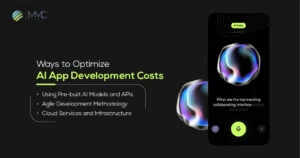
As a business, you can strategically reduce the cost of AI app development without compromising quality. Here are some effective approaches:
1. Leverage Pre-Built AI Models and APIs
Using pre-built AI models and APIs eliminates the need to develop AI algorithms from scratch. These models are created and refined by experts, ensuring high accuracy and reliability.
For example, AI chatbot developers often use OpenAI’s GPT API or Google Dialogflow API. This allows easy integration of natural language processing capabilities while saving time, development effort, and training costs.
2. Adopt Agile Development Methodology
Agile methodology breaks development into small, manageable sprints, each delivering specific features. Iterative testing ensures early detection of issues, reducing costly rework.
A phase-wise development approach under agile helps validate AI functionalities step-by-step and keeps the project aligned with business goals.
3. Use Cloud Services and Infrastructure
Cloud platforms reduce upfront costs for hardware and infrastructure. With pay-as-you-go models, you only pay for the resources you use. Cloud services also offer access to advanced AI tools, automated maintenance, security updates, and scalable computing power.
For sensitive data, some enterprises may prefer on-premises or private cloud hosting to meet compliance and security requirements, which should be factored into cost planning.
How MMC Global Optimizes Your AI App Development Cost
As a leading AI app development company, MMC Global helps businesses build AI apps efficiently while keeping costs under control. We act as trusted advisors, guiding clients through every step of the AI journey from planning and model selection to architecture design, development, deployment, and ongoing optimization.
Our team combines technical expertise with business insights to ensure smarter, cost-effective decisions. MMC Global focuses on maximizing the value of every feature while avoiding unnecessary expenses. By leveraging agile workflows, reusable code, pre-trained AI models, scalable cloud architectures, and industry-specific accelerators, we reduce AI app development costs without compromising quality, performance, or future scalability.
Additionally, we provide post-development support, continuous monitoring, AI model retraining, and feature upgrades ensuring your AI app remains secure, up-to-date, and ready for long-term growth.
Real Projects Where MMC Global Optimized AI App Development Cost
MMC Global has successfully delivered multiple AI-powered solutions across sectors, consistently helping clients manage budgets, speed up launch timelines, and maintain high-quality performance.
Government Chatbot Solution – AI Assistant for UAE Citizens (Khalid)

Our Government Chatbot is an AI-powered, multilingual assistant designed to streamline citizen interactions and enhance access to public services. Equipped with OCR technology, it extracts data from English and Arabic PDFs, converting text images into machine-readable content. Available 24/7, it provides instant responses, retrieves important information, and efficiently handles inquiries, improving accessibility and user experience.
Key Features:
- 24/7 citizen support for uninterrupted government service access
- OCR-enabled extraction from English and Arabic PDFs
- Multilingual interface for broad user engagement
- AI-driven responses for faster, smarter interactions
Tarot Tap – AI-Powered Tarot Chatbot & Image Generator

Tarot Tap transforms tarot readings with an AI-driven chatbot and image generator. The chatbot leverages natural language processing to offer personalized readings, while a custom-trained AI model generates unique tarot card visuals inspired by traditional decks. This fusion of AI technology and mysticism delivers intuitive insights to users globally.
Key Contributions:
- Developed an AI chatbot for personalized tarot readings
- Implemented NLP algorithms to enhance reading accuracy
- Curated a tarot card image dataset for model training
- Trained AI to generate high-quality custom tarot visuals
- Integrated chatbot and image generation for a seamless experience
Custom AI Chatbot for Abu Dhabi Data Portal (Rashid)
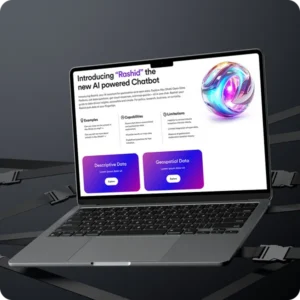
Rashid is an AI chatbot built for the Abu Dhabi Data Portal, allowing users to query extensive public datasets using natural language. The chatbot supports contextual understanding through NLU, dynamic data visualization, and smooth data retrieval/export capabilities.
Key Contributions:
- Integrated large public datasets into the portal
- Developed and deployed a chatbot API for seamless integration
- Implemented NLU for accurate query interpretation
- Enabled multi-format data visualization
- Streamlined querying and export of filtered datasets
Palo Alto Networks – AI Workflow Automation Intelligence

This AI automation solution for Palo Alto Networks optimizes contract renewals, identifies upsell opportunities, and automates promotional campaigns. Integrated with Salesforce, it ensures timely alerts and enhances operational efficiency through intelligent, data-driven workflows.
Key Contributions:
- Automated contract lifecycle management
- Identified upsell and tech refresh opportunities using AI insights
- Enabled targeted promotional actions and customer engagement
- Synchronized with Salesforce for real-time updates
- Improved retention with proactive alerts for contract expiry
Little Birds – Sentinel AI: Advanced CSAM Detection & Prevention
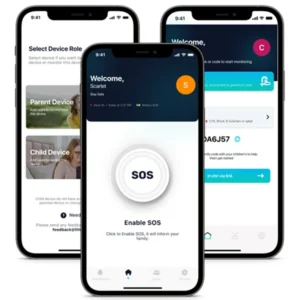
Sentinel AI is a sophisticated system designed to detect and prevent Child Sexual Abuse Material (CSAM) online. Leveraging advanced machine learning, it scans images, videos, and text across digital platforms to provide real-time identification and reporting to authorities.
Key Contributions:
- Deployed AI models for precise CSAM detection and classification
- Minimized false positives and negatives for accurate content flagging
- Enabled real-time alerts and reporting to law enforcement
- Strengthened digital safety by automating CSAM prevention
Why Businesses Trust MMC Global for Cost-Efficient AI App Development
With extensive experience in delivering practical AI solutions, MMC Global ensures:
- Faster delivery through agile and modular development approaches
- Transparent pricing with clear cost planning
- Optimized cloud infrastructure to reduce ongoing expenses
- Scalable architectures built for future growth
- Long-term support with no hidden costs
Across industries, government, healthcare, social media, enterprise, or real estate MMC Global helps businesses build AI apps within budget while ensuring high performance, scalability, and measurable ROI.
Conclusion
Understanding the cost of AI app development is crucial for effective planning, budgeting, and launching a successful product. Whether you are creating a government chatbot, a fitness platform, a real estate solution, or an advanced social app, having the right strategy and technical guidance ensures your AI app stays within budget while remaining scalable and high-performing.
Partnering with an experienced AI app development company like MMC Global helps businesses reduce risks, optimize resources, and speed up time-to-market. MMC Global combines innovation, industry expertise, and cost-efficient methodologies to deliver AI solutions that provide real value. With careful planning, transparent pricing, and reliable post-launch support, your vision can be transformed into a powerful AI application that meets user needs and drives measurable business results.
Frequently Asked Questions
1. How much does it cost to create an app with AI?
The cost to develop an AI-powered app typically ranges between $60,000 and $150,000, depending on complexity, features, and integrations.
2.How much does AI development cost?
AI development can start from $20,000 for simple AI models and go beyond $200,000 for advanced, custom AI systems with complex functionality.
3. How much does it cost to develop a standard app?
For mobile or web apps without AI, costs usually range from $30,000 for basic apps to $100,000+ for enterprise-grade solutions.
4. What are the main factors influencing AI app costs?
The key cost drivers include:
- App complexity and feature set
- Data processing and AI model requirements
- Development team expertise
- Integrations with existing systems
- Ongoing support and maintenance
5. How much does it cost to maintain an AI app?
Maintenance typically costs 15–20% of the initial development cost per year. This includes routine updates, cloud hosting, AI API usage, data refreshes, and scaling to support more users factors that define the total cost of ownership for an AI app.