
Going a few steps back, let’s reminisce about how everyone imagined flying cars, time travel, and teleportation. Now, as we are in the 21st century, it’s pretty much clear that we have come so far in achieving that. Today, we can witness our vehicles alerting us about the brake failure, suggesting the speed limit, and the easiest route in a matter of time to keep you out of trouble.
Who would have thought that it would be AI in automotive industry? Right now, we have vehicles, factories, and connected systems all relying on accurate data to make quick, right choices just in time. With the help of natural language processing and advancements of artificial intelligence in automotive, the focus is also shifting more towards making vehicles run without drivers.
These advancements come with a lot of consideration and precision to avoid any negligence in the first place. Moreover, the leading automotive companies, thriving in the industry, are introducing artificial intelligence to their systems.
Let’s read further in this blog about how AI is reshaping the automotive industry, its applications, trends, and what benefits it has to offer.
What is AI in Automotive Industry And How AI is Reshaping it?
AI in automotive industry means the use of such systems that can analyze accurate data, train from different patterns, and make decisions in a way that improves the operation of any vehicle, how it is built, and how services are delivered. It also enables cars to respond in real-time, points out errors, supports manufacturers, and helps businesses make quick, data-backed decisions.
A recent study indicates that in 2026, AI in automotive industry is expected to grow to a whopping $14.99 billion, and will reach a mark of $51.68 billion by 2034. That’s a CAGR of 16.7%.
These numbers show the growing importance of artificial intelligence in vehicles. As vehicles are also becoming connected and data-driven, we can also notice that the safety, efficiency, and overall driving experience are also improving.
Key Technologies Behind Automotive AI
There are a few core technologies that power AI functions in this space. Let’s have a quick look at it to understand it better:
- Machine Learning: Machine Learning enables systems to learn from past and current data without being explicitly programmed. This lets the systems improve performance over time by identifying patterns and predicting the future.
- Computer Vision: This helps in interpreting visual data collected from cameras and different sensors, resulting in object identification, reading traffic signals, and analyzing road conditions.
- Natural Language Processing: With the help of Natural Language Processing (NLP), it has become easier for drivers to stay in touch with the vehicle via voice commands. It also improves the experience by hand-free control over different operations, such as navigation, media, and communication.
- Edge AI: It helps in processing data within the vehicle instead of relying on other external servers. It cuts the response time and makes fast decisions in critical situations.
How Does AI Fit into the Automotive Industry?
The automotive industry is not limited to vehicles only. It has been spread across numerous layers. Below are a few examples of industries in which artificial intelligence is perfectly playing its role.
- Vehicles: It improves driving capabilities by real-time data processing, allowing useful features like driver assistance, route optimization, and control accessibility.
- Manufacturing: From the lens of production, it helps in automating processes, detecting early issues, and improving efficiency.
- Supply Chain: The supply chain supports demand forecasting, inventory management, and logistics planning for smooth operations by reducing delays.
Customer Experience: Brands can provide personalized driving experiences with the help of user interactions, preferences, and behavior.
The Importance Of AI In Automotive Industry
AI in the automotive industry has been expanding rapidly ever since vehicles have become increasingly dependent on automotive software solutions, advanced datasets, and intelligent systems. Automakers are facing increasing complexity, stricter safety rules, and faster innovation at the same time. Challenges seem to grow at every step, but here is the catch: artificial intelligence is helping to manage every pressure in a smarter way.
A resource also states that the global AI automotive market is expected to reach $7 billion by 2027. Additionally, Statista informs that in 2030, we can see the size of the automotive intelligence market reach the mark of $74.5 billion in 2030. This reflects the importance of using AI in automotive to smoothly perform operations without compromising on safety and quality.
Rising Complexity in Modern Vehicles
In 2026, vehicles are built with multiple layers of software, sensors, and electric systems that work in unity all the time. This resulted in a complex vehicle architecture, requiring intelligent systems to deal with a massive amount of data. Artificial intelligence in the automotive industry helps systems in interpreting data, performing functions, and executing multiple operations smoothly. The dependency of AI increases more as features like connected services and advanced driver assistance are added.
Demand for Safety And Automation
Safety has been at the forefront when it comes to vehicles. Modern systems are created in such a way that they actively detect high or low risk chances beforehand by monitoring surroundings, driving behavior, and internal functions of the car. Technologies backed by machine learning, such as automatic emergency braking, have been actively added to modern vehicles.
Pressure to Reduce Costs And Product Launch
Traditional development and manufacturing processes require years and a huge investment in return. This makes keeping up with the market trends a bit difficult. AI in automative industry addresses this challenge efficiently by helping in different stages like design, production, and supply chain operations, speeding up the whole process without breaking the bank.
According to Forbes, approximately 64% of businesses truly believe that AI can speed up their production process easily to transform business operations.
What Are The Core Applications of AI in Automotive Industry?
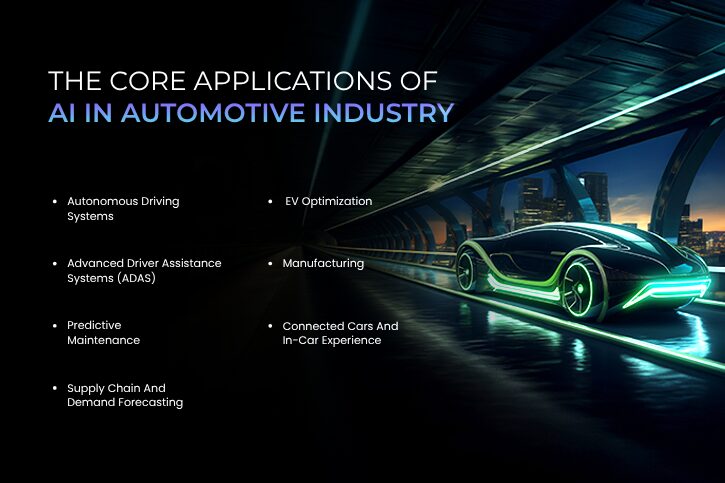
AI in automotive industry is used in numerous operations. Every single application serves a purpose of providing safety, efficiency, and performance while allowing businesses to make smart and quick decisions.
1. Autonomous Driving Systems
It is the most advanced application of artificial intelligence in the automotive industry. Simply put, it is a group of systems depending on combined sensors, cameras, radar, and LiDAR to collect data in the meantime from the surroundings. AI uses it to identify objects, road conditions, and make driving decisions without any human panicking in the front seat.
LiDAR: A sensor technology using laser pulses to calculate distances and create 3D maps of surroundings, so that vehicles can detect objects and estimate depth in real-time.
2. Advanced Driver Assistance Systems (ADAS)
Advanced Driver Assistance Systems also play a crucial part in road safety by providing alerts and automation while driving. MarketsandMarkets states that the ADAS market is projected to reach 652.5 million units in 2032, as per the increasing demand of safer vehicles.
Here are a few common features provided by ADAS:
- Lane Assistance.
- Collision Avoidance.
- Adaptive Speed Control.
3. Manufacturing
Manufacturing has been reshaped after being introduced to systems derived from AI. Manufacturers are getting inspired by different approaches used by large-scale companies in using AI to wind up repetitive tasks and improve accuracy. Robotics is able to handle assembly processes with attention to detail; meanwhile, computer vision systems inspect parts and detect defects in the production phase.
The result? Waste reduction and rapid manufacturing while keeping the quality intact.
4. Predictive Maintenance
Artificial intelligence collects data from different components in vehicles to identify unusual patterns before they turn into major problems.
Instead of waiting for something to go south, drivers and operators receive alerts, leaving a margin to schedule maintenance at the right time.
5. AI in Electric Vehicles (EV Optimization)
In electric vehicles, it manages the battery usage and monitors energy consumption. It also analyzes driving patterns and conditions, and suggests preferred routes and adjusts power usage accordingly. EV optimization helps in maintaining battery life and improving energy.
6. Connected Cars And In-Car Experience
Connected cars depend on AI to provide a personalized and interactive driving experience. These systems train on human behavior and preferences to automatically adjust the settings.
Voice assistants let users independently control navigation, radio, and communication without ever needing to take their hands off the steering wheel. As these systems learn from user behavior, they tend to improve more as time passes by.
7. Supply Chain and Demand Forecasting
AI is also being used to reshape the management of supply chains, OEMs, and battery suppliers. Depending on the historical production insights, emerging market trends, and external factors like shipping or raw material shortages, AI can easily predict demand with accuracy.
As for EVs, battery management is more crucial than ever. AI monitors manufacturing and optimizes energy distribution to make sure that only the right batteries reach the right assembly lines.
In short, AI in automotive industry is allowing smoother logistics and better coordination between OEMs and suppliers.
Latest AI Trends Transforming Automotive Industry (2026)
As AI has already been transforming numerous industries and their operations, it is no wonder that there are certain trends setting up the foundation of the automotive industry by focusing on improving performance, reducing latency, and enabling scalable vehicle systems.
Rise of Edge AI in Vehicles
- Processes data in the meantime without using onboard computing units.
- Minimizes latency to make real -time decision in critical situations.
- It supports current functions within the vehicle as well as surroundings, such as detecting nearby objects, avoiding collision, assisting users, and navigating without depending on cloud connectivity.
Generative AI in Automotive Design And Engineering
- Generative AI models help in generating optimized designs based on the required performance.
- With the help of digital twins, it stimulates real conditions for testing and validation.
- Minimizes the need for physical prototypes to speed up the development.
Software-Defined Vehicles (SDVs)
Functionality in most of the vehicles is controlled via code rather than hardware. This allows:
- Over-the-air (OTA) updates for fixing errors, bugs, and improving overall functions.
- Separation between hardware layers and software layers for better flexibility.
- Supports quick deployment of new AI functionalities.
AI And EV Convergence
- Analyzes battery life using timely diagnosis and predictions with advanced models.
- optimizes charging and thermal management, enabling a longer battery span.
- Helps in adjusting energy usage on the basis of driving patterns and surroundings.
AI-Powered Mobility-as-a-Service (MaaS)
- With the use of data, AI optimizes the way vehicles are allocated and used across networks.
- It also optimizes routes and matches relevant ride opportunities to reduce waiting times and prevent wasting fuel. This helps in ride-hailing and fleet management platforms.
- Improves usage of shared systems by monitoring user patterns and peak hours.
Real-World Use Cases of AI in Automotive Industry
AI in automotive industry has successfully taken a lead role in multiple popular companies globally to focus on their operational efficiency and reduce dealing with repetitive and complex tasks manually. Let’s have a look together at how artificial intelligence is fulfilling its role in a particular area.
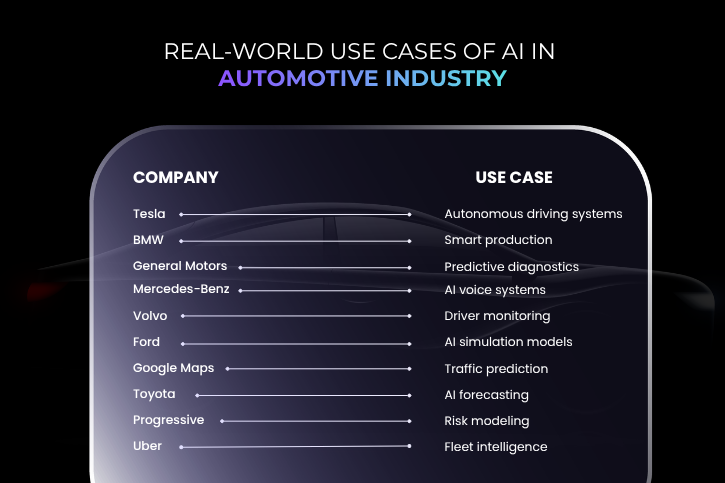
Self-Driving Technology
Autonomous systems in Tesla use deep learning models with different sensors to make decisions with minimal human intervention. These deep learning models have also successfully introduced driving without actual needing a human driver to safely travel places.
Manufacturing Automation
In BMW, AI-integrated robotics and computer vision are installed for smart production processes.
Predictive Vehicle Maintenance
General Motors leverages ML models on sensor data to make predictive diagnoses. This smartly triggers alerts for early maintenance to reduce downtime nd risks.
In-Car Virtual Assistants
Integrated NLP models in Mercedes-Benz help in command recognition and task execution in simple language. Continuously improves over time with regular interaction and contextual learning.
Driver Behavior Monitoring And Safety Systems
Driver behavior monitoring in Volvo uses behavioral analytics and vision to track natural human reactions like fatigue, distraction, numbness, and other similar patterns to activate quick alerts or safety measures.
AI in Vehicle Design And Prototyping
Ford uses AI simulation models for generative design and digital twins to stimulate performance, minimizing physical testing phases.
Smart Traffic And Route Optimization
In Google Maps, AI is trained on current and previous data to forecast congestion, predict traffic, and suggest optimized routes.
AI in Automotive Supply Chain Management
AI forecasting in Toyota plans inventory management, predictions, and risk analysis to improve the supply chain and reduce delays.
AI in Insurance And Risk Assessment
Progressive uses telematics data and AI algorithms to assess driving patterns, allowing usage-based pricing and automating claim processing.
Autonomous Fleet And Ride-Sharing Optimization
Uber uses fleet intelligence for demand prediction, ride allocation, and route optimization to increase fleet efficiency and reduce wastage of time.
What Are The Benefits of AI In Automotive Industry?
AI in automotive industry has initiated to provide benefits beyond automation and safety for businesses and consumers. It has now begun to show a great impact on the way companies generate revenue, and customers get personalized experiences.
Key Benefits For Businesses
- New revenue Streams: OEMs are moving further by offering subscription-based features, services, and upgrades. This results in new opportunities in which multiple features can be activated or improved after purchase.
- Customer Retention: Businesses are now understanding user behavior in real-time, which enables them to offer more personalized updates and recommendations. In this way, valuable customers keep getting engaged for growing retention and lifetime value.
- Marketing and Sales Optimization: AI models monitor data, preferences, and usage patterns to provide accurate targeted campaigns and recommend the ideal product as per the requirement.
- Improved Sales Revenue: AI also allows proactive suggestions, engagement, and finds out opportunities for upselling after reading the vehicle data.
Key Benefits For Consumers
- Advanced Personalization: AI delivers a deeply personalized experience with the help of users’ driving habits and patterns, so that the vehicle automatically adapts to the habits and reduces manual labor.
- Smarter Feature Access and Continuous Improvements: Vehicles get timely updates and new features via software. In this way, consumers benefits for growing capability, which keeps the vehicle updated for a long time.
- Connectivity and Digital Experience: AI connects applications and cloud systems in automobiles for remote access and control.
- Cost Visibility and Ownership: It also informs about fuel usage, energy consumption, and needed services, to help users plan their budget accordingly.
Power Up Your Automotive Business With MMC Globals’ AI Solution
As we have made it to the end, concluding it with the insights of how AI in automotive industry is leading the way, providing multiple benefits for everyone, and how it has been used smartly in the industry. Undoubtedly, automobile companies are bridging the gap between traditional processes and automation really fast; however, it is also important to know which AI model and functionality works the best for you.
So, to end this frustration in the most convenient way, MMC Global stands at the front to provide custom AI solutions that allow OEMS, mobility providers, and brands to turn complexity into revenue streams. Our main focus is to solve the challenges to improve performance and business growth with the help of AI models that grow and learn flexibly for a lifetime.
So, this is the right time to join hands with us to create AI applications and move ahead of the competition before anyone else in the industry.
Frequently Asked Questions
How is AI used in automotive industry?
AI in automotive industry is used to improve different necessary operations like driving, manufacturing, safety, and making decisions. It also powers auto-driving systems, ADAS, and predictive maintenance.
Will AI replace car mechanics?
No, AI will not completely replace car mechanics; however, it will transform the way things used to function. Mechanics will use AI tools to diagnose, predict, and correct errors. All of this still requires a human in the loop for complex mechanical and hardware issues.
What is the future of AI in automotive industry?
The future of AI in automotive industry is focused on connected and self-learning automobiles. We will witness cars becoming autonomous, energy-efficient, and more personalized.
What is predictive maintenance?
Predictive maintenance means a combined system in which AI monitors the data to detect errors before they happen. AI in vehicles uses sensors and ML to identify warning signs in early stages.
How are automotive companies leveraging generative AI in vehicles?
Automotive companies leverage generative AI to design parts, stimulate performance, and improve engineering. Gen AI also helps in creating digital twins for testing, which reduces the requirement for physical prototypes.