
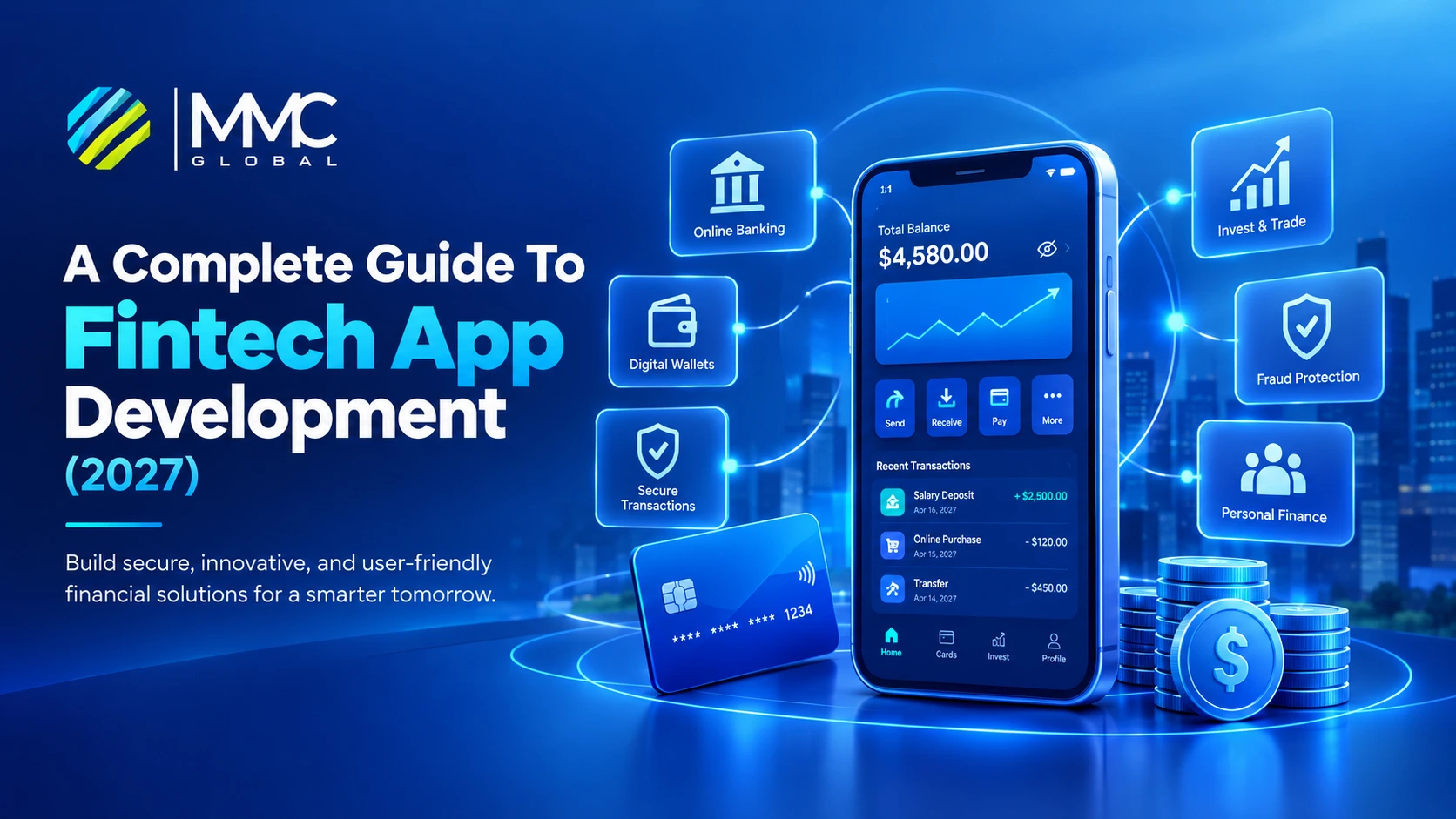
The rise in the use of modern technology has transformed the way we do everything. Managing money is no exception. Whether you are sending someone money or paying for your morning coffee, you no longer need to carry cash (only if there’s a dire need) or visit a bank just to get through minor things easily. Thanks to fintech app development for introducing such ease, where daily financial tasks just happen in a few taps.
Think about it: when was the last time you stood in the never-ending bank queue just to check your balance? Today, you can simply open up the banking app and see where your money stands in a few seconds. Need to split a bill quickly? An e-wallet or peer-to-peer payment app can handle that, too.
It’s no surprise that everyone’s getting so comfortable with these solutions. Moreover, entrepreneurs are taking notes and looking for ways to build fintech mobile apps of their own to take part in this competition. But making one that people actually trust needs a proper strategy to keep their money safe and make every transaction work the way it should.
But where do you really begin? Let’s find out in this blog.
What Is A Fintech Mobile App? A Quick Glance
A fintech mobile app, a combination of the terms “financial” and “technology”, brings financial services to your fingertips through software created to deal with real transactions. It lets users access banking services and make digital payments without depending much on in-person processes.
Behind the screen, banking APIs connect apps with financial institutions while payment gateways process digital payments. For security, encryption and authentication mechanisms help secure sensitive data and prevent unauthorized account access.
Each feature inside fintech app development should serve its purpose without compromising accuracy or security. After all, when an app deals with people’s money, getting the details right matters the most.
Discuss your ideal app ideas with our consultants on a quick call and watch their domain knowledge and expertise turn them into a powerful fintech app.
Let’s Connect!The Market Opportunities Of Fintech App Development in 2027
Fintech application development continues to introduce various new opportunities for businesses as digital payments expand and consumers adopt mobile-first financial services. The market is vividly presenting the growing numbers for those who are looking for a sign to hop on the journey to introduce their own digital finance solutions.
- Global digital payment transactions are estimated to be valued at $37.45 trillion in 2026 and increase to $46.25 trillion by 2031.
- The Fintech-As-A-Service industry is also projected to reach $906,14 billion by 2030, allowing businesses more ways to incorporate existing capabilities into their fintech products without creating every component from scratch.
- And here is something worth noticing: Gen Z has also taken over this industry. 92% of Generation Z prefer mobile banking applications over in-person bank visits. For businesses targeting young customers, a mobile-first experience is becoming increasingly important.
The takeaway? Do not consider them as current trends only. There is a growing market for digital financial services.
Different Types Of Fintech Apps In The Industry
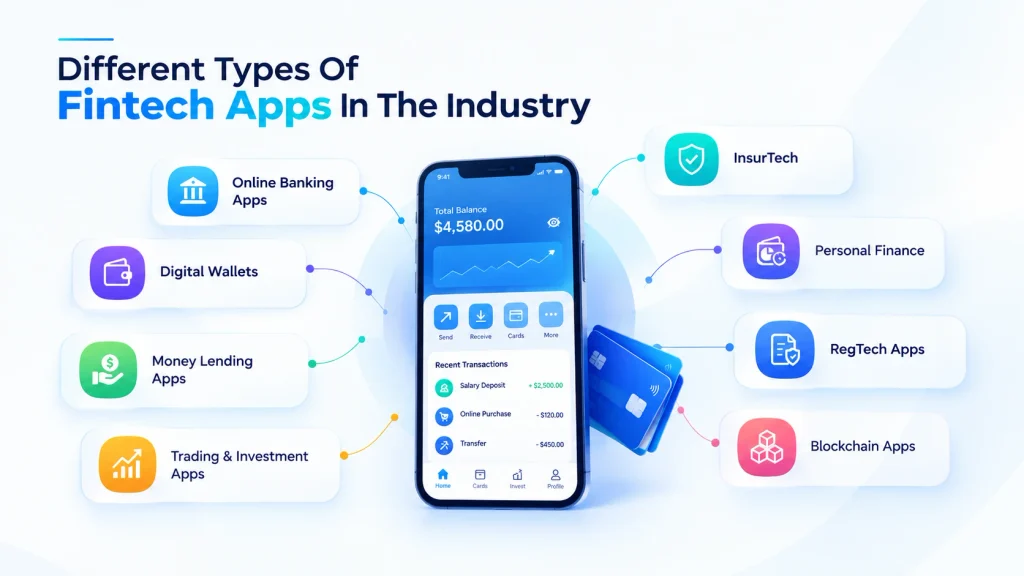
The fintech industry covers a much wider range of financial services than just offering banking apps or P2P transfers. Each app serves a different purpose. Let’s have a quick look at the main types and see what makes each of them useful.
Online Banking Apps
Online banking applications let users access their bank accounts through their mobile phones. Users can easily check current balances, transfer funds, make bill payments, and review account statements. Some apps also support check deposits and card control.
Digital Wallets
Ever made a payment using Apple Pay or Google Pay? That’s a digital wallet. These store payment credentials or wallet balances and let people make purchases without using a debit card.
The market is also growing. The global e-wallet market is projected to reach $786.67 billion in 2032.
Let’s take a peek at the top 3 digital wallets of all time:
| Digital Wallets | Key Uses |
| PayPal | Online payments, money transfers, and merchant checkout. |
| Apple Pay | Contactless in-store payments and online purchases. |
| Google Pay | Contactless payments and online checkout on supported devices. |
Money Lending Apps
Money lending applications connect borrowers with lenders or allow financial institutions to offer online loans. Individuals can submit online applications and provide financial details.
Depending on the service, the app also supports credit assessments, loan approvals, fund disbursement, and repayment tracking.
According to a report, the digital lending platform industry is estimated to grow $54 billion by 2033.
Trading And Investment Apps
Looking to buy stocks without contacting a broker? Trading and investing apps offer users access to financial markets through their digital devices. They can check stock prices and place trades from one account.
Depending on the platform, customers may also invest in ETFs or bonds. Some apps offer robo-advisors that use algorithms to recommend investments and manage portfolios based on users’ financial goals and risk tolerance.
InsurTech
Insurtech apps make insurance services easier to access. Customers can compare policies and purchase coverage without handling each step through a dedicated agent. They can also submit claims and check their progress on the platform.
For insurance providers, these applications can reduce manual work. Digital claims submission and automated document checks help teams process requests more efficiently.
Personal Finance
Personal finance apps help people keep track of their money. They can link to bank accounts and sort transactions into spending categories. Some of the common features are:
- Spending summaries and budget limits.
- Savings goals and progress tracking.
- Bill reminders for upcoming events.
- Income and expense records.
Some platforms also identify unusual spending patterns.
RegTech Apps
Financial businesses should stick to strict rules around customer identity and suspicious activity. RegTech (Regulatory Technology) platforms help organizations meet these requirements easily through software development.
For instance, a RegTech app can verify user identity during onboarding. It can also flag suspicious activity and screen customers against sanctions lists.
Blockchain Apps
Blockchain applications use distributed ledger technology to record transactions across a network. In fintech, they support cryptocurrency transfers and digital asset trading. A few also enable tokenization or cross-border payments.
Features You Don’t Want To Miss Out On In A Fintech App
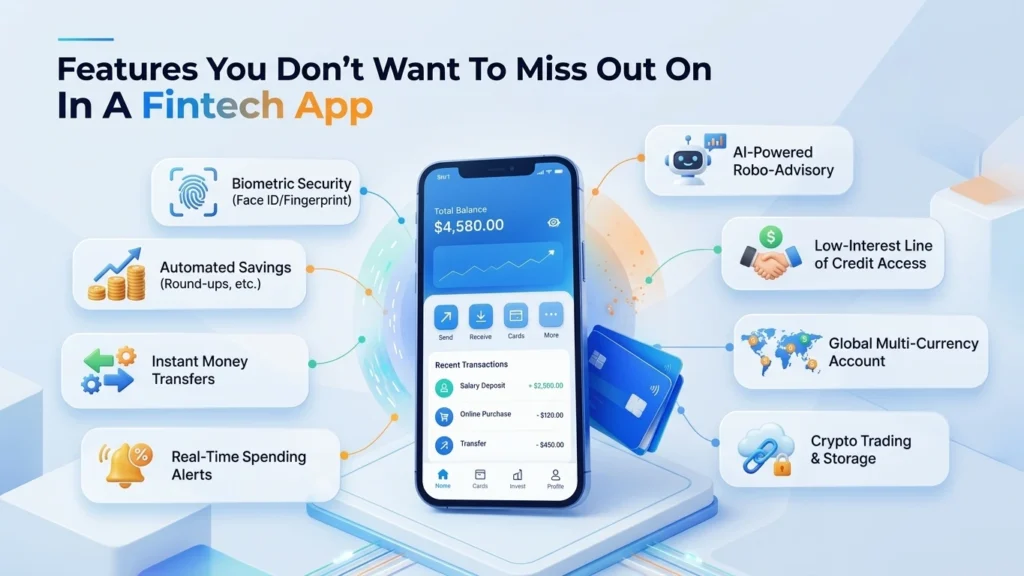
There are a few essential features that one should consider during fintech app development. Here is a list of what deserves a place in your platform and where the details actually matter.
1. Secure Authentication And Access Control
Logging in to the platform in literal seconds feels like a dream come true, until it becomes an easy way of getting into someone else’s account. Fintech app development needs a careful balance between convenience and protection. Ensure fingerprint impressions and facial recognition for quick sign-in, while MFA adds another highly secure verification step.
2. Bank Account And Payment Integration
Payment gateway integration goes underestimated pretty easily until a transaction gets stuck halfway. Now, that’s what high-cortisol really feels like. Your app has to communicate with banks and payment providers, then inform people what actually happened, while keeping the situation from escalating.
Banking APIs can connect supported financial accounts, while payment gateways process online card payments. For apps focusing solely on the USA, Automated Clearing House (ACH) transfers may also be relevant.
Moreover, here is another detail you need to focus on: failed and pending transactions. Users should be able to tell whether a transaction is in process, has failed, or needs further action.
3. Personalized Financial Dashboards
If your users have to switch between 5 different screens to understand their finances, the platform is not doing enough work to end up in their preference list. Start with the records they are most likely to check, like:
- Available balances.
- Recent transactions.
- Upcoming payments.
Spending categories and simple comparisons can help people spot changes in their regular habits.
4. Customer Support Chatbots
A chatbot can answer daily queries and direct users to appropriate help channels. NLP helps it interpret questions that don’t follow a fixed script.
These AI assistants stay available 24/7 to answer customers’ questions anytime, without making them wait annoyingly long. The most important development decision is knowing when the automated bots should stop trying to solve problems on their own.
Disputes and suspected account takeovers may need human support.
5. Alerts And Notifications
Timely notifications should not be treated like a secondary thought. Fintech apps must be able to distinguish between routine updates and alerts that require immediate attention.
Payment confirmation, low-balance warnings, and bill reminders play a huge role in keeping budgets on the right track. Security alerts serve a different purpose by drawing attention to unfamiliar activity. give users control over routine notifications, but make sure important alerts remain clear and easy to act on.
6. Digital Wallet And Account Management
Digital wallets offer different services like adding or removing payment methods, wallet activity reviews, and current balance management. Support for services like Apple Pay or Google Pay can be relevant when the platform offers compatible payment experiences.
Account control also deserves to be under the spotlight. If anybody loses a card, they must be able to freeze it without getting lost in multiple settings or spending a large chunk of their time trying to contact support. These decisions tell if managing money in the application is straightforward or unnecessarily stressful.
7. AI-Powered Financial Assistance
Fintech mobile apps already gather insights that help users make better final calls. Artificial Intelligence can make that data easier to explore.
Machine Learning (ML) also helps determine patterns and support personalized recommendations. The impact of AI in fintech is absolutely insane. In early 2026, it was reported that 40% of fintech service providers noticed increased profitability after embedding AI-related capabilities in their solutions.
But financial guidance needs careful management. The software must be capable of differentiating between observations based on previous history and recommendations that involve uncertainty.
8. Budgeting And Expense Management
Subscriptions renew quietly in the background every month. Small purchases can add up easily as well. Budgeting tools let users catch these expenses before they lose track of their monthly budget.
Automatic transaction categorization can sort purchases into certain groups. Users can set limits according to the category and track progress toward monthly or annual savings goals.
9. Multi-Layer Security And Fraud Prevention
When people trust a platform with their money, they look for more than a password to keep it safe. Fraud prevention adds a layer of protection by tracking financial activity and identifying unusual patterns.
If something seems off, the app can flag it for review and notify the user. This helps catch potential threats early and provides users with great peace of mind.
10. Multi-Language and Currency Support
Supporting a large customer base spread across countries includes personalized date formats, decimal separators, currency symbols, and payment convenience. All these factors can affect how people interpret financial information.
Multi-currency support becomes equally useful for international payments and accounts that hold foreign currencies. Individuals must see the exchange rate and applicable fees before confirming a transfer.
Mobile app developers should also account for currency precision and rounding, as even small discrepancies can cause confusion when displayed amounts don’t match the final transaction.
Let’s talk to our experts to pen down who your target audience is and what solution you want to introduce. With MMC Global, we help you narrow down the niche without hassle.
Talk To Our ExpertsHow To Develop A Fintech Application: Step-By-Step Approach
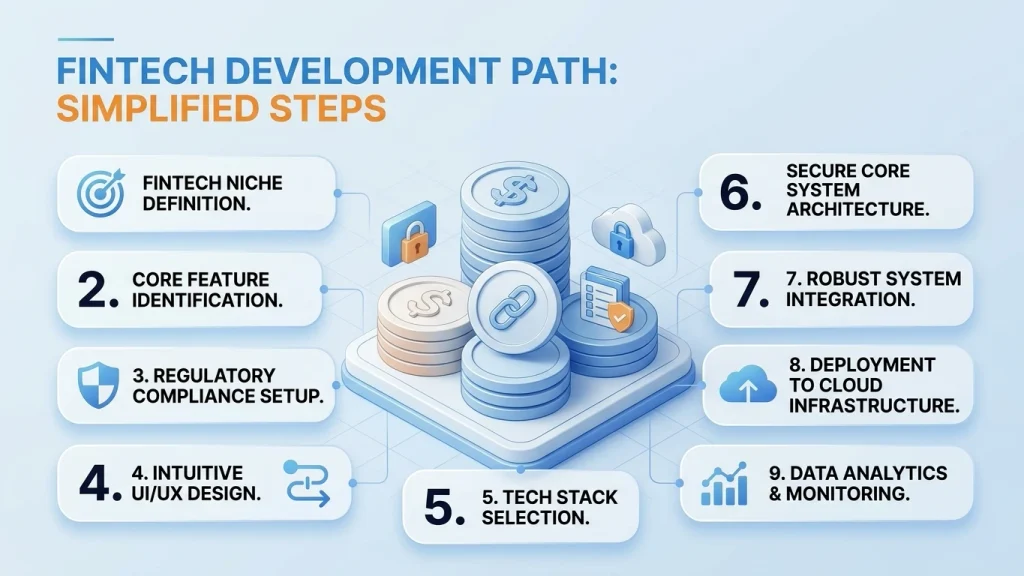
As we have reviewed the growing opportunities the market is presenting, it has become essential to take an immediate step towards building a fintech giant.
But before making huge commitments, let’s take a look at the entire fintech app development process to unveil what it takes to create something that users trust to use.
Step 1: Define The App’s Niche
First, decide what type of problem your fintech mobile app is going to tackle. As we have seen above, there is no single type of platform. So, narrow down your ideal platform. Each option has entirely different user expectations and development requirements.
Research your target audience and competitors before finalizing your idea. You just need a clear reason for users to choose your app instead of reinventing the entire wheel.
Step 2: Identify Key Features
Now, you must know what your app is going to offer. It’s time to decide which features belong in the first version. Start with the ones that users need to complete the main purpose of the platform. An e-wallet, for example, will have different priorities from an investment app.
Separate your requirements into 2 groups:
- Must-have: The main capabilities users need from the beginning.
- Future additions: Extras you can add as the app develops.
This keeps the initial scope manageable and helps you save time.
Step 3: Follow Legal Compliance And Regulations
Fintech mobile apps can face strict regulatory requirements depending on their services and target markets. Consider the following legal compliance and regulations:
- KYC (Know Your Customer)
- AML and BSA
- OFAC screening
- GLBA
- PCI DSS
Depending on your business model, you may also need to assess state money transmitter licensing, consumer protection rules, and requirements enforced by regulators such as the CFPB. Not every fintech app is subject to every rule.
Work out which obligations apply before finalizing your product requirements. A compliance specialist can help you get that right.
Step 4: Design the UI/UX
Fintech app development includes complex mechanisms already; that’s why your UI should make things easier instead of complicating things further.
Users must know where to check their balance, how to complete a payment, and where to find transaction history without playing the detective through the menus.
Create wireframes before moving to detailed screen designs. After that, build a clickable prototype and test it by performing common tasks.
Step 5: Choose The Tech Stack
The fintech mobile application performance is highly affected by technology toolkits. The tech stack also determines how easily developers can maintain it and how well it is going to support upgrades. Choose frameworks as per your platform’s actual needs instead of picking whatever is trending.
Step 6: Build An MVP
Before moving forward with a full-fledged platform, create an MVP first. A minimum viable product gives users a working version of your fintech mobile app with only essential features to solve the main problem.
For instance, an MVP for a personal finance app may have account connections, expense tracking, and a basic spending dashboard. More advanced features can be added later once you understand what users consider helpful.
Do not cut corners on security or compliance. These are must-have requirements for the platform, not optional extras.
Step 7: Test Your App Pre-Launch
Before launch, test that the platform app handles real-world conditions properly. Make sure to perform:
- Functional testing: to verify key capabilities.
- Integration testing: to check bank and payment APIs.
- Security testing: to determine vulnerabilities.
- Performance testing: to check behavior under heavy usage.
- Compliance testing: to validate required controls and records.
Step 8: Launch And Gather User Feedback
By now, the app should have passed the testing phase. It’s time to introduce the fintech mobile app to the users. Before release, prepare your App Store or Google Play Store listings, customer support channels, privacy disclosures, and any required operational procedures.
Make sure your support team is ready to handle questions and that users can easily report problems. Keep a close eye on how people use the platform and pay attention to recurring complaints.
User feedback and usage analytics can help you identify confusing screens or features that are not performing as they should.
Step 9: Post-Launch Updates And Iteration
Launching your fintech app is a milestone, not the end of development. Third-party APIs change, and security vulnerabilities can emerge at any given moment. Create a proper plan for maintenance instead of waiting for something to go wrong.
Use performance data to decide what to improve next. A useful fintech app is the one that continues to work well as people rely on it, instead of the one that launches with a long list of features that nobody really understands.
Technology Stack Needed For A Robust Fintech App
So, you must have figured out what your fintech app will do and the set of features it will be going to have. Now comes the technical part: choosing the frameworks that will make it work. Here is a look at the tech stack commonly used in powerful fintech app development:
| Categories | Frameworks, Technologies, And Toolkits |
| iOS Development | Swift, SwiftUI, UIKit |
| Android Development | Kotlin, Jetpack Compose |
| Cross-platform | Flutter, React Native |
| Web Frontend | React, Angular, Vue.js, Next.js |
| Backend Development | Node.js, Express.js, Java Spring Boot, ASP.NET Core |
| API Development | REST APIs, GraphQL, OpenAPI |
| Rational Databases | PostgreSQL, MySQL, Microsoft SQL Server |
| NoSQL Databases | MongoDB, Amazon DynamoDB |
| Caching | Redis, Memcached |
| Cloud Hosting | AWS, Azure, GCP |
| Deployment And DevOps | Docker, Kubernetes, GitHub Actions |
| Payment Processing | Stripe, Adyen, Braintree |
| Banking Data Integration | Plaid, Finicity |
| Authentication And Identity | OAuth 2.0, Auth0 |
| Encryption And Key Management | AWS KMS, Azure Key Vault, Google Cloud KMS |
| Fraud Detection And Risk Analysis | Python, TensorFlow, PyTorch |
| Security Testing | OWASP ZAP, Burp Suite, Snyk |
| Monitoring And Performance | Prometheus, Grafana, OpenTelemetry |
| Analytics | Google Analytics |
How Much Does It Cost To Build A Fintech App?
After working across numerous industries, especially in finance, MMC Global has found that fintech app development costs have no fixed scope. The type of app that you envision developing and the features inside it set the entire budget.
MVP Development: $36,000 to $90,000
What determines the cost: The budget depends on the core features, the complexity of the design, and integrations you want in the first version of your app.
Basic Fintech App: $50,000 to $150,000
What determines the cost: Adding account management and payment processing increases development time and costs significantly. The budget also relies on the authentication methods and security measures required in your app.
Mid-Level App: $120,00 to $350,000
What determines the cost: Advanced features like fraud detectors, robo-advisors, and personalized financial insights take extra development hours and effort. Additionally, incorporating multiple third-party services can increase the fintech app development cost.
Enterprise Platform: $240,000 to $700,000+
What determines the cost: Most enterprise fintech app development requires complex integrations and robust security measures. Supporting high transaction volumes and meeting industry-specific compliance requirements can further increase the budget.
Take the Next Step For Your Fintech App With MMC Global!
As we have been through this entire guide, we can confidently conclude that the fintech app development industry is not stopping or stripping off opportunities sooner or later. Every report indicates that the chart is constantly moving upwards, which means users are always on the hunt for another “industry giant”.
After evaluating every step and what you need to consider, there is one thing that you should not miss out on: a resilient partnership for fintech mobile app development. MMC Global, a trusted mobile app development company, has been serving clients with powerful solutions for 13+ years. Our philosophy for financial solutions remains: building highly secure and premium-quality fintech apps that keep the user’s trust intact at every stage.
We follow proven methodologies and adhere to fintech compliance and regulations to ensure your app stays relevant all the time. So, let’s grab a chance in the booming market today with MMC Global.
Partner with MMC Global today to develop a sleek, secure, and optimized fintech software.
Book A Consultation Now!Frequently Asked Questions
What is a fintech app?
A fintech app is a mobile or digital platform that connects with financial institutions to handle daily money management like digital payments, banking, lending, and investing directly from a smartphone. It uses secure APIs and payment gateways to make financial transactions fast, paperless, and accessible anywhere.
How can I build a fintech app?
You can build a fintech app by defining your niche, choosing essential features, and selecting a tech stack before developing a working minimum viable product (MVP). The development process requires integrating secure banking APIs, following strict regulatory requirements like KYC and PCI DSS, and testing the system thoroughly before launching.
How much does it cost to build a fintech mobile app?
Building a fintech mobile app typically costs between $36,000 for a basic MVP and up to $700,000 or more for a complex enterprise platform. Final development expenses depend directly on feature complexity, security controls, third-party API integrations, and the compliance standards your app needs to follow.
How long does it take in fintech app development?
Fintech app development usually takes between 3 to 9 months depending on product scope and overall platform complexity. A basic MVP can take about 12 to 16 weeks to launch, while advanced platforms with heavy compliance checks and custom AI features require 6 to 12 months of development time.
What are the latest trends in fintech application development?
The latest trends in fintech application development center around AI-driven financial assistance, embedded finance, open banking APIs, and contactless digital wallets. Top platforms are also focusing heavily on instant P2P payments, automated wealth management, and multi-factor biometric security to deliver smooth and safe user experiences.