

Technology is changing everything around us, and healthcare is also moving fast with it. These days, Augmented Reality (AR) in healthcare is getting a lot of attention and opening new ways to use smart medical tools.
According to a report by Business Wire, the AR healthcare market is expected to grow by nearly $9.8 billion by 2027, with a yearly growth rate of around 22.5% between 2023 and 2027. This shows that working with an augmented reality app development company can be a smart choice for future success.
In simple words, Augmented Reality is a technology that adds digital things like 3D models, images, or text into the real world. You can experience it through a smartphone or special AR glasses, where digital content is placed on top of what you see in real life.
How Augmented Reality is Transforming Healthcare
Technology is reshaping the healthcare industry, and Augmented Reality (AR) is one of the biggest drivers of this change. AR allows doctors and medical staff to see complex data in a more visual way, which improves accuracy in surgeries, makes diagnosis easier, and leads to better patient care. Let’s explore how AR is making a difference in different areas of healthcare:
1. Training
Doctors, nurses, and medical students need a lot of training before they treat real patients. With AR, trainees can practice real-life medical situations in a safe, digital environment.
For example, Yale University uses AR in nursing education. Students can scan QR codes on tablets to view medical simulations like wounds or injuries. This helps them practice diagnosing and treating conditions before stepping into real hospital settings.
2. Operating Room
AR is becoming more popular in surgeries because it adds 3D visual layers during operations. This gives surgeons better visibility and helps them make more precise decisions.
One example is Scopis, a medical tech solution that lets surgeons switch between virtual and real views during procedures. It has shown great results in spinal surgeries by improving accuracy and reducing risks.
3. AR with IoT
The Internet of Things (IoT) is already helping healthcare by collecting patient data, tracking vital signs, and connecting devices. When combined with AR, it becomes even more powerful.
For instance, physiotherapists now give AR-based exercise instructions. Patients can see movements visually, making it easier to follow. Meanwhile, IoT devices record health data and provide doctors with valuable insights.
For the best medical solutions, choose a leading healthcare app development company in the USA to bring your ideas to life.
4. Mental Health Support
AR is also being used in mental health treatments. It helps in therapies for anxiety, depression, PTSD, and phobias.
For example, if someone has a fear of spiders, AR can simulate a controlled environment where the patient faces their fear safely, step by step. This makes therapy more effective without real-world risks.
5. Medical Consultations
AR is not just for surgeries or training. Doctors can also use AR for remote consultations. With advanced AR tools, they can view scans, reports, and 3D visuals of a patient’s condition.
This makes healthcare more accessible, especially in remote areas where medical facilities are limited. Patients can still receive accurate diagnoses and treatment advice without needing to travel.
Also Read: How Web App Development Improves Patient Care in Healthcare Industry
Trends of Augmented Reality in Healthcare
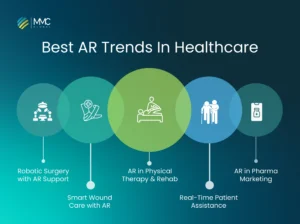
Augmented Reality is shaping the future of healthcare. Below are the top trends that are creating groundbreaking changes in the medical field:
1. Robotic Surgery with AR Support
Robotic-Assisted Surgery (RAS) is already changing the way complex operations are done. When combined with Augmented Reality (AR), surgeons get live, 3D views of delicate body structures. This makes surgeries more precise, safe, and effective.
For example, robotic procedures in liver surgeries have shown better accuracy and improved patient outcomes when AR imaging is used during the operation.
2. Smart Wound Care with AR
AR is also helping in wound care and treatment. With AR-enabled devices, doctors and nurses can scan wounds and instantly see details like size, depth, and level of tissue damage. This real-time overlay helps them decide the right treatment faster.
In cases like ulcer wounds, AR tools guide medical staff with clear visual feedback, improving both speed and accuracy of care.
3. AR in Physical Therapy & Rehab
Recovery is faster and more engaging when AR is part of physical therapy. Patients can follow personalized therapy exercises, and AR ensures they perform every move correctly.
In one study, patients who used AR/VR-based rehabilitation showed noticeable improvements in balance and walking compared to those in traditional therapy. AR is also being used in medical training, like the Augmented Studio project at the University of Melbourne, to help physiotherapists learn with more precision, highlighting the growing role of mobile apps in the healthcare industry.
4. Real-Time Patient Assistance
AR is making hospital visits smoother for both doctors and patients. Instead of flipping through paper charts, doctors can view patient data visually through AR overlays, saving time and improving decisions.
It also helps patients directly. For example, Aira uses AR to assist visually impaired patients by connecting them with live agents who guide them through hospital spaces or medication routines.
5. AR in Pharma Marketing
In healthcare marketing, visuals speak louder than words. AR lets pharmaceutical companies create 3D models of body parts and show how a drug works in real time.
For instance, a 3D AR model of the human heart can demonstrate how a new medicine affects blood flow making complex science easy to understand for both doctors and patients.
Also Read: How Digital Transformation Upgrades Patient Care in the Healthcare Sector.
Real-World Examples of AR in Healthcare
Augmented Reality (AR) is one of the fastest-growing technologies in healthcare. It is improving patient care, medical education, and clinical practices. Below are some real-world applications of AR that are transforming the healthcare industry:
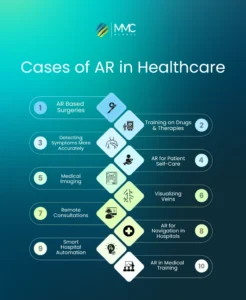
1. AR in Medical Training
According to the AAMC report, the U.S. could face a shortage of nearly 124,000 doctors by 2034. AR can help by providing virtual medical training, allowing students and professionals to learn anatomy and body functions without needing traditional cadavers.
One example is FlexAR, which combines written notes with 3D visuals so learners can study more interactively and efficiently.
2. AR in Surgeries
AR gives surgeons an edge by creating digital models of procedures before they enter the operating room. It outlines steps, risks, and alternatives, helping them stay better prepared.
The xvision Spine System by Augmedics is a great case. It lets surgeons see a patient’s anatomy through skin and tissue like an X-ray view making operations safer and more precise.
3. Training on Drugs & Therapies
AR makes it easier to explain how new drugs or therapies work. With 3D illustrations, healthcare teams can see the effect of a disease and how a treatment helps.
For instance, the VisMol System with Microsoft HoloLens creates interactive AR environments where researchers can test and refine drug discoveries together.
4. Detecting Symptoms More Accurately
Patients don’t always describe symptoms correctly, which can lead to wrong diagnoses. AR tools can help capture more accurate details.
An example is EyeDecide AR, which uses smartphone cameras to simulate eye anatomy and explain conditions with clarity, helping both patients and doctors.
5. AR for Patient Self-Care
AR also empowers patients to take better care of themselves. In physiotherapy, AR apps guide users through movements, making recovery easier and more effective.
Apps like Know My Heart and Know My Pulse help patients track heartbeat patterns and manage conditions like atrial fibrillation, ensuring they stay on top of treatment.
6. Medical Imaging
AR converts CT scans into 3D maps that can be shown on screens, headsets, or directly projected onto the patient. This gives surgeons a real-time guide during operations.
Platforms like Immersive Touch provide 3D “X-ray vision” so doctors can see detailed anatomy during every step of a surgery.
7. Visualizing Veins
Finding veins for blood samples or IVs can be tricky. AR scanners solve this by projecting the vein network onto the skin.
AccuVein’s vein finder uses lasers and AR processing to highlight veins, making blood draws and IV insertions much easier and safer.
8. Remote Consultations
AR is changing the way remote consultations work by making interactions more engaging and effective. With these advanced tools, doctors can see 3D models of a patient’s body, overlay diagnostic details, and work with real-time medical data. If you are planning to create a healthcare solution, you can partner with an iOS app development company or an Android app development company to build the right platform for your needs.
A great example is Teladoc Health, a popular telemedicine platform that connects patients with doctors worldwide through secure video calls, phone consultations, and instant messaging.
9. AR for Navigation in Hospitals
Hospitals can be confusing to navigate. AR-powered wayfinding apps guide patients and staff to their destinations using smartphone maps.
Resonai’s virtual concierge app offers turn-by-turn hospital navigation and can even highlight busy areas to improve social distance. In emergencies like fires or earthquakes, AR can direct people to the safest exits quickly.
10. Smart Hospital Automation
Modern hospitals are becoming “smart” by connecting systems, devices, and workflows. AR adds value by improving real-time monitoring, training, and emergency preparedness.
At Cortelli Vaughan Hospital in Canada, smart workflows automate tasks, freeing staff to focus on patient care. AR-powered digital twins and AI in healthcare help hospitals simulate scenarios and plan better.
Benefits of AR in Healthcare
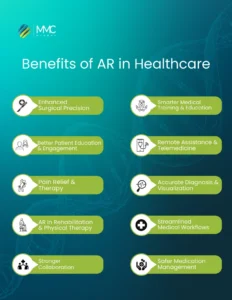
Augmented Reality (AR) has become a powerful tool in healthcare, supporting diagnosis, treatment, and medical education. By adding digital elements to the real world, AR makes it easier for doctors to achieve accurate diagnoses and provide better patient care. If you are exploring innovative AR app ideas, healthcare is one of the best industries to apply them.
1. Enhanced Surgical Precision
AR helps surgeons perform complicated operations with higher accuracy. By projecting 3D visuals of blood vessels, nerves, and organs, it reduces errors, shortens surgery time, and lowers the risk of complications. It also makes minimally invasive surgeries safer, helping patients recover faster with less pain.
2. Smarter Medical Training & Education
Instead of relying on cadavers or plastic models, medical students can now learn through AR-based 3D simulations. These interactive tools give them a deeper understanding of anatomy and medical procedures. Trainees can also practice surgeries in a safe virtual environment before treating real patients building confidence and skills.
3. Better Patient Education & Engagement
AR makes medical information easier for patients to understand. With 3D visuals of their own condition, patients can see how treatments work, ask better questions, and feel more confident about their care.
4. Remote Assistance & Telemedicine
AR allows doctors to collaborate across distances in real time. For example, a surgeon in one location can guide another by overlaying instructions directly on surgical tools. It also supports telemedicine by helping specialists view patient data and provide remote care especially useful in underserved areas.
5. Pain Relief & Therapy
AR can distract patients during painful procedures, making treatments less stressful. It’s also being used in therapy for PTSD, anxiety, and phobias. In wound care or injections, AR helps reduce perceived pain while keeping patients engaged.
6. Accurate Diagnosis & Visualization
Radiologists and doctors can use AR to overlay CT or MRI scans directly onto a patient’s body. This helps them detect problems earlier, visualize internal conditions more clearly, and plan more effective treatments.
7. AR in Rehabilitation & Physical Therapy
Patients recovering from injuries can use AR-based exercises that are interactive and fun. The system tracks movements, provides instant feedback, and keeps patients motivated making therapy more effective.
8. Streamlined Medical Workflows
AR improves efficiency across hospitals by guiding professionals with real-time visuals and data. Faster decisions, fewer errors, and smoother teamwork lower costs while improving overall patient care.
9. Stronger Collaboration
Distance is no longer a barrier. AR enables doctors from different countries to work together on difficult cases, share expertise, and communicate more clearly. This global collaboration improves patient outcomes and advances healthcare research.
10. Safer Medication Management
From prescribing to administering drugs, AR gives healthcare workers tools to ensure accuracy and safety. AR simulations also allow training with real-world scenarios while keeping hygiene standards intact, preparing professionals for better patient care.
With AR-powered apps, patients can see how a medicine works inside their body and also learn about possible side effects in an easy-to-understand way.
Challenges and Limitations of Using AR in Healthcare
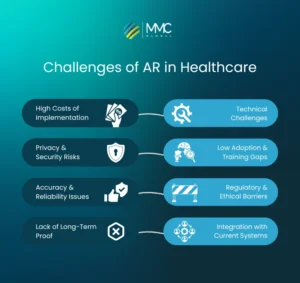
Although Augmented Reality brings many benefits to healthcare, it also has certain drawbacks. Below are some of the key challenges and limitations of using AR in the medical field:
1. High Costs of Implementation
One of the biggest challenges in bringing AR to healthcare is the cost. Building and integrating AR solutions requires expensive hardware, advanced software, and specialized training. Devices like AR headsets and smart glasses are costly, and their regular updates and maintenance also add extra expenses. This makes it hard for smaller clinics or startups to adopt.
2. Technical Challenges
AR in healthcare isn’t simple to set up. Medical data like 3D anatomy models or imaging scans are highly complex, and the systems must run smoothly without slowing down hospital operations. This requires advanced expertise and precision engineering.
3. Privacy & Security Risks
AR systems often deal with sensitive patient data, which makes privacy a big concern. If not secured properly, this data could be exposed to cyberattacks or leaks. On top of that, healthcare AR solutions must follow strict regulations (like HIPAA in the US), which adds another layer of complexity.
4. Low Adoption & Training Gaps
Since AR is still new in healthcare, many doctors and medical staff are not yet comfortable using it. Proper training is required, and that takes time and resources. Some professionals may also resist switching to new technology, slowing down adoption rates.
5. Accuracy & Reliability Issues
In medicine, even a tiny mistake can have serious consequences. If AR projections are inaccurate during a surgery or diagnosis, the results could be dangerous. Ensuring the technology is reliable and precise is one of the biggest challenges developers face.
6. Regulatory & Ethical Barriers
Healthcare is heavily regulated, and introducing AR devices or apps requires strict approval processes. Getting regulatory clearance can take years, especially when it comes to regulatory approval for new AR medical devices. Ethical questions also arise, particularly when AR tools are used in critical, life-or-death decisions. Any error in such cases can be extremely risky.
7. Lack of Long-Term Proof
Although AR shows great potential, there’s still not enough long-term research to prove its effectiveness in healthcare. Many AR apps are still in testing stages, and limited evidence makes hospitals and professionals hesitant to invest fully.
8. Integration with Current Systems
Most healthcare organizations already use electronic health records (EHRs), imaging systems, and diagnostic tools. Adding AR into these systems is not always smooth because of outdated infrastructure or compatibility issues. This slows down real-world adoption.
It can be difficult to add AR into healthcare systems without disturbing existing workflows or needing major system changes.
Future of Augmented Reality in Healthcare
Augmented Reality is quickly becoming a major part of healthcare. A 2025 survey found that 84% of healthcare professionals believe AR and VR will positively change the industry in the coming years. From patient care to surgery and education, AR is expected to bring powerful changes to medicine.
Many hospitals already use AR to support medical staff in daily work, making treatments safer and more effective. Tools like Microsoft HoloLens and Google Glass, which didn’t succeed in the general market, are now proving useful in healthcare. Research also predicts that the AR healthcare market could reach nearly $29 billion by 2028. Let’s look at some of the biggest trends expected in the future:
1. Advanced Surgeries
In the coming years, AR will make surgeries more precise and less invasive. Surgeons will be able to see 3D overlays of patient scans and anatomy during operations, helping them avoid mistakes and reduce risks. Remote experts will also be able to guide procedures, giving more people access to quality care.
2. Personalized Patient Care
Doctors will use AR to show patients how treatments will affect their bodies, making it easier to create personalized health plans. AR apps, along with wearable technology in healthcare, will also support self-care and rehabilitation, allowing patients to take an active role in their recovery.
3. Smarter Medical Training
Medical training will rely more on AR simulations. Students and doctors will be able to practice complex procedures in safe, interactive environments before working with real patients. This approach will improve learning and confidence while reducing risks.
4. Remote Healthcare with AR
As telemedicine grows, AR will make remote care more effective. Doctors will guide patients through self-checkups using 3D visuals and provide detailed instructions in real time. This will be especially valuable for people living in remote or underserved areas.
5. Better Diagnostics
AR will transform the way doctors diagnose illnesses. Radiologists and other specialists will use AR to overlay 3D images such as MRIs or CT scans directly onto patients’ bodies. This will help detect conditions earlier and improve accuracy.
6. Mental Health & Rehabilitation
AR will play a big role in therapy and rehabilitation. Patients with anxiety, PTSD, or phobias will benefit from controlled AR environments to face their fears safely. For physical rehab, AR will guide patients through exercises while tracking their progress in real time.
7. Real-Time Collaboration
Doctors and surgeons across the world will collaborate through AR. Teams will share live 3D information during consultations and surgeries, making decision-making faster and more accurate.
8. AR Wearables in Healthcare
Future AR wearables will help monitor patients’ health by tracking vital signs and alerting professionals in case of emergencies. They will also remind patients to take medicines and support healthy daily routines.
9. Elderly Care with AR
AR applications will improve elderly care by supporting daily tasks, medication management, and physical therapy. These tools will also provide mental stimulation and exercises to keep seniors active and engaged.
10. Addressing Global Healthcare Challenges
AR can help bridge gaps in healthcare worldwide. From bringing expert medical advice to remote communities to offering advanced training for local healthcare workers, AR will improve access to quality care and reduce inequalities.
Partner with MMC Global to Build AR-Powered Apps
The technology industry is growing fast, and Augmented Reality (AR) is becoming one of the most promising tools for healthcare. While more research and adoption are still in progress, AR already has the power to improve clinical practices, patient care, and medical education.
If you are looking for trusted mobile app development services, MMC Global is here to help. Our experts have strong experience in creating AR-based apps with advanced features that deliver real value. Partner with us today and let us turn your vision into a successful solution.
Frequently Asked Questions
Q. What is AR in healthcare?
Augmented Reality (AR) is a modern technology that adds digital elements like 3D images, data, or visuals into the real world. In healthcare, AR is used in surgeries, medical training, patient care, and consultations.
For example, surgeons can use AR to see a patient’s anatomy during surgery, making complex operations safer. Medical students can learn with interactive 3D models of the human body, making their education more engaging and practical.
Q. How is AR used in healthcare?
AR is helping doctors and medical staff in many ways. During surgery, AR can project 3D images and important data into the surgeon’s view, improving accuracy. For diagnosis, AR displays medical imaging data directly on the patient’s body, helping doctors plan better treatments.
In education, AR apps help students and patients understand procedures more clearly in a risk-free way. It also supports remote consultations by allowing specialists to share real-time data and visuals.
Q. How do AR and VR help in medical training?
Both Augmented Reality (AR) and Virtual Reality (VR) are making medical training more effective. They create immersive and interactive experiences where students can practice surgeries or explore the human body without risk.
This reduces training costs and helps learners build confidence before moving to real-life operations. AR also provides 3D anatomical models that students can study in detail.
Q. What is an example of AR in healthcare?
One of the best examples is creating virtual 3D patients using MRI scans. These models can show detailed layers of the body, including organs, bones, veins, and arteries. Doctors can detect tumors, infections, or other issues much earlier with this technology.
If you are planning to build a healthcare app, you can also use our cost estimation tools to calculate development costs.
Q. How can MMC Global help healthcare organizations with AR solutions?
MMC Global is a trusted app development company with strong expertise in AR solutions. We help healthcare providers adopt AR to improve patient care, surgeries, training, and remote consultations.
Our team builds secure, scalable, and user-friendly AR applications that connect theory with real-world practice. If you want to bring your vision to life, MMC Global is ready to support your journey to success.
Q. What is the difference between AR and VR in healthcare?
Virtual Reality (VR) creates a completely simulated environment, replacing the real world with a digital one. Augmented Reality (AR), on the other hand, mixes digital content with the real world, enhancing what you see and experience.
In simple terms, AR improves both the real and virtual world together, while VR immerses you only in a virtual world.