
Friday night at 8 PM. Your kitchen is slamming, tickets are piling up, and the floor is pure chaos. You’re surviving the rush, but a quiet leak is draining your profits.
It starts with a missing $5 bill. No big deal, right? Wrong!
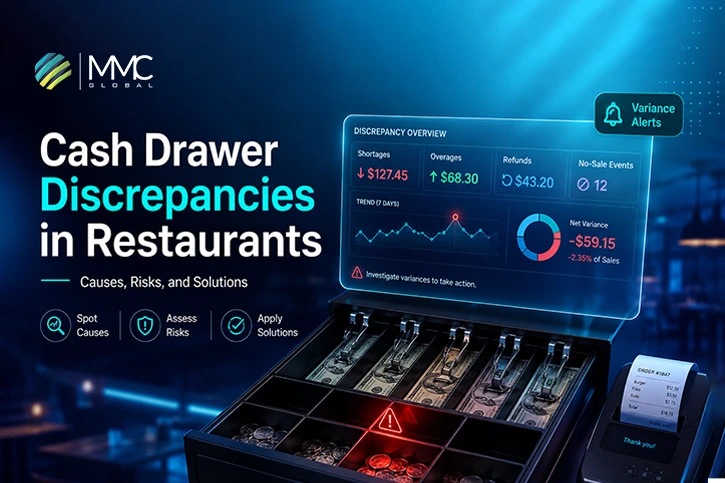
When your bookkeeper flags frequent restaurant financial discrepancies, it is never just about a few missing bills. It is a data integrity crisis. In fact, a register that ends up “over” is just as dangerous as one that is “short”, both mean your tracking is broken.
Every single unmatched penny signals a breakdown in your restaurant loss prevention strategy. If you can’t trust your till, you can’t scale your business.
Let’s pull back the curtain on why your cash isn’t lining up, and how to fix it before your hard-earned margins completely vanish.
Understanding Restaurant Financial Discrepancies: The Cost Of Missing A Penny
A restaurant financial discrepancy might look harmless on the surface. But in reality, it is a signal that something in your cash flow system is not being recorded, tracked, or handled correctly.
Every time your cash drawer does not match your expected sales, it creates a gap between what your business should have earned and what is actually sitting in the till. Over time, they stack up across shifts, locations, and staff rotations, quietly eating into your profit without triggering immediate alarm.
What makes this even more critical is consistency. A single mismatch could be a mistake. But repeated discrepancies point to a deeper breakdown in your restaurant cash drawer management process.
At scale, these errors affect more than cash. They distort your reporting, weaken your forecasting, and make it harder to identify whether your losses are operational inefficiencies or deeper control issues.
In simple terms, missing a penny is never about the penny. It is about losing visibility into your actual business performance.
Common Causes Of Restaurant Accounting Errors
Cash doesn’t just sprout wings and fly out of the till. When your numbers don’t line up, it is always the result of specific, repeatable operational blind spots.
Let’s break down exactly where these costly restaurant accounting errors are actively hiding during your shifts.
Human Operational Errors
In a fast-paced environment, simple human mistakes happen easily. A tired bartender hands back a $20 bill instead of a $10 during a heavy rush. A server accidentally inputs a cash payment as a credit card transaction on the screen.
Fatigue during peak hours causes staff to rush, leading to keying errors. These minor slips quickly snowball into significant financial blind spots by the end of the night.
Weak Cash Handling Policies
Without a formal restaurant cash drawer policy template in place, accountability completely vanishes. Allowing multiple employees to work out of a single, shared drawer makes it impossible to trace errors to a specific person.
When there is no clear shift accountability, staff become careless with the till. Loose rules create an environment where small cash variances are treated as normal rather than a problem to fix.
System And Process Gaps
Discrepancies often start before the doors even open. Starting a shift with an improper opening cash setup throws off the math for the rest of the day.
If your system allows managers or staff to process untracked voids and refunds without strict verification, cash disappears without a paper trail.
Internal Loss Risks
Unrecorded cash usage is a major threat to your bottom line and a core focus of restaurant loss prevention. This happens when staff pulls petty cash for quick errands without logging it, or when messy tip mismanagement skews the drawer balance.
Over time, these actions form distinct cash leakage patterns. When left unchecked, these habits turn minor tracking issues into intentional internal skimming and profit drain.
Accounting Errors and Restaurant Financial Discrepancies Explained
When restaurant accounting errors become a recurring theme, they stop being mere inconveniences and start eroding your balance sheet. Understanding the mechanics of these gaps is the first step toward reclaiming your profit. These discrepancies aren’t just isolated events; they are symptoms of a larger, systemic breakdown between your front-of-house operations and your back-office financial reality.
Impact On Bookkeeping
The ripple effect of a “minor” drawer variance hits your books harder than most owners realize. When daily reconciliation is inaccurate, your sales reports are fundamentally flawed. This forces your accounting teams to spend hours chasing “ghost” transactions rather than focusing on high-level growth strategy.
Inconsistent data entry leads to unreliable profit and loss statements, making it impossible to accurately track food costs or labor percentages. Ultimately, messy books prevent you from making data-driven decisions, turning your financial analysis into guesswork.
POS vs Cash Mismatch
A mismatch between your Point of Sale (POS) terminal and the physical cash in your till is a direct failure of restaurant cash drawer management. This specific gap often occurs when payment methods are miscategorized or when manual voids happen without being properly reflected in the digital audit trail.
For owners using Toast, this mismatch often highlights a failure to fully utilize system-level controls. If your POS reports $500 in cash but you only have $480, you have a revenue leak that complicates your bank deposits and confuses your end-of-day cash reconciliation.
System Dependency Issues
The danger lies in over-relying on a system that hasn’t been properly configured for your specific needs. Many owners believe that simply “having a POS” is enough to guarantee accuracy, but Toast POS consulting services exist because software is only as good as its setup.
Without optimized backend permissions, custom user roles, and enforced workflows, your system is vulnerable to human error. Without professional optimization, you are not using your tech to its full potential, leaving your business exposed to preventable, system-driven financial losses.
How to Prevent Cash Drawer Discrepancies in Restaurants
Fixing a leaky cash flow system requires more than just telling your team to “be careful.” It demands a strategic, bulletproof operational framework. By combining clear physical protocols with advanced point-of-sale settings, you can learn how to prevent cash drawer discrepancies before they take a bite out of your weekend profits.
Standardizing End-Of-Shift Reconciliation
- Count cash before closing POS shift: Never let a server or cashier access their final sales report until the physical cash has been pulled and counted. This makes sure a clean, unbiased count.
- Match POS reports with physical cash: Compare the physical till total against the digital shift report. For Toast users, this means pulling the native Cash Activity Report to check for real-time tracking alignment.
- Document discrepancies immediately: If the numbers are off by even a few cents, log it right away. Tracking these patterns immediately helps identify if you are dealing with an honest mistake or a systemic problem.
Enforcing Structured Cash Drawer Policies
- One drawer per cashier per shift: Eliminate the shared till. Assigning a single employee to a specific drawer guarantees absolute accountability for every penny that enters or leaves that station.
- Mandatory opening/closing cash logs: Require staff to sign off on their starting cash float and their final closing drop. This creates a hard paper trail that protects both the employee and your business.
- Supervisor verification system: Never let a cashier audit their own till alone. A manager or supervisor should always counter-sign the final drop log to verify that the physical cash matches the reported data.
Staff Training And Accountability Systems
- Cash handling training programs: Train your floor staff on basic register discipline, such as counting change aloud to guests and keeping bills organized by denomination in the drawer.
- Error tracking per employee: Keep a quiet, centralized log of variances categorized by individual team members. This makes it incredibly easy to see which employees need extra training, or closer supervision.
- Performance-based monitoring: Reward staff who consistently balance their drawers perfectly. Turning accurate restaurant cash drawer management into a metric for promotions or bonuses builds a culture of honesty.
Operational Best Practices Checklist
- Daily cash audits: Run a surprise mid-day till count during slower operational hours to catch discrepancies before the chaotic end-of-night rush sets in.
- Shift-based reconciliation logs: Treat every shift as its own financial ecosystem. Reconcile the lunch rush entirely before opening up the registers for the dinner crowd.
- Strict refund/void approvals: Restrict all voids, comps, and post-payment edits behind manager-level access keys. Forcing manager approval instantly eliminates unauthorized cash payouts and protects your bottom line.
Automated Cash Handling for Restaurants: The Next Step in Control
Operational policies lay the groundwork for accurate bookkeeping, but human management has its limits during a chaotic dinner rush. To truly eliminate modern operational gaps, forward-thinking operators are turning toward technology.
Stepping up to automated cash handling for restaurants allows you to trade manual guesswork for precise, system-driven control over your cash flow.
What Automation Actually Means In Cash Management
- Reduced manual counting: Automation replaces old-school spreadsheet tallies with smart systems that instantly calculate cash flows, minimizing the time managers spend physically sorting bills in the back office.
- System-driven reconciliation: Instead of manually comparing paper receipts to a computer screen, software instantly cross-references physical cash inputs against digital sales logs to flag immediate variances.
- Real-time cash tracking: Advanced systems keep a live digital paper trail of every single transaction, drawer pop, and payout, letting you monitor your business’s financial health on the fly.
Benefits Of Automation In Daily Operations
- Lower human error rate: By removing the need for manual data entry, you eliminate the tired math mistakes that frequently trigger messy cash variances.
- Faster shift closing: Automated counting and reporting trim the time-consuming end-of-night balancing process from an hour down to a few seamless minutes, drastically lowering your nightly labor costs.
- Better financial visibility: Operators gain an immediate, crystal-clear view of daily profit margins, making it incredibly easy to catch micro-losses before they turn into major monthly deficits.
- Strong audit readiness: Clean, automated data histories ensure your financial records are always organized, accurate, and completely prepared for sudden tax or internal corporate audits.
Where Automation Still Needs Human Oversight
- Cash handling discipline: No matter how smart your cloud technology is, it cannot stop a cashier from handing back the wrong physical change to a customer if they aren’t paying attention.
- Policy enforcement: Systems provide the data, but management must still step in to hold staff accountable when the system highlights consistent errors or non-compliance.
- Exception management: When rare anomalies occur, like an unexpected system interruption or an authorized emergency payout, a trained manager must still manually review and approve the discrepancy.
Also, read our detailed guide on “How a Toast POS Audit Can Help Identify Suspicious Employee Activity”
Restaurant Loss Prevention Through Better Cash Control Systems
At the end of the day, securing your cash isn’t just about micro-managing pennies; it is about building a proactive shield around your hard-earned restaurant revenue.
Shifting your focus toward robust operational infrastructure allows you to stop treating cash variances as an annoying cost of doing business and start viewing them as fixed profit leaks that you can actively repair.
Cash Leakage As A Hidden Profit Killer
A missing five-dollar bill here and a ten-dollar variance there might seem harmless during a busy week. However, these small, daily losses quietly accumulate into thousands of dollars of lost revenue by the end of the year.
These hard-to-detect operational gaps act as an invisible drain on your cash flow, slowly eating away at your bottom line while slipping right past standard, macro-level bookkeeping reviews.
Linking Cash Control To Profitability
Tightening your cash security protocols directly improves your restaurant’s net margins. When your physical cash matches your system reports perfectly, your inventory data, food cost calculations, and sales tracking all align seamlessly.
This high-level data accuracy paves the way for precise financial forecasting, optimized ordering cycles, and incredibly smooth audit outcomes that protect your business from costly compliance fines.
Preventive Systems Vs Reactive Correction
Waiting until midnight to notice that a till is short is an outdated, reactive approach to management. Effective restaurant loss prevention relies on proactive policy enforcement rather than late-night damage control. By setting up real-time monitoring tools, granular employee permissions, and structured approval loops on the floor, you can stop cash handling mistakes and unauthorized drawer openings the exact moment they happen.
Take Total Control of Your Restaurant’s Cash Management with MMC Global
Plugging the leaks in your cash flow demands an airtight operational strategy. No matter what system you use on the floor, technology is only as effective as the policies, user permissions, and management workflows backing it up. Leaving your systems on default settings or ignoring daily variances is a recipe for compounded financial leakage.
At MMC Global, we bridge the gap between high-level restaurant operations and advanced point-of-sale security. We help operators move away from reactive damage control and step into proactive revenue protection.
Don’t let your hard-earned restaurant margins slip away through minor daily variances and loose floor habits. Let us help you establish a foolproof cash management framework that protects your staff, simplifies your bookkeeping, and secures your profits.
Ready to eliminate cash discrepancies for good? Contact MMC Global today to schedule a comprehensive operational audit and lock down your business’s revenue.