
Remember the rule: your application does not care how big your company is. It only cares about whether the right people can build it right.
It can become a grave problem when a promising product needs the actual skills that your internal team lacks. Hiring for each requirement can increase total delivery time before development even takes place. On the other hand, if you keep the project small, you will leave crucial parts of the product underbuilt.
For many organizations, outsourcing app development solves that mismatch without forcing them to hire an entire in-house technical team just around the app. They can bring in the expertise their project needs and scale the support as the work evolves.
However, the interesting part is yet to come. Some choices can silently make an outsourcing deal work beautifully. Others can turn a solid app project into a series of never-ending lessons.
So, before you hand your product to someone else, there are a few things worth figuring out first.
Why Outsourcing App Development Has Become Important In 2026?
An application needs a surprisingly long list of capabilities before a user ever downloads it. Development is only a single piece of the entire puzzle. Numerous factors can easily enter the picture.
That makes maintaining everything in-house a huge commitment than it may first appear. Businesses still need to build and improve their apps. The question is whether they want every skill sitting under the same roof permanently.
To answer that, outsourcing app development has made this decision easier in 2026. And the digits reveal how much the wider technology industry is moving in that direction:
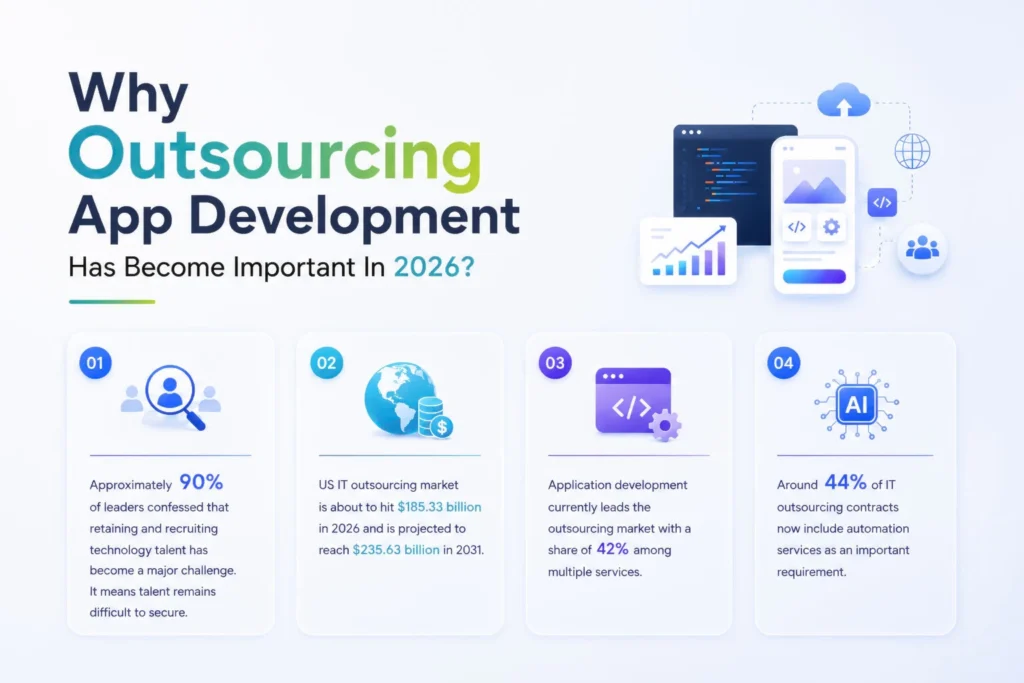
- Approximately 90% of leaders confessed that retaining and recruiting technology talent has become a major challenge. It means the talent remains difficult to secure.
- US IT outsourcing market is about to hit $185.33 billion in 2026 and is projected to reach $235.63 billion in 2031.
- Application development currently leads the outsourcing market with a share of 42% among multiple services.
- And let’s not forget the boom of AI. Around 44% of IT outsourcing contracts now include automation services as an important requirement.
All these studies are coming back to the same reality: businesses are being pushed to look for innovative ways to secure the technical capabilities without slowing down the product plans. For mobile app development, that makes outsourcing a reliable and relevant option in 2026.
Bring the right technical expertise to your project without the cost and complexity of building a full in-house development team.
Discuss Your App IdeaThe Different Outsourcing Types: Onshore, Nearshore, And Offshore
Where your development team operates matters more than it usually seems. Geography can shape how teams work together, how quickly decisions move, and how comfortable you feel while handing over your project.
That leaves you with the 3 broad paths for outsourcing mobile app development: onshore, nearshore, and offshore. Each of them makes a different balance between proximity and overall project economics.
Onshore Outsourcing
With onshore outsourcing, your partner works in the same country as your business. That means you will be working with an app development team in New York City, California, or Texas.
You will be sharing working hours and similar business environments, which makes discussions easier when your product needs continuous input or quick decisions. The real catch? That reliability often comes with higher mobile app development costs.
This outsourcing method suits businesses that place a premium on proximity and close collaboration and are comfortable paying more for it.
Nearshore Outsourcing
Nearshore outsourcing lets you connect with teams in a nearby country or region. Businesses mostly look towards countries like Mexico, Brazil, and Argentina for development.
The minimal time-zone gap makes collaboration easier while still offering organizations access to a broader talent pool and potentially a slightly lower budget than domestic teams.
Works in favor of companies looking for a middle ground between local convenience and broader market access.
Offshore Outsourcing
Then there is an option for companies or stakeholders looking much farther from home.
When you choose offshore software development outsourcing, it means partnering with developers residing in a distant country. The most popular destinations are India, Pakistan, Bangladesh, the Philippines, Poland, and Ukraine.
This distance can result in coordination challenges. At the same time, it lets you easily access large technology talent pools and more affordable development costs. Different working hours also allow continuous work beyond your local business day.
Is Outsourcing App Development The Right Choice For Your Business?
Straight up, outsourcing app development is not automatically the correct solution for every project. The better call depends on what your business needs right now and what your existing team can realistically handle.
A quick checklist before making the move can protect you from building the wrong foundation around the wrong problem.
When Outsourcing App Development Makes Sense
Outsourcing mobile app development makes sense only if:
- Your team lacks critical skills.
- The development workload keeps piling up.
- The project has an urgent deadline.
- You require niche expertise for certain areas in the project.
- You need to scale the team.
- You are going with an MVP development or testing a new product idea.
- You need short-term support for a major release.
- Your in-house developers need to focus on core product work.
- The project requirements need adjustments.
When Keeping Development In-House Makes Sense
The right choice when:
- The software depends too much on proprietary technology.
- Software development is central to your organization.
- Your in-house team already has the right skills.
- You have enough development capacity for the entire production process.
- You need deep internal collaboration to develop a digital product.
- You need strict control over the project decisions.
- Long-term app maintenance becomes a huge responsibility.
- Your development roadmap is stable and predictable.
- Keeping product knowledge internal is a priority.
The Middle Ground: Build In-House And Outsource Strategically
You do not have to go 100% with any one side. Another strategy is to find the middle ground between both models.
Multiple organizations divide the tasks by keeping product strategy and critical decisions internally while partnering with an offshore software development company for specific tasks. This way, you can have practical control over the product without overwhelming your internal or external teams.
The Top Advantages Outsourcing Brings To The Table
The interesting part of outsourcing mobile app development is the way it changes what your business needs to build, maintain, and carry internally.
The list below mentions the benefits outsourcing offers to startups and enterprises. Let’s take a look:
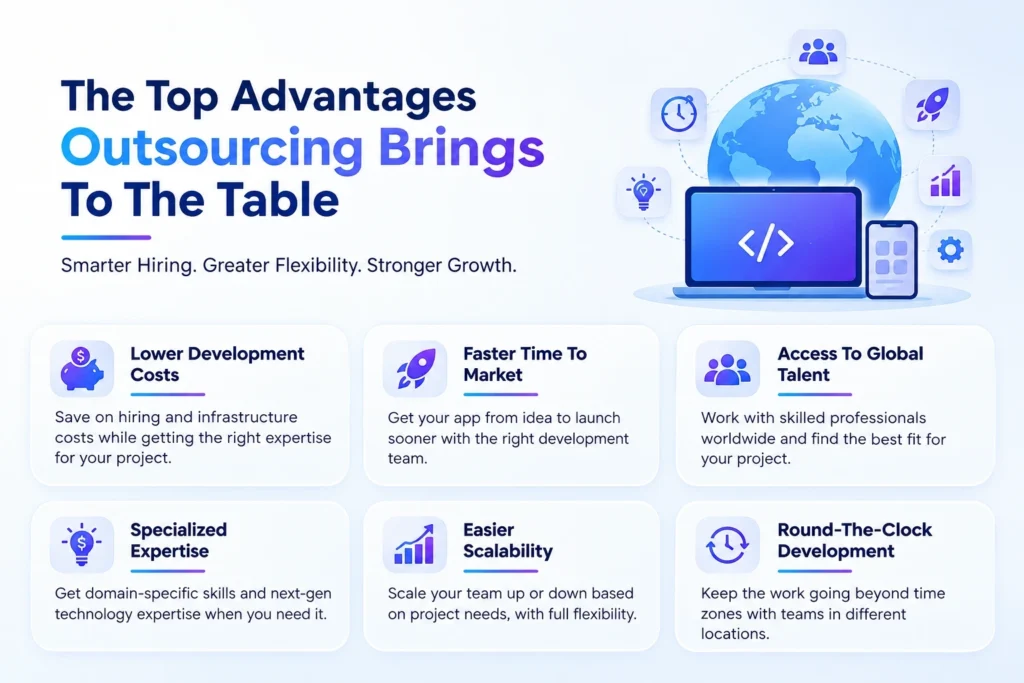
Lower Development Costs
Outsourcing saves you from building a permanent cost structure around a project that may not need it in the future. A talented offshore custom software development company lets you bring in the capacity without the burden of handling every salary and operating expense that comes along with expanding an in-house team.
Faster Time To Market
You do not always get the luxury of waiting for the team to grow before the project can move. An established mobile app development partner brings the right resources into the project sooner, which helps you keep the process moving while your current team handles its existing priorities.
Access To Global Talent
A local hiring market often offers limited resources. Outsourcing app development lets you look beyond technology hubs globally and find creators based on relevant experience rather than simply limiting you to the talent available nearby.
Specialized Expertise
Some requirements are just too specific to justify a permanent role. Since we know that next-generation frameworks are taking over the mainstream industry, apps also need expertise like AI integration, cloud, cybersecurity services, or anything particular for at least one stage of development. With an outsourcing facility, you can easily get that knowledge when the project really calls for it.
Easier Scalability
Your development team doesn’t have to stay the same size throughout the software development lifecycle. When you outsource app development, you gain flexibility to add and remove capacity based on what the roadmap demands. This gives the product more room to grow without forcing your internal headcount to follow the same pattern.
Round-The-Clock Development
A distributed development team keeps the work continuous beyond your own working hours. Coding, testing, and bug resolution can continue across time zones instead of stopping at the end of one team’s day.
From MVP development to complex enterprise applications, get the expertise and resources needed to move your project forward.
Start Your ProjectWhich Outsourcing Model Fits Your App Development Project?
There are different ways to structure an outsourcing engagement. The setup can vary based on the way development needs to be handled and how much involvement you want from your internal team.
The models defined next in this blog are widely used by businesses for outsourcing mobile app development. Each of them works slightly differently from each other.
Fixed-Price Model
When you know what you are building and when you want it delivered, the fixed-price model is the best fit to keep the project tied to an agreed scope.
It works well for projects when requirements are already clear. The less ambiguity there is around the features and deliverables, the more useful a fixed commitment becomes.
A Quick Note: Adding new requirements results in scope changes and additional costs.
Time And Materials
Time and Materials offer breathing room during the development phase. You actually pay for the development time and resources used instead of finalizing the entire work around one fixed scope.
That makes it useful for applications where user feedback, testing, or market response may change the next build.
Dedicated Development Team
This one makes more sense when development becomes an ongoing operation rather than a one-off assignment.
Instead of continuously bringing different people into different stages, you get a team focused on your mobile app and able to create deeper knowledge of its infrastructure and roadmap as time passes.
The dedicated development team model is especially useful when there is a need for continuous oversight and the internal team wants to keep control over direction without handling every delivery role itself.
Staff Augmentation
Think of the times when you do not need a whole new team to handle what 3 or 4 people can possibly and easily handle. Yes, that’s what staff augmentation is for.
It lets you add external developers, or more specifically specialists, directly into your current setup. You can keep the ownership of the software and day-to-day decisions bound to you and your internal team while the added individuals perform the specific task to fill the skill gap.
Highly preferable when your team is already moving but just needs additional firepower to get through the workload.
What Is The Cost Of Outsourcing Mobile App Development?
The offshore outsourcing development cost is shaped around multiple things combined together. The most common are: where the team is located, how ambitious the app is, and what you want it to do.
Cost By Region
Where your development team resides can change the budget considerably. Broad 2026 ranges are:
- Asia ($15 – $60/hour)
Asia has turned out to be the most cost-efficient offshore outsource software development destination, with major technology markets like India, Pakistan, and the Philippines. Attractive for business owners searching for broader coverage at affordable prices.
- Eastern Europe ($25 – $100/hour)
Countries like Poland, Ukraine, and Bulgaria have created software development ecosystems with strong engineering talent. Eastern Europe is often considered when a project requires deeper expertise.
- Middle East ($50 – $120+/hour)
Vision 2030 has changed the technical landscape of the entire Middle East, making UAE, Saudi Arabia, and Egypt emerge as notable development markets. Rates vary according to the region. Check the cost of mobile app development in Saudi Arabia, covered in our detailed guide.
- Latin America ($30 – $110/hour)
Brazil, Argentina, and Colombia are well-known outsourcing destinations for owners seeking closer hours overlapping with the U.S. This makes day-to-day collaboration simpler for teams that prefer more real-time interaction.
- North America ($70 – $250+/hour)
The USA and Canada generally rank at the higher end of outsourcing rates; however, they also offer strong access to senior developers and mature technology systems. This makes sense for projects where local collaboration is prioritized more than minimizing delivery costs.
- Africa ($15 to $50/hour)
Countries such as Egypt, South Africa, and Morocco are establishing increasingly capable software development markets. This region offers competitive rates with growing skills across mobile apps, web development services, and emerging technologies.
Cost By App Type
Your mobile or web application’s complexity is usually a better pricing signal than its label. Here’s a rough breakdown:
- Basic ($20,000 – $50,000)
Apps in this tier focus on a straightforward purpose. Content apps, calculators, simple utility apps, basic booking platforms, or early-stage MVPs with standard user accounts and limited backend requirements fall in this category.
- Mid-Level ($50,000 – $120,000)
The scope gets broader here. Mid-complexity apps may involve integration of multiple third-party APIs or specific features like GPS, etc.
- Complex/Enterprises ($120,000 – $300,000+)
The technology becomes a major part here. Advanced security, large user volumes, AI, and enterprise integrations can all push the development effort considerably higher.
Cost By Features
- User Accounts & Profiles: Basic sign-up is relatively straightforward. Things become more involved when you add role-based access, social login, multi-factor authentication, or detailed user management.
- Payments: Payment gateways, subscriptions, digital wallets, and transaction handling bring additional backend work plus security and compliance considerations.
- GPS & Location: Live tracking, geofencing, route mapping, and location-based notifications require considerably more development work.
- Real-Time Communication: Live messaging, voice calls, video calls, presence indicators, and file sharing can introduce additional infrastructure and testing requirements.
- AI & Machine Learning: Outsource AI development can range from a simple API integration to a much deeper system involving recommendation engines, computer vision, natural language processing, or custom machine learning models. The difference can be significant.
- Third-Party Integrations: Every external service adds another moving part. CRMs, payment systems, maps, analytics tools, cloud services, and enterprise software can increase both development and maintenance effort.
- Advanced Security: Encryption, biometric authentication, fraud detection, compliance requirements, and more sophisticated access controls can add substantial work, particularly for fintech, healthcare, and enterprise applications.
Work with a development team that brings technical expertise, transparent communication, and the flexibility to scale around your project.
Talk to Our ExpertsHow To Choose The Right App Development Outsourcing Partner
Finding an outsourcing mobile app development partner means you are looking for a team that can understand your entire project and stays dependable once development moves forward.
- Relevant Experience: Look for experience with apps similar to yours. Familiarity with your industry or product type can shorten the learning curve.
- Technical Expertise: Make sure the team can handle your required tech stack and the technical demands of the product.
- Portfolio Quality: Look at the products they have actually built and how closely they match your requirements.
- Client Reviews: Reviews can reveal things a portfolio cannot. Pay attention to comments about reliability, communication, and delivery.
- Communication: Agree on how often you will communicate and who will be your main point of contact.
- Development Process: Ask how they handle planning, development, testing, and changes once the project is underway.
- Pricing Model: Understand what you are paying for and what can change the final bill. A low quote means little if the scope is unclear.
- Security Practices: Check how the team handles sensitive data, access controls, and secure development practices.
- IP Ownership: Make sure the contract clearly states who owns the source code, designs, and other project assets.
- Post-Launch Support: The work should not disappear the day your app goes live. Clarify maintenance, updates, and support before development begins.
- Team Structure: Know who will actually work on your project. A sales team impressing you is not the same as the development team delivering it.
- Project Transparency: You should be able to see what is being worked on, what is delayed, and what needs your attention without having to chase for updates.
Potential Risks And How You Can Overcome Them: Key Considerations
Outsourcing makes app development simpler, but only when the working arrangement is transparent from the beginning. Most problems usually appear when something remains vague or is never put into the agreement.
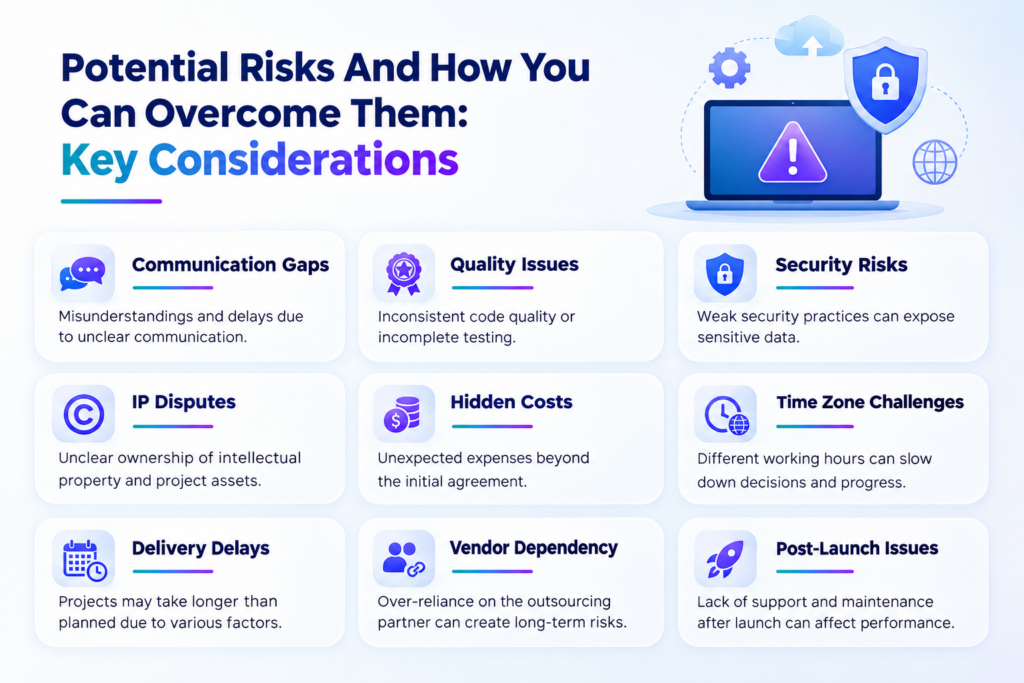
Communication Gaps
Problem: You and your outsourcing app development partner may interpret requirements differently. Most of the time, important updates also get buried when there is no clear communication structure.
Solution: Choose reliable communication channels like Zoom, Slack, and Meet, and schedule meetings and reporting responsibilities before development starts.
Scope Creep
Problem: Additional features and revisions change the direction of the original scope. The project gradually crosses the limits of the original budget and timeline.
Solution: Define the scope early and firmly stick to it. Treat each new requirement as a formal change with its own impact on cost and delivery.
Quality Issues
Problem: An outsourced app can fall short when development goes faster than testing or when quality expectations were never clearly established.
Solution: Set measurable quality standards and include QA throughout development. Do not leave testing for the final stretch.
Security Risks
Problem: Poor access controls or weak security practices can expose sensitive information.
Solution: Check the partner’s security measures before work starts and limit access to the systems and data the project actually requires.
IP Disputes
Problem: Confusion can arise over who owns the assets created during development.
Solution: Make intellectual property ownership explicit in the contract and confirm that all final project assets are transferred to your business.
Hidden Costs
Problem: A project can become more expensive when the initial estimate excludes revisions, additional features, third-party services, or other work outside the agreed scope.
Solution: Ask what the quoted price includes and establish how extra work will be approved and billed.
Time Zone Challenges
Problem: Working across distant time zones can make quick decisions harder and leave issues waiting until the other team comes online.
Solution: Set overlapping working hours for key discussions and establish clear handoffs for work that continues across time zones.
Delivery Delays
Problem: Development delays can push back testing and launch plans that depend on the app being ready.
Solution: Break the project into defined milestones and track progress against agreed deadlines rather than waiting until the final launch date.
Vendor Dependency
Problem: Too much product knowledge can end up sitting with the outsourcing app development partner. Switching teams later can then become unnecessarily difficult.
Solution: Keep documentation current and retain ownership of credentials throughout the engagement.
Post-Launch Issues
Problem: Complexities often become visible only after real users start using the app. Without an agreed support arrangement, even small issues can become difficult to resolve quickly.
Solution: Define post-launch support before development begins, including maintenance responsibilities, response times, and how future updates will be handled.
Make Outsourcing App Development Easy With MMC Global
You already have enough to ponder about. Your application should not be the next thing you have to constantly chase.
With MMC Global, you get an outsourcing app development collaborator that understands what you envision for your app. We bring the right technical expertise into the build while keeping you involved in the places where your decisions matter the most.
Need an MVP quickly? Expanding an existing app? Dealing with a technical problem? We cover them all. We shape the engagement around your preferences.
Our outsourcing mobile app development services are designed to simplify the entire project lifecycle.
Whether you are building an MVP, scaling an existing application, or adding specialized expertise, we can help you find the right development approach.
Get Started TodayFrequently Asked Questions
How much does it cost to outsource mobile app development?
The cost to outsource mobile app development typically ranges from $25,000 to $150,000+ depending on overall project complexity. Simple apps with standard features sit on the lower end, while complex apps with AI integration or custom backends cost significantly more. Final pricing ultimately depends on your required feature set, UI design depth, and team location.
Do I need an LLC to start an app?
You do not legally need an LLC to start an app, but forming one is strongly recommended before launching to the public. An LLC protects your personal assets from potential business debts, copyright disputes, and legal liabilities. It also makes it much easier to open business bank accounts, accept app store payments, and sign vendor contracts.
How to pick the best outsourcing app development company?
To pick the best outsourcing app development company, review their past portfolio, client ratings, communication workflows, and core technical stack. Look for partners with direct experience building similar products and verified client reviews on independent platforms. Always start with a short discovery phase or pilot project to test their delivery speed and code quality.
What are the benefits of outsourcing app development?
The primary benefits of outsourcing app development include lower overall development costs, faster time-to-market, and direct access to specialized global talent. It eliminates the heavy overhead of full-time engineering salaries and recruitment delays. This allows your core business team to stay focused on product strategy, marketing, and user acquisition.
Do I need any documents for outsourcing development?
Yes, you need specific legal and technical documents for outsourcing development to safeguard your intellectual property and outline clear deliverables. Key legal contracts include a Non-Disclosure Agreement (NDA), a Master Services Agreement (MSA), and a Statement of Work (SOW). You should also share a simple Product Requirements Document (PRD) to define app features accurately.