
Looking for a home shouldn’t feel like a headache. But for most people, property hunting is often slow, confusing, and full of outdated information.
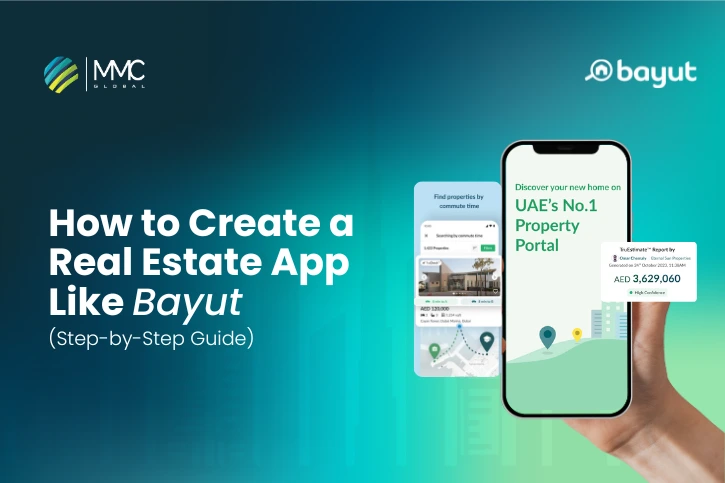
That’s where modern real estate apps like Bayut make a big difference. With just a few taps, users can explore verified property listings, take virtual tours, and even get personalized recommendations based on their needs.
Bayut, one of the most popular real estate apps in the UAE, has transformed the way people buy, sell, and rent properties. From browsing thousands of options to connecting with agents instantly, it has become a trusted platform for anyone searching for their next home.
The demand for such apps is massive. In fact, Dubai’s real estate market alone reached over AED 761 billion in transactions last year, proving how huge the potential is for property platforms.
If you’re planning to build a similar app, now is the right time to partner with the leading real estate app developers in UAE and a trusted mobile app development company in Dubai to turn your idea into the next big real estate solution.
But remember behind every successful app like Bayut is a strong idea, thorough research, and a carefully designed plan.
In this guide, we’ll walk you through the complete process of building a real estate app that’s modern, user-friendly, and reliable just like Bayut.
What Is Bayut?
Bayut is a real estate platform based in the UAE that helps buyers, sellers, and renters connect in one place. With its easy-to-use app, users can:
- Browse thousands of property listings
- Get smart, AI-powered recommendations
- Use map-based search for nearby options
- Take virtual tours of properties
- Check agent and agency profiles instantly
Key Features Every Real Estate App Like Bayut Should Have
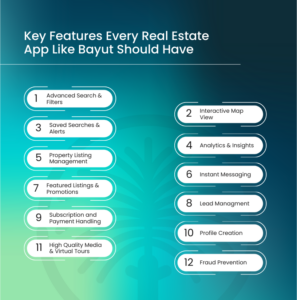
An app like Bayut works so well because it balances the needs of everyone involved buyers, renters, agents, and the platform owner.
If you want your real estate app to succeed, focus on speed, accuracy, ease of use, and AI solutions in real estate that build trust.
The following features will not only help you match Bayut but also give your app its own unique edge in the market.
Let’s break it down:
| Feature | For Buyers & Renters | For Agents & Agencies | For Admin (App Owner) |
| Advanced Search & Filters | Easily find properties by price, area, size, and type | – | – |
| Interactive Map View | Explore properties with nearby schools, malls, and transport | – | – |
| High-Quality Photos & Virtual Tours | Check detailed images and 360° tours | Upload property photos and videos | Approve content quality |
| Saved Searches & Alerts | Save favorites and get instant notifications | – | Send targeted updates |
| Instant Messaging | Chat directly with agents | Reply to client queries | Track conversations for safety |
| Property Listing Management | – | Add, edit, and manage listings | Approve or reject listings |
| Lead Management | – | Track potential clients and follow up | – |
| Featured Listings & Promotions | – | Highlight properties for better reach | Control promotional slots |
| Verified Profiles | Trust verified agents and agencies | Apply for verification badges | Approve or decline requests |
| Analytics & Insights | – | See listing views and performance | Monitor platform activity |
| Payments & Subscriptions | – | Buy premium listing packages | Manage billing and payments |
| Fraud Protection | Safe browsing with verified listings | Keep property details accurate | Detect and block fake activity |
Also Read: Explore 20 money-making apps in the UAE that help you earn effortlessly from home.
Why Bayut Stands Out in the Real Estate Market
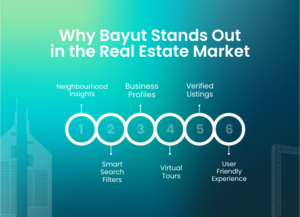
The Bayut property app is a complete digital platform that helps people in the UAE buy, rent, or sell homes with ease.
What makes it truly powerful is how smoothly it connects buyers, renters, sellers, and agents all in one place.
With its modern design, smart search system, and personalized suggestions, Bayut has become one of the most trusted real estate apps in the region.
Here’s why users prefer an app like Bayut when searching for properties:
- Easy-to-Use Design: The app is simple, clean, and fast. Anyone can start exploring homes right away without feeling lost or waiting too long for pages to load.
- Smart Search Options: Users can filter by price, location, size, bedrooms, and even amenities. This helps narrow down the search quickly and saves a lot of time.
- Trusted Listings: Every property comes with real photos, accurate details, and verified information. This ensures people don’t waste time on fake or outdated posts.
- Virtual Property Tours: Can’t visit in person? No problem. The app offers 360° tours, floor plans, and property highlights so users can make decisions confidently.
- Agent & Business Profiles: Buyers and renters can view professional profiles, check reviews, and connect directly with agents through calls, email, or WhatsApp.
- Neighborhood Information: From schools and supermarkets to transport links, users can explore nearby amenities and get a full view of the area before making a choice.
Different Types of Real Estate Apps in the UAE
Searching for a home has never been this convenient. From browsing verified property listings to taking a full 3D tour of a luxury villa without even leaving your sofa technology has completely transformed the real estate experience.
Apps like Bayut, Property Finder, and Zillow have changed the way people buy, sell, and rent homes. But here’s the truth: not all real estate apps are the same.
Each type of app is built for a specific audience, solves a particular problem, and offers its own unique features.
So, if you’re thinking about developing a real estate app for the UAE market, creating just a generic platform won’t cut it. You’ll need to understand the different types of real estate apps, who uses them, and why they matter.
Here’s a breakdown of the main types:
| Type of App | Description | Target Users |
| Property Listing Platforms | Online marketplaces that connect buyers, renters, sellers, and agents with updated property listings. | Homebuyers, Renters, Real Estate Agents |
| Broker & Agency Apps | Branded apps developed by real estate agencies to showcase their listings and offer direct client services. | Agency Clients, Property Buyers |
| Real Estate Investment Apps | Platforms focused on buying, selling, and managing investment properties and real estate portfolios. | Investors, Expats, High-Net-Worth Individuals |
| Rental Management Apps | Tools that simplify rental agreements, payment tracking, and property maintenance. | Tenants, Landlords, Property Managers |
| Virtual Tour & 3D Apps | Apps that provide immersive virtual tours and 3D walkthroughs for remote or luxury property buyers. | Overseas Buyers, Premium Clients |
| Auction-Based Real Estate Apps | Platforms where users can bid on properties through secure online auctions. | Investors, Bargain Hunters |
| Commercial Property Apps | Apps designed for leasing and selling offices, warehouses, retail stores, and other commercial spaces. | Business Owners, Corporate Tenants |
| Community Living & Property Apps | Apps built for gated communities or residential complexes to manage facilities, events, and resident services. | Residents, Building Managers |
Step-by-Step Guide to Building a Real Estate App Like Bayut
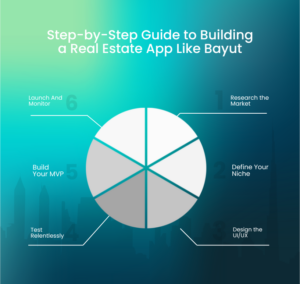
Building a Bayut-like app is not just about coding, it’s about solving real problems for buyers, renters, sellers, and agents while keeping up with the fast-moving property market.
To build an app that people trust and enjoy using, you’ll need a smart business plan, a clean design, and reliable technology.
Here’s a step-by-step guide to turning your idea into a working real estate platform:
Step 1: Research the Market
The first step in creating a real estate app like Bayut is understanding your audience.
- Are you focusing on first-time buyers, long-term renters, investors, or all of them?
- What challenges do they face during property searches?
- What features do they wish they had?
Next, study your competitors’ apps like Bayut, Property Finder, and Dubizzle. As part of the app development process, notice what works well and where they fall short. Those weaknesses are your chance to stand out.
A great way to collect insights is by reading user reviews in app stores. Real feedback will show you exactly what people care about.
Step 2: Define Your Niche
Since the real estate app market is crowded, you need to be clear about who you’re serving.
Decide which property type or audience you want to target:
- Apartments for rent
- Luxury villas
- Commercial office spaces
- Short-term serviced apartments
Your niche shapes your app’s features, branding, and marketing approach.
For example, Bayut made its mark in the UAE’s premium property segment. Where will you focus?
Step 3: Design the UX/UI
Before development, map out how your app will look and feel.
Use design tools like Figma or Adobe XD to create wireframes and clickable prototypes.
Keep the layout simple and mobile-friendly:
- High-quality property images
- Easy filters and map-based search
- Clear call-to-action buttons
- Smooth, fast loading pages
Remember: a real estate app should be so intuitive that users can find what they need in less than a minute without needing a guide or tutorial.
Step 4: Build Your Minimum Viable Product (MVP)
Don’t try to launch with every feature right away. Instead, start with a minimum viable product (MVP), just like 70% of successful startups do.
This means including the must-have features first, and leaving advanced features for later updates.
| Must-Have | Nice-to-Have | May-Have |
| User login & signup | Save favorites | Push notifications |
| Property listings | In-app chat | User reviews |
| Property photos & details | Multi-language support | Mortgage calculator |
| Search & filters (price, location, size) | Recently viewed | 3D virtual tours |
| Contact form / call button | Schedule visits | Voice search |
| Basic admin panel | Email alerts | AR previews |
Launching with an MVP lets you test your idea, gather feedback, and save money before scaling up.
Step 5: Test Relentlessly
Before launching, your app must go through serious testing to make sure it’s stable, easy to use, and safe.
Run different types of tests:
- Functional tests: Check buttons, forms, and workflows
- UI/UX tests: Try the app on multiple devices and screen sizes
- Performance tests: Ensure fast loading and smooth navigation
- Security tests: Protect user data and prevent fraud
Every issue fixed before launch is a better experience for your users.
Step 6: Launch and Monitor
Once your app is polished and tested, launch it on iOS, Android, or both.
But launching is just the beginning. You need to monitor performance and user engagement daily.
Use tools like:
- Firebase for real-time analytics and crash reports
- Google Analytics to track traffic and behavior
- Hotjar / Mixpanel to understand user journeys
Check where users are enjoying the app, where they get stuck, and where they leave. Then, use this data to improve the app with updates that boost satisfaction and retention.
How Much Does It Cost to Develop an App Like Bayut?
Developing a real estate app like Bayut can cost anywhere between $20,000 and $250,000 (or more).
The final price depends on several factors such as the app’s features, design quality, technology stack, and the hourly rates of the development team you choose.
If you’re planning to build one for the UAE market, it’s important to understand the realistic app development cost in UAE, especially in Dubai, so you can plan your budget wisely.
Here’s a breakdown of different app types and their estimated costs, including how to create a Dubai taxi booking app.
| App Type | Estimated Cost (AED) | What’s Included |
| Basic Property App | AED 18,000 – AED 75,000 | Core features like listings, property details, search, and basic filters |
| Mid-Level App | AED 75,000 – AED 185,000 | User profiles, chat with agents, saved searches, and notifications |
| Advanced App | AED 185,000 – AED 550,000+ | All of the above plus AI-driven recommendations, 3D property tours, and a premium UI/UX |
| Bayut-Like App (UAE Market) | AED 30,000 – AED 250,000 | A full-featured marketplace with listings, profiles, filters, messaging, and payments |
| High-End Enterprise App | AED 370,000 – AED 1,850,000 | Scalable platform with advanced analytics, AR/VR, multilingual support, and enterprise-grade features |
Best Monetization Strategies for a Real Estate App Like Bayut
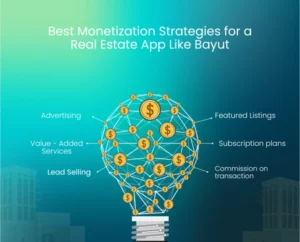
If you want your real estate app to grow steadily and generate profit, you’ll need a clear monetization strategy.
Without one, even the most feature-rich app could end up being an expense instead of a business.
Platforms like Bayut have mastered this balance offering value to users while maintaining strong, recurring revenue streams.
The good news? You can apply similar models to your app, whether your main audience is buyers, renters, agents, or property developers.
Here are some of the most effective monetization strategies for a Bayut-like app:
- Featured Listings
- Subscription Plans
- Transaction Commissions
- Advertising
- Selling Leads
- Value-Added Services
Here’s a closer look at 9 ideal features for a real estate app that can help your platform stand out and drive lasting growth.
Now let’s break them down in detail:
| Strategy | How It Works | Why It Works |
| Featured Listings | Property owners or agents pay to have their listings shown at the top of search results. | Gives sellers more visibility and generates more inquiries. |
| Subscription Plans | Offer monthly or yearly membership packages with perks like unlimited listings, insights, and branding tools. | Creates steady, recurring revenue and builds loyalty among agents/agencies. |
| Transaction Commission | Charge a small percentage on each property sale or rental completed through the app. | Ties your earnings directly to the success of your platform. |
| Advertising | Sell targeted ad space to businesses like movers, mortgage providers, or interior designers. | Adds extra value for users while monetizing your traffic. |
| Lead Selling | Provide verified buyer/renter leads to property agents or developers. | Saves agents time and delivers high-quality prospects. |
| Value-Added Services | Offer premium extras such as virtual tours, professional photography, or property valuations for a fee. | Makes listings more attractive and helps properties sell or rent faster. |
Pro Tip: Start with just one or two revenue models, then expand as your user base grows. This avoids overwhelming new users and lets you scale naturally.
Read More About: Cost To Build a Mobile Car Wash App In Dubai?
Major Challenges in Creating a Real Estate App Like Bayut
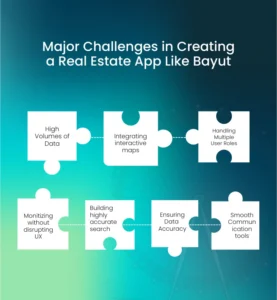
Behind the clean design and fast search results of an app like Bayut, there is a lot of hidden work technology, data management, and smart business strategy.
To succeed, your app must be strong, secure, and scalable. It should handle live property data, support different user roles, and work well with the local real estate market.
Most importantly, it needs to give users a smooth, reliable, and easy experience.
Here are the main challenges you may face when building an app like Bayut:
High Volumes of Data
A Bayut-like app handles thousands of property listings daily. This includes images, videos, and floor plans. It must also support smart filters for price, location, amenities, and property type while keeping listings updated in real time.
The real challenge is building a backend system that can store and process all this information quickly. If not, your app will slow down, annoy users, and lose traffic.
Building Highly Accurate Search
Most users don’t just browse, they search with clear needs. For example: “One-bedroom apartment under AED 80,000 in Dubai Marina” or “Shop in Sharjah with parking.”
Your app must deliver highly accurate and flexible results. This means designing search algorithms that filter by price, location, size, and features without delay. It should also manage spelling mistakes, use smart ranking, and give the most relevant results first.
A weak search engine can frustrate users and push them away.
Integrating Interactive Maps
Maps are one of Bayut’s strongest features. They let users see exactly where a property is located and explore nearby facilities.
But integrating maps is not simple. You need APIs like Google Maps to show accurate locations, smooth zooming, and clustering of listings. The map must also update instantly when users apply filters.
If maps load slowly or use too much mobile data, users will get frustrated.
Ensuring Data Accuracy
Trust is everything in real estate. If users find fake or outdated listings, they won’t come back.
That’s why your app, built with the right mobile app development company in Saudi Arabia, should:
- Verify agents before allowing them to post.
- Check and approve listings before publishing.
- Allow users to report wrong or fake information.
This usually needs both automation and manual checks. Building trust takes time, but losing it can happen instantly.
Handling Multiple User Roles
A Bayut-style platform doesn’t just serve property seekers. It also works for agents, agencies, and admins.
Each group needs different features:
- Buyers and renters want simple browsing.
- Agents need tools to add listings and track leads.
- Admins must approve listings, manage users, and handle disputes.
Creating separate dashboards with proper permissions requires strong planning and security.
Smooth Communication Tools
The real value of a real estate app is connecting seekers with agents.
That means adding safe communication options like in-app chat, call buttons, email alerts, and push notifications. Users should know instantly when an agent replies, a property matches their saved search, or the price changes.
At the same time, privacy and spam protection are very important. Without smooth communication, your app will just feel like a static directory.
Monetization Without Disrupting UX
The app must earn money, but not at the cost of user experience.
Bayut does this with featured listings, premium accounts for agents, and ads.
The key is balance. Too many ads can push users away, but too few won’t cover costs. Paid content should blend naturally into search results while still standing out enough for advertisers.
Read: How Much Does It Cost To Make A Food Delivery App Dubai?
Recommended Tech Stack for Building a Real Estate App Like Bayut
The tech stack (your mix of programming languages, frameworks, and tools) is one of the most important parts of your app.
Choose the right one, and your real estate app could become the go-to platform for property seekers.
Your tech stack affects everything speed, security, scalability, and cost. A strong setup ensures:
- Fast loading for property images and videos
- Ability to handle more users and listings as you grow
- Strong security for sensitive buyer/seller data
- Smooth search and filtering for user convenience
- Support for both mobile and web platforms
Here’s a recommended tech stack for building an app like Bayut:
| Layer | Technology | Why It’s a Good Choice |
| Frontend (Web) | React.js | Delivers fast, responsive UI; large developer community |
| Frontend (Mobile) | React Native or Flutter | Build for iOS & Android from a single codebase |
| Backend | Node.js with Express.js | High performance, great for real-time data |
| Database | PostgreSQL + MongoDB | PostgreSQL for structured data; MongoDB for flexible property details |
| Cloud Hosting | AWS or Google Cloud | Secure, scalable, and reliable hosting |
| Search | Elasticsearch | Super-fast search across thousands of listings |
| Media Storage | AWS S3 | Affordable, scalable storage for images & videos |
| Maps | Google Maps API or Mapbox | Accurate property locations with smooth navigation |
| Authentication | Firebase Auth or Auth0 | Secure and quick user login system |
| Notifications | Firebase Cloud Messaging (FCM) | Reliable push notifications for web and mobile |
| Payments | Stripe or PayPal | Safe, easy payments for bookings or premium listings |
| Admin Dashboard | React.js + Ant Design | Simple, professional interface for admin controls |
This stack gives you a solid foundation whether you start small in one city or scale into a global marketplace.
Begin with the essentials, focus on user experience, and pick tools that let you grow without having to rebuild everything later.
Also Read: 12 Best Taxi Apps in Dubai You Can Rely on.
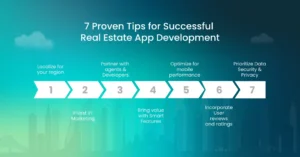
7 Proven Tips for Successful Real Estate App Development
Building a real estate app isn’t just about listing properties. It’s about guiding users through the full journey from searching and exploring neighborhoods to connecting with agents and closing deals.
Today’s users expect convenience, trust, and value at every step. If your app delivers that, you’ll stay ahead of the competition.
Here are 7 proven strategies to help your app grow and win users:
1. Localize for Your Region
People connect more with apps that feel designed for them.
Don’t just translate text, adapt your app to the local culture, language, and property rules.
- Show prices in local currency
- Use regional units of measurement
- Follow local real estate laws and trends
- Customize filters based on market behavior
When users feel the app speaks their “local language,” they’re far more likely to trust and stay.
2. Invest in Marketing
Even the smartest app won’t succeed if no one knows about it. That’s why marketing is non-negotiable.
- Use SEO so your app shows up when people search for homes or rentals in your region
- Run targeted ads on Google, Instagram, Facebook, and TikTok
- Partner with influencers and use email campaigns to nurture leads
A visible brand builds trust before people even download your app and accelerates growth.
3. Partner with Agents & Developers
Local agents and developers aren’t competitors, they’re your strongest allies.
By working with them, you gain:
- Exclusive property listings
- Fresh buyer and renter leads
- Insider market insights
In return, they get exposure and more clients. A strong partnership strategy can turn your app into a must-have tool for both buyers and sellers.
4. Bring Value with Smart Features
Basic listings aren’t enough anymore. To really stand out, add features that make decisions easier:
- AI-powered property suggestions
- Mortgage calculators
- Neighborhood and school guides
- Virtual property tours
These extras transform your app from “just another search tool” into a trusted companion for home seekers.
5. Optimize for Mobile Performance
In real estate, speed is everything.
If your app is slow to load images or process searches, users will move to a competitor. To avoid that:
- Optimize property images and videos
- Streamline your code
- Test performance on different devices and network speeds
A fast, smooth app experience keeps users engaged and satisfied.
6. Incorporate User Reviews and Ratings
Trust drives real estate decisions. Adding verified reviews can build that trust.
- Let users rate agents, neighborhoods, and listings
- Highlight verified feedback to boost credibility
- Create a sense of community where people share real experiences
When users see honest reviews, they feel more confident in their choices and more loyal to your app.
7. Prioritize Data Security and Privacy
Real estate apps handle sensitive data: phone numbers, financial details, even mortgage eligibility. With 39% of UAE residents unaware of their data exposure, protecting this information is critical.
- Use encryption and secure logins
- Be transparent with your privacy policies
- Follow regional data protection laws
When users see that their data is safe, they’ll trust your app with their most important decisions.
Wrapping Up
Creating a real estate app like Bayut starts with understanding the needs of modern buyers, sellers, and renters then turning those needs into a smooth, easy-to-use solution.
With the right features, smart design, and solid market research, your app can deliver real value and stand out in today’s competitive property market.
At MMC Global, we bring 10+ years of experience in building powerful digital solutions for real estate businesses across the UAE and beyond.
Our development team works with you from day one concept to launch, ensuring your app from real estate to ecommerce app development in Dubai aligns perfectly with your audience, market trends, and long-term growth goals.
From strategy and prototyping to coding, testing, and ongoing support, MMC Global is your full-cycle technology partner for creating a successful real estate app.
FAQs About Creating a Real Estate App Like Bayut
Q. How do I start a real estate app?
The first step is to decide your focus: will your app be for rentals, property sales, commercial spaces, or a mix of all? Next, study your audience, check out competitors, and make a list of must-have features. Once that’s clear, pick a reliable development team or platform, design a simple interface, and build a basic MVP (minimum viable product) to test your idea. Gather feedback, improve the app, and then launch the full version when it’s ready for real users.
Q. How much does it cost to build a real estate app?
The price depends on how advanced you want the app to be. A simple MVP usually costs $20,000 – $40,000, while a feature-rich app with advanced tools may go from $60,000 to $120,000+ depending on complexity and developer rates.
Q. How long does it take to make a real estate app like Bayut?
A basic MVP can take around 3–6 months. If you want a full app with advanced features like AI-powered suggestions, 3D virtual tours, or interactive maps, expect 8–12 months or more. The timeline also depends on team size, development method, and testing cycles.
Q. What is the best real estate app to use?
It depends on your location. In the UAE and Middle East, Bayut is one of the most popular choices. In the U.S., Zillow is great for market insights, while Realtor.com is trusted for verified MLS listings. The “best” app is the one that offers accurate listings, local coverage, and a smooth experience for your needs.
Q. Which technologies are best for a real estate app?
For mobile apps, Flutter and React Native work well since they support both iOS and Android. On the backend, popular choices include Node.js, Django, or Laravel. For data, you can use PostgreSQL (structured data) or MongoDB (flexible data). For maps and locations, Google Maps API is a must-have.
Q. Can I start small and add features later?
Absolutely! In fact, starting small is smarter. Launch with an MVP that covers core features like property search, listings, and contact options. Once real users give feedback, add advanced features like chat with agents, mortgage calculators, or neighborhood insights. This way, you only invest in features your users actually want.
Q. How do I make my app stand out from competitors?
The key is to deliver trust, speed, and value. Offer verified listings, make your app fast and easy to use, and add smart features like AI property recommendations, 3D tours, or neighborhood guides. Always focus on accurate data and excellent customer support users stick with apps that feel reliable and professional.
Q. Are real estate apps really worth it?
Yes, both for buyers and sellers. For buyers and renters, apps save time and make house-hunting easier. For sellers and agents, apps bring in more leads and connect them with serious clients. The most important part is using an app that provides verified, scam-free listings so everyone benefits.