
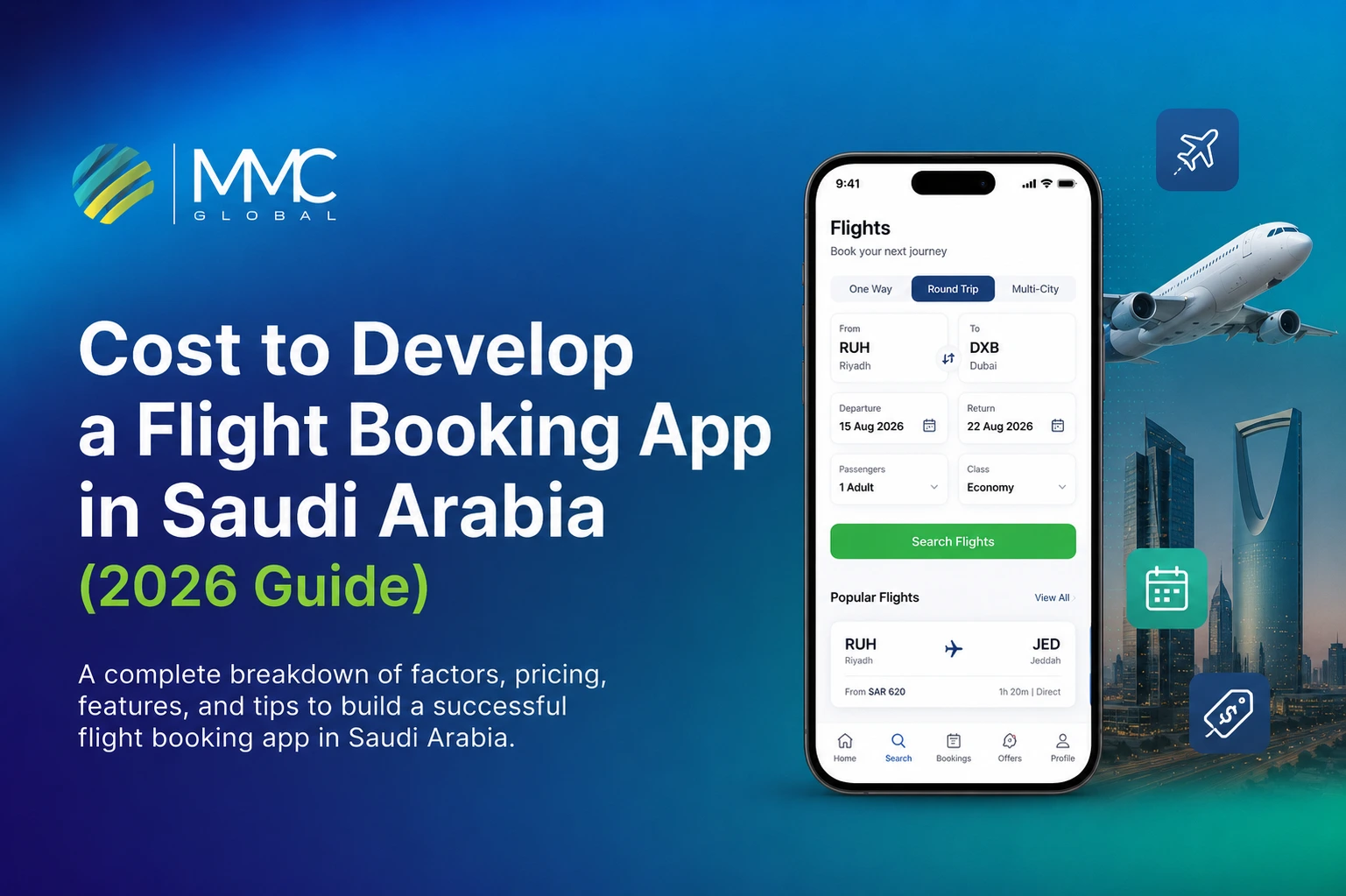
The cost to develop a flight booking app in Saudi Arabia typically ranges from SAR 150,000 to SAR 1,000,000 or more. The final investment depends on several factors, including the app’s features, design, third-party API integrations, platform (Android, iOS, or both), and the overall complexity of the project.
As more travelers prefer booking flights through mobile apps, the demand for digital travel solutions continues to grow. From searching for flights and comparing ticket prices to making secure payments and receiving real-time updates, users now expect a seamless booking experience. This creates a valuable opportunity for airlines, travel agencies, and startups planning to invest in mobile app development in Saudi Arabia.
Saudi Arabia’s travel technology market is expanding rapidly, fueled by Vision 2030, the launch of Riyadh Air, increasing tourism, and mega projects like NEOM. As the country’s tourism and aviation sectors continue to evolve, businesses are investing in modern flight booking applications to meet the growing demand for digital travel services.
Before estimating your budget, it’s important to understand what influences the development cost. In this guide, we’ll explore the key factors that affect pricing, essential features, technology requirements, and the estimated cost of building a scalable flight booking app in Saudi Arabia in 2026.
How Much Does It Cost to Build a Flight Booking App?

The cost of developing a flight booking app in Saudi Arabia depends on the app’s features, level of customization, and overall complexity. While every project has different requirements, most flight booking apps fall into one of the following categories:
| App Complexity | Estimated Development Cost | Estimated Timeline |
|---|---|---|
| Basic (MVP) | SAR 80,000 – 150,000 | 3–4 Months |
| Mid-Level App | SAR 180,000 – 350,000 | 5–8 Months |
| Advanced Enterprise App | SAR 400,000 – 900,000+ | 9+ Months |
These estimates are based on current market trends in Saudi Arabia. The final development cost may vary depending on factors such as the number of features, UI/UX design, third-party API integrations, security requirements, supported platforms (Android, iOS, or both), and ongoing maintenance needs.
Key Factors That Affect Flight Booking App Development Cost in Saudi Arabia

If you’re planning to build a flight booking app, one of the first questions you’ll likely ask is, “How much will it cost?” While it’s a common question, there isn’t a fixed answer. The overall cost depends on your business requirements, the features you want to include, and the complexity of the application.
Unlike standard mobile apps, a flight booking platform requires advanced integrations with airline systems, secure payment gateways, real-time flight data, booking management, and a seamless user experience. If you’re targeting the Saudi Arabian market, you’ll also need support for both Arabic and English, along with compliance with local regulations and payment methods.
Each of these elements directly impacts the development time, technical effort, and overall project budget. Let’s explore the key factors that influence the cost of developing a flight booking app in Saudi Arabia.
1. App Complexity
The complexity of your application is one of the biggest factors that determines the final development cost.
A basic MVP (Minimum Viable Product) includes essential features such as user registration, flight search, ticket booking, secure payments, and booking confirmation. This version is ideal for startups that want to launch quickly while keeping development costs under control.
A mid-level application adds more advanced capabilities, including smart search filters, real-time flight updates, seat selection, fare comparison, push notifications, and user profile management. These additional features require more development time and backend resources, increasing the overall cost.
For an enterprise-grade flight booking app, the investment is significantly higher. These platforms often include AI-powered fare prediction, multiple Global Distribution System (GDS) integrations, loyalty programs, multilingual support, analytics dashboards, commission management, and cloud infrastructure capable of handling thousands of concurrent users.
2. Platform Selection (iOS, Android, or Cross-Platform)
The platform you choose has a direct impact on your flight booking app development cost.
If you’re targeting only iOS or Android, the initial development cost will be lower because you’re building for a single platform. This is a practical option for startups or businesses launching an MVP.
However, many businesses in Saudi Arabia prefer to reach a larger audience by launching on both iOS app and Android app. Developing separate native apps provides better performance, security, and platform-specific features, but it also increases the overall development budget.
Another cost-effective option is cross-platform development using frameworks like Flutter or React Native. With a shared codebase, developers can build apps for both platforms simultaneously, reducing development time and costs while maintaining a consistent user experience.
Ultimately, the right platform depends on your budget, target audience, and long-term business goals.
3. Flight API and GDS Integration
A flight booking app cannot function without access to real-time airline data. This is why integrating reliable flight APIs and Global Distribution Systems (GDS) is one of the most important parts of development.
Popular providers such as Amadeus, Sabre, and Travelport allow users to search flights, check seat availability, compare fares, and complete bookings in real time.
These integrations require API configuration, testing, certification, and ongoing maintenance. If your app connects with multiple airline systems or GDS providers, the development effort and overall cost will naturally increase.
4. Payment Gateway Integration
Secure and convenient payment options are essential for any flight booking application.
To serve customers in Saudi Arabia, your app should support popular payment methods such as Mada, Apple Pay, Visa, Mastercard, and other digital wallets.
Each payment gateway requires API integration, security testing, and compliance with industry standards such as PCI DSS. Additional features like refunds, payment verification, and multi-currency support can further increase development time and cost.
Investing in secure payment infrastructure improves customer trust and ensures smooth online transactions.
5. Backend Infrastructure and Cloud Architecture
While users interact with the front end of your app, the backend is responsible for handling all the critical operations behind the scenes.
A robust backend manages:
- Real-time flight search and fare updates
- Booking confirmations
- Secure user authentication
- Payment processing
- Customer profiles and booking history
- API communication with airlines and GDS providers
- Data storage and analytics
If your business expects high traffic during busy travel periods such as Ramadan, Hajj, or holiday seasons, you’ll need scalable cloud infrastructure with load balancing, auto-scaling, backup systems, and advanced security.
The more scalable and reliable your backend architecture is, the higher the development investment will be.
6. Compliance with Saudi Regulations
Every flight booking app operating in Saudi Arabia must comply with local regulations related to payment security, customer privacy, and data protection.
Depending on your business model, your application may need to meet requirements for:
- PCI DSS compliance
- Data privacy and protection
- Secure payment processing
- Consumer protection regulations
- User consent and data management
Meeting these standards often requires additional development, security testing, legal consultation, and regular compliance audits. Although this increases the initial budget, it helps protect your business from security risks and regulatory penalties.
7. Security and Fraud Prevention
Flight bookings involve high-value online transactions, making travel apps a common target for fraud and cyberattacks.
To protect both your business and your customers, your application should include advanced security measures such as:
- End-to-end encryption
- Two-factor authentication (2FA)
- Secure tokenization
- Fraud detection systems
- Anti-bot protection
- Login monitoring and suspicious activity alerts
Building strong security into your application from the beginning not only safeguards sensitive customer data but also improves user confidence and reduces financial risk.
Step-by-Step Flight Booking App Development Cost Breakdown

Whether you’re a startup, travel agency, or established airline, understanding where your development budget is spent is an important part of planning a flight booking app.
Building a modern flight booking application involves much more than designing screens and writing code. Your investment covers UI/UX design, backend development, flight API integrations, payment gateway implementation, cloud infrastructure, security, testing, and deployment.
Breaking down the development cost by each stage gives you a clear picture of how your budget is allocated. It also helps you prioritize features, plan your investment effectively, and avoid unexpected expenses during the development process.
1. UI/UX Design
A well-designed user interface is one of the biggest factors behind a successful flight booking app. Travelers expect a fast, intuitive, and visually appealing experience from the moment they open the app until they complete their booking.
For businesses in Saudi Arabia, it’s also important to support both Arabic and English to serve a wider audience.
A professional UI/UX design typically includes:
- Clean and modern interface
- Easy flight search and filtering
- Smooth booking and checkout process
- Responsive navigation
- Attractive booking confirmation screens
The design phase usually covers user research, wireframing, interactive prototypes, and final UI design. Investing in a better user experience can improve customer satisfaction, increase booking conversions, and encourage repeat users.
Estimated Cost: SAR 25,000 – SAR 100,000
2. Frontend Development
Frontend development focuses on everything users see and interact with inside the application.
If you choose native app development, separate applications are built for iOS and Android, providing excellent performance and a platform-specific experience. However, this approach requires more development time and a higher budget.
Many businesses also choose Flutter or React Native to build a single app for both platforms. This reduces development time while maintaining a consistent user experience across devices.
Interactive elements such as animated booking confirmations, real-time fare updates, and smooth transitions can further increase development effort.
Estimated Cost: SAR 70,000 – SAR 300,000
3. Backend Development
The backend is the foundation of a flight booking application. It manages all business logic and ensures that users can search, book, and manage flights without interruptions.
A robust backend handles:
- Flight search requests
- Real-time pricing and availability
- Booking management
- User accounts
- Secure payment processing
- Database management
- Admin dashboard
- Reports and analytics
Because flight information changes in real time, the backend must process large amounts of data quickly while maintaining high security and reliability.
Estimated Cost: SAR 80,000 – SAR 350,000
4. Third-Party API Integrations
A flight booking app relies on multiple third-party services to deliver accurate and up-to-date travel information.
Common integrations include:
- Flight APIs and GDS providers (Amadeus, Sabre, Travelport)
- Payment gateways
- SMS and email notification services
- Maps and airport location services
- Push notification platforms
Each integration requires API implementation, testing, security validation, and ongoing maintenance.
Keep in mind that some providers also charge separate licensing or transaction fees, which are different from your app development costs.
Estimated Cost: SAR 50,000 – SAR 200,000
5. Quality Assurance and Testing
Before launching your application, every feature should be thoroughly tested to ensure a smooth and reliable booking experience.
Testing generally includes:
- Functional testing
- Performance testing
- Load and stress testing
- Security testing
- Device compatibility testing
- Bug fixing
Since flight booking apps process payments and personal information, even a small issue can affect user trust. Comprehensive testing helps deliver a stable, secure, and high-performing application.
Estimated Cost: SAR 20,000 – SAR 80,000
6. App Maintenance and Updates
Launching your app is only the beginning. Regular maintenance keeps your platform secure, stable, and compatible with the latest technologies.
Ongoing maintenance usually includes:
- Bug fixes
- Performance improvements
- Security updates
- API updates
- New feature development
- Operating system compatibility
- Server monitoring
As airline APIs, payment systems, and mobile operating systems continue to evolve, regular updates are essential for providing a seamless user experience.
Estimated Annual Cost: 15–25% of the initial development cost
7. Cloud Infrastructure
Most modern flight booking apps are hosted on cloud platforms such as Amazon Web Services (AWS), Microsoft Azure, or Google Cloud Platform (GCP).
Cloud infrastructure enables your application to:
- Handle high booking volumes
- Scale automatically during peak travel seasons
- Store user and booking data securely
- Deliver fast performance worldwide
- Improve reliability with backups and disaster recovery
If your platform expects increased traffic during events such as Hajj, Umrah, or national holidays, investing in scalable cloud infrastructure becomes even more important.
Estimated Cost: SAR 3,000 – SAR 20,000+ per month
Hidden Costs of Flight Booking App Development You Should Know

When planning a flight booking app, most businesses focus only on the initial development cost. While this helps estimate the project budget, it doesn’t tell the full story.
Beyond design and development, there are several ongoing expenses that can affect your overall investment. From third-party service fees and cloud hosting to marketing and customer support, these hidden costs can significantly impact your long-term budget if they aren’t planned in advance.
Understanding these expenses early allows you to create a realistic budget, avoid unexpected surprises, and build a sustainable travel business.
Let’s look at the most common hidden costs of flight booking app development.
1. GDS and Flight API Usage Fees
To provide real-time flight information, your app must integrate with Global Distribution Systems (GDS) such as Amadeus, Sabre, or Travelport.
While integration is part of the development process, many providers also charge ongoing fees, including:
- Per-booking transaction charges
- API usage fees
- Licensing or subscription costs
As your booking volume increases, these recurring expenses also grow. Factoring them into your business model helps protect your profit margins.
2. App Store Publishing Fees
Publishing your app on mobile app stores involves additional costs.
For example:
- Apple App Store requires an annual developer membership.
- Google Play Store charges a one-time developer registration fee.
Beyond publishing, you’ll also need to invest time and resources in App Store Optimization (ASO), app updates, policy compliance, and maintaining your app listings to improve visibility and downloads.
Although these costs are relatively small, they continue throughout your app’s lifecycle.
3. Marketing and User Acquisition
Launching your app is only the first step. Attracting users often requires a dedicated marketing budget.
Common marketing expenses include:
- Google Ads
- Social media advertising
- Search Engine Optimization (SEO)
- Content marketing
- Influencer partnerships
- App install campaigns
- Referral and loyalty programs
The travel industry is highly competitive, so acquiring new customers can become one of your largest ongoing investments.
4. Legal and Regulatory Compliance
If you’re operating in Saudi Arabia, your app must comply with local laws related to payments, customer privacy, and data protection.
Additional costs may include:
- Legal consultation
- Privacy policy and Terms & Conditions preparation
- Regulatory approvals
- Security audits
- Compliance updates
Investing in compliance helps reduce legal risks and builds trust with customers.
5. Customer Support Operations
Travelers expect quick assistance when they experience booking issues, cancellations, payment problems, or flight changes.
Setting up an efficient customer support system may involve:
- Customer support agents
- Arabic and English support
- CRM software
- Live chat
- Email and phone support
- Staff training
Providing reliable customer service improves customer satisfaction and encourages repeat bookings.
6. Payment Gateway Transaction Fees
Every online booking includes payment processing fees charged by payment providers.
Depending on your payment gateway, you may incur:
- Percentage-based transaction fees
- Fixed processing charges
- Refund processing fees
- Chargeback fees
- Currency conversion charges
These ongoing transaction costs should be included when calculating your revenue and pricing strategy.
7. Refunds, Cancellations, and Chargebacks
Cancellations and refund requests are common in the travel industry.
Managing them involves both operational effort and financial costs, including:
- Refund processing
- Airline cancellation policies
- Payment reversals
- Chargeback handling
- Customer support time
Planning for these situations helps maintain smooth business operations while protecting customer relationships.
8. Ongoing Maintenance and Technical Updates
Technology constantly evolves, and your app must evolve with it.
Regular maintenance includes:
- Updating flight APIs
- Supporting new Android and iOS versions
- Bug fixes
- Performance optimization
- Feature enhancements
- Security updates
Ignoring maintenance can lead to poor performance, compatibility issues, and a negative user experience.
9. Security Monitoring and Data Protection
Flight booking apps store sensitive customer information, making cybersecurity a top priority.
Ongoing security investments may include:
- Continuous security monitoring
- Penetration testing
- Fraud detection systems
- SSL certificate renewals
- Data backup solutions
- Threat detection and incident response
A strong security strategy helps protect customer data, reduces cyber risks, and safeguards your business reputation.
How to Reduce Flight Booking App Development Costs in Saudi Arabia

Developing a flight booking app is a significant investment, but careful planning can help you control costs without compromising quality. By focusing on the right features, selecting suitable technologies, and following a phased development approach, you can build a scalable application while staying within your budget.
Here are some practical strategies to reduce flight booking app development costs in Saudi Arabia.
1. Launch with an MVP
Start with a Minimum Viable Product (MVP) that includes only the essential features, such as:
- User registration
- Flight search
- Flight booking
- Secure payments
- Booking confirmation
Launching an MVP allows you to validate your idea, collect user feedback, and enter the market faster. Once your app gains traction, you can gradually introduce advanced features like AI-powered fare prediction, loyalty programs, or hotel bookings.
2. Choose Cross-Platform Development
Instead of building separate native apps for Android and iOS, consider using Flutter or React Native.
With a single codebase, you can:
- Reduce development time
- Lower development costs
- Simplify maintenance
- Reach users on both platforms simultaneously
This approach is especially beneficial for startups and businesses looking to launch quickly without exceeding their budget.
3. Work with an Experienced Development Partner
Choosing the right development company can save both time and money.
An experienced team understands the complexities of flight booking applications, including:
- Flight API and GDS integrations
- Secure payment processing
- Cloud infrastructure
- Scalability
- Aviation industry standards
Their expertise helps avoid costly mistakes, project delays, and unnecessary redevelopment later in the project.
4. Focus on Essential Features First
Not every feature needs to be included in the first release.
Prioritize functionalities that directly improve the booking experience, such as:
- Flight search
- Fare comparison
- Booking management
- Secure checkout
- Push notifications
Features like AI recommendations, travel insurance, loyalty rewards, or advanced analytics can be introduced in future updates based on customer demand.
5. Avoid Excessive Customization
Custom animations, complex user interfaces, and highly personalized experiences can significantly increase development time and costs.
Instead, start with a clean, intuitive, and user-friendly design that focuses on usability. As your business grows, you can gradually enhance the interface with premium design elements and additional customization.
6. Use Scalable Cloud Infrastructure
Cloud platforms such as AWS, Microsoft Azure, and Google Cloud Platform (GCP) allow you to pay only for the resources you use.
This provides several benefits:
- Lower initial infrastructure costs
- Easy scalability during peak travel seasons
- Reliable performance
- Reduced server maintenance
A scalable cloud architecture ensures your app can grow alongside your business without requiring major infrastructure upgrades.
7. Leverage Trusted Third-Party APIs
Developing every feature from scratch increases both cost and development time.
Instead, integrate trusted third-party services for:
- Flight search and booking
- Payment processing
- SMS and email notifications
- Maps and location services
- Push notifications
Using proven APIs speeds up development, improves reliability, and reduces maintenance efforts.
8. Release Your App in Phases
Rather than launching every feature at once, adopt a phased rollout strategy.
For example:
- Release an MVP first.
- Gather user feedback.
- Improve existing features.
- Add advanced functionality over time.
- Expand into new customer segments or markets.
This approach helps spread development costs over multiple phases while reducing project risk.
9. Define Clear Requirements from the Start
Many projects exceed their budgets because requirements continue to change during development.
Before development begins:
- Finalize your feature list.
- Define project goals.
- Create a realistic roadmap.
- Set clear milestones.
- Maintain regular communication with your development team.
A well-defined project scope minimizes unnecessary revisions, shortens development time, and helps keep the project within budget.
5 Popular Flight Booking Apps and Their Estimated Development Costs
Many of today’s leading flight booking apps didn’t become successful overnight. Behind every platform is years of development, continuous improvements, advanced integrations, and significant investment.
If you’re planning to build a flight booking app in Saudi Arabia, studying successful travel platforms can help you understand the level of features, technology, and budget required. While the exact development costs of these apps aren’t publicly available, the estimates below are based on their functionality, infrastructure, scalability, and overall complexity.
Note: These are estimated development costs for building an app with similar features and capabilities. Actual costs may vary depending on your project requirements.
1. Skyscanner
Estimated Development Cost: SAR 900,000 – SAR 1,500,000+
Skyscanner is one of the world’s most popular flight comparison platforms. It allows users to search and compare fares from hundreds of airlines and travel agencies in real time.
Key Features:
- Flight comparison
- Flexible date search
- Price alerts
- Multi-city booking
- Hotel and car rental integration
- Smart search filters
Its large-scale search engine and real-time fare aggregation require advanced backend infrastructure and complex API integrations.
2. Expedia
Estimated Development Cost: SAR 1,200,000 – SAR 2,000,000+
Expedia is a comprehensive travel platform that enables users to book flights, hotels, vacation packages, and car rentals from a single application.
Key Features:
- Flight booking
- Hotel reservations
- Vacation packages
- Car rentals
- Loyalty rewards
- Secure payment system
Because it supports multiple travel services and serves millions of users worldwide, its development requires enterprise-level architecture and cloud infrastructure.
3. Kayak
Estimated Development Cost: SAR 800,000 – SAR 1,300,000+
Kayak is a travel metasearch platform that compares flight prices across airlines and online travel agencies, helping users find the best deals.
Key Features:
- Flight search
- Advanced filters
- Fare comparison
- Price forecasting
- Travel alerts
- Multi-platform support
Its intelligent search capabilities and data aggregation make it a feature-rich travel application.
4. Hopper
Estimated Development Cost: SAR 700,000 – SAR 1,200,000+
Hopper stands out for its AI-powered price prediction technology, helping travelers determine the best time to book flights at lower prices.
Key Features:
- AI fare prediction
- Price tracking
- Booking recommendations
- Push notifications
- Personalized travel suggestions
Building an app with similar AI capabilities requires machine learning models, historical pricing data, and sophisticated analytics.
5. Booking.com
Estimated Development Cost: SAR 1,000,000 – SAR 1,800,000+
Booking.com is widely recognized for hotel reservations but also offers flight booking, airport taxis, car rentals, and vacation packages through its travel ecosystem.
Key Features:
- Flight booking
- Hotel reservations
- Car rentals
- Airport transfers
- Secure payment processing
- Customer reviews and ratings
Its ability to manage millions of listings and bookings requires highly scalable infrastructure and robust backend systems.
What Can You Learn from These Apps?
Although each platform serves a different segment of the travel industry, they share several core features:
- Real-time flight search
- Secure online payments
- Advanced API and GDS integrations
- Scalable cloud infrastructure
- User-friendly UI/UX
- Personalized recommendations
- High-level security and compliance
If you’re planning to build a flight booking app in Saudi Arabia, you don’t need to launch with every advanced feature on day one. Starting with an MVP and gradually adding new capabilities is often the most cost-effective approach while creating a scalable and competitive travel platform.
Build Your Flight Booking App in Saudi Arabia
Developing a flight booking app in Saudi Arabia requires careful planning, the right technology, and a clear understanding of your business goals. Depending on the features, platform, integrations, and overall complexity, the development cost can range from SAR 80,000 for a basic MVP to SAR 900,000+ for an enterprise-level solution.
A successful flight booking app is more than just an attractive interface. It should offer real-time flight search, secure payment processing, reliable GDS integrations, multilingual support (Arabic and English), strong security, and a scalable cloud infrastructure to deliver a seamless booking experience.
Whether you’re a startup, travel agency, airline, or online travel business, choosing the right travel app development services and development strategy can help you reduce costs while building a platform that grows with your business.
Looking for a Flight Booking App Development Partner?
If you’re planning to build a custom flight booking app in Saudi Arabia, our experienced development team can help you transform your idea into a secure, scalable, and feature-rich travel platform.
From UI/UX design and flight API integration to payment gateway implementation, cloud deployment, and ongoing maintenance, we provide end-to-end flight booking app development services tailored to your business needs.
Get in touch with MMC Global – Saudi Arabia experts today to discuss your project and receive a customized development estimate for your flight booking app.
Frequently Asked Questions
1. How much does it cost to develop a flight booking app in Saudi Arabia?
The cost of developing a flight booking app in Saudi Arabia typically ranges from SAR 80,000 to SAR 900,000+, depending on the app’s complexity, features, supported platforms, and third-party integrations. A basic MVP costs significantly less than an enterprise-grade application with advanced features such as AI recommendations, GDS integrations, and multilingual support.
2. What factors have the biggest impact on flight booking app development costs?
Several factors influence the overall development cost, including:
- App complexity and features
- UI/UX design
- iOS, Android, or cross-platform development
- Flight API and GDS integrations
- Payment gateway integration
- Cloud infrastructure
- Security and compliance requirements
- Ongoing maintenance and support
The more advanced your application, the higher the development investment.
3. Should I choose native or cross-platform development?
It depends on your business goals and budget.
Native development offers better performance and platform-specific optimization but requires separate apps for Android and iOS, making it more expensive.
Cross-platform frameworks like Flutter and React Native allow developers to build one application for both platforms, reducing development time and overall costs while maintaining excellent performance for most business applications.
4. How long does it take to build a flight booking app?
The development timeline depends on the scope of your project.
- Basic MVP: 3–4 months
- Mid-level application: 5–8 months
- Enterprise application: 9–12+ months
The timeline may increase if your app requires complex integrations, custom features, or extensive testing.
5. Are there any hidden costs involved?
Yes. Besides the initial development budget, you should also plan for ongoing expenses such as:
- GDS or flight API usage fees
- Cloud hosting
- App Store and Google Play publishing fees
- Marketing and customer acquisition
- Payment gateway transaction fees
- Maintenance and software updates
- Security monitoring and compliance
Planning for these recurring costs helps avoid unexpected expenses after launch.
6. Why is UI/UX design important for a flight booking app?
A well-designed interface makes it easier for users to search flights, compare fares, complete bookings, and manage their trips.
For businesses targeting Saudi Arabia, offering a seamless Arabic and English experience, intuitive navigation, and a smooth checkout process can improve user satisfaction, increase booking conversions, and encourage repeat customers.
7. Which third-party integrations are essential for a flight booking app?
Most flight booking applications require integrations with:
- Flight APIs and GDS providers (Amadeus, Sabre, Travelport)
- Payment gateways (Mada, Visa, Mastercard, Apple Pay)
- SMS and email notification services
- Maps and location services
- Push notification platforms
These integrations enable real-time flight availability, secure payments, and a better overall user experience.
8. Is developing a flight booking app a profitable business in Saudi Arabia?
Yes. Saudi Arabia’s growing tourism sector, increasing smartphone adoption, digital payment usage, and government initiatives under Vision 2030 have created strong demand for online travel services. A well-designed flight booking app can generate revenue through booking commissions, service fees, partnerships, premium subscriptions, and travel-related add-on services.
9. How do I choose the right flight booking app development company in Saudi Arabia?
When selecting a development partner, consider the following:
- Experience in travel and aviation app development
- Expertise in GDS and flight API integrations
- Strong UI/UX design capabilities
- Secure and scalable development practices
- Transparent pricing and communication
- Ongoing maintenance and technical support
Choosing a company with proven experience in travel technology can help ensure your project is delivered on time, within budget, and built for long-term growth.