
In the ever-evolving world of iOS app development, choosing the right programming language is the first step toward building successful, high-performance, and scalable mobile applications. Apple’s iOS ecosystem is renowned for its security, speed, and sleek user interface, which is why selecting the most suitable language matters more than ever.
Whether you’re a startup looking to launch an innovative app or an enterprise aiming to expand digital reach, understanding the best programming languages can streamline your development process and help you deliver top-tier user experiences. Below are the five best programming languages for iOS app development in 2025 and beyond.
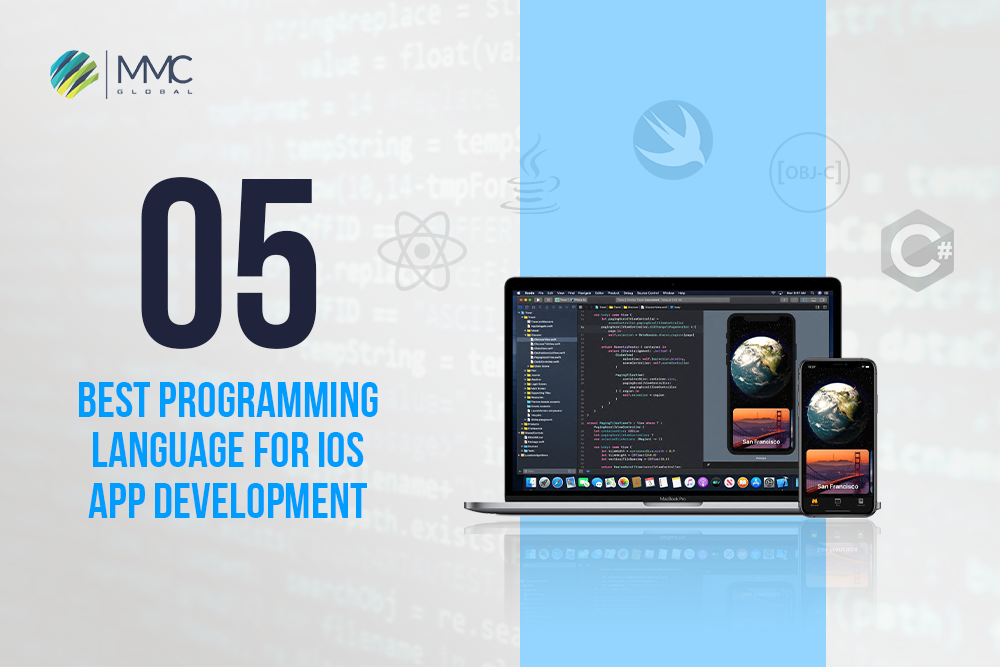
5 Best iOS Programming Languages For iOS App Development
1. Swift – Apple’s Modern Language for iOS App Development
Swift has quickly become the gold standard in iOS app development since its introduction by Apple in 2014. Designed to replace Objective-C, Swift offers a more modern, safer, and faster way to build apps for iOS, iPadOS, macOS, watchOS, and tvOS. Its syntax is clean and concise, making it easier for developers to write readable and maintainable code.
One of Swift’s biggest advantages is performance. Apps developed in Swift are significantly faster than those written in older languages. It also integrates seamlessly with Apple’s Cocoa and Cocoa Touch frameworks. Thanks to features like optional types, generics, closures, and memory management via ARC (Automatic Reference Counting), Swift ensures that iOS app development is not only faster but also less prone to errors. Businesses seeking Swift app development services can benefit from faster delivery, improved app stability, and future-ready solutions. With a growing developer community and constant improvements from Apple, Swift is undoubtedly the most future-proof choice for iOS applications.
2. Objective-C – The Veteran Language Still Going Strong
Before Swift took the spotlight, Objective-C was the cornerstone of iOS app development for over three decades. While not as commonly used for new projects today, it remains an essential language, especially for maintaining legacy iOS applications or integrating with existing codebases.
Objective-C is a superset of the C programming language, offering dynamic typing, message-passing, and object-oriented capabilities. It allows developers to interact with Apple’s mature APIs and libraries at a low level, giving them fine-grained control over app behavior. While the syntax can be more complex and verbose compared to Swift, Objective-C is still supported and widely used in enterprise environments. If you’re working on a large-scale app with a long history, having Objective-C knowledge remains valuable in the iOS app development landscape.
3. C# – A Cross-Platform Powerhouse via Xamarin
C# is a robust, object-oriented programming language developed by Microsoft. When used with Xamarin, a powerful open-source mobile app platform, C# becomes a viable and efficient option for iOS app development. Xamarin allows developers to write code once and deploy it across iOS, Android, and even Windows, making it ideal for businesses aiming for cross-platform compatibility.
C# brings strong type-checking, asynchronous programming with async/await, and a rich set of libraries through the .NET framework. Xamarin compiles apps into native code, ensuring high performance and native UI look and feel. For developers already familiar with C# For those working in enterprise Microsoft environments, using Xamarin for iOS app development can drastically reduce both development time and maintenance costs while still delivering a native user experience.
Read more: How to Start iOS App Development On Windows
4. JavaScript (with React Native) – Bridging Web and iOS Worlds
JavaScript is not typically associated with native iOS app development, but frameworks like React Native have changed the game. Created by Facebook, React Native allows developers to build mobile applications using JavaScript and React, with the ability to render native UI components for iOS.
The main advantage of using JavaScript with React Native is code reusability. A significant portion of the codebase can be shared between iOS and Android platforms, accelerating development cycles. JavaScript’s asynchronous and event-driven architecture makes it ideal for building highly interactive user interfaces. Although it may not match Swift or Objective-C in terms of performance for computation-heavy tasks, React Native is a solid choice for startups and businesses that prioritize faster time-to-market and budget efficiency in iOS app development.
5. Kotlin (Multiplatform) – The Future of Cross-Platform Native Development
While Kotlin is primarily known as the preferred language for Android, Kotlin multi platform is gaining momentum in the iOS app development space. Kotlin multi platform allows developers to write shared business logic in Kotlin, which can then be used across Android and iOS apps. This significantly reduces code duplication and ensures consistency in application behavior.
Kotlin offers modern features such as null safety, extension functions, coroutines, and a concise syntax, making it appealing for mobile developers. For teams looking to maintain a shared codebase while delivering native performance on both platforms, Kotlin Multiplatform is an innovative and growing option. While it may not yet be as mature as Swift for full iOS development, its flexibility and productivity gains make it a language worth considering in your iOS app development toolkit.
[Bonus read]: Top Benefits of iOS App Development
Why Choose iOS for App Development?
In today’s fast-paced digital economy, mobile apps have become vital tools for businesses aiming to boost engagement, streamline operations, and stay competitive. Among the two dominant mobile platforms, Android and iOS, Apple’s iOS stands out for several compelling reasons. Whether you’re a startup launching your first app or an enterprise optimizing your digital footprint, choosing iOS app development can offer significant advantages in terms of performance, revenue, user trust, and long-term scalability.
1. High-Quality User Experience
One of the primary reasons businesses prefer iOS app development is the superior user experience Apple is known for. Apple maintains strict guidelines for UI/UX design, performance, and security, ensuring that apps on the App Store are polished and reliable. The consistency in iOS devices’ screen sizes, hardware capabilities, and operating system versions allows developers to create smooth, responsive applications with minimal fragmentation.
From intuitive navigation to elegant interfaces, iOS apps deliver a premium experience that keeps users engaged. This quality-focused ecosystem encourages higher user satisfaction and loyalty, essential factors for retention and long-term business success. When you choose iOS app development, you’re not just creating an app; you’re building a trusted digital experience.
2. Strong Security and Privacy Standards
Security is a top priority in iOS app development, making it the go-to choice for apps handling sensitive information such as financial data, health records, or personal details. Apple’s closed ecosystem, along with rigorous app vetting processes, minimizes the risk of malware and data breaches. Features like secure app sandboxing, Face ID, Touch ID, and data encryption enhance user protection.
In an era where digital privacy is under constant scrutiny, iOS users trust the platform’s ability to safeguard their data. Apple’s regular updates and adherence to strict privacy regulations like GDPR make it a reliable environment for both developers and users. For businesses that need to build apps where security cannot be compromised, iOS app development is a clear winner.
3. Higher Revenue Potential
Although Android dominates in terms of global market share, iOS consistently leads in app revenue. iPhone and iPad users are more likely to spend money on apps and in-app purchases, making iOS app development highly attractive for companies focused on profitability. According to industry statistics, iOS users have higher average income levels, which translates into greater purchasing power within apps.
This revenue potential is especially beneficial for monetization models based on subscriptions, eCommerce, premium content, or SaaS offerings. Whether you’re launching a paid app, freemium model, or an in-app marketplace, developing for iOS gives you access to a customer base that is more inclined to pay for digital experiences. For businesses aiming for strong ROI, iOS app development offers a more lucrative pathway.
4. Faster Development and Testing Cycles
Thanks to Apple’s streamlined ecosystem, iOS app development typically involves shorter development and testing cycles compared to Android. With fewer device variations, screen sizes, and OS versions to support, developers can focus on optimizing the app for a limited number of environments. This results in faster deployment, lower testing costs, and more efficient maintenance.
Apple also provides powerful tools like Xcode, Swift, TestFlight, and Instruments to support robust development workflows. These integrated tools help in debugging, profiling, UI designing, and beta testing, which accelerates the overall time-to-market. For businesses operating under tight deadlines or budgets, the efficiency of iOS app development becomes a significant competitive advantage.
5. Strong Brand Reputation and Global Reach
Apple is one of the most valuable brands in the world, and its products have a loyal user base across North America, Europe, Australia, and parts of Asia. By investing in iOS app development companies can tap into this premium market segment and align their brand with Apple’s reputation for quality and innovation.
Moreover, iOS apps have better chances of standing out in the App Store due to Apple’s selective publishing process. This curation ensures that users are presented with high-quality apps, and developers benefit from enhanced credibility and discoverability. If you want to associate your app with trust, prestige, and innovation, iOS app development positions your brand in a highly favorable light.
6. Seamless Integration with Apple Ecosystem
Another compelling reason to opt for iOS app development is the seamless integration with Apple’s ecosystem of devices and services. From iPhones and iPads to Apple Watch, Apple TV, and MacBooks, your app can be designed to offer synchronized experiences across multiple platforms. Features like Handoff, Continuity, and iCloud enable smooth data sharing and user experiences across devices.
This interconnected ecosystem not only enhances user satisfaction but also opens up new functionality for apps. For instance, a health and fitness app can integrate with Apple Watch, while a productivity tool can sync across iPhone and Mac in real time. Developing for iOS means you’re not just building a mobile app, you’re designing for an entire digital lifestyle.
Factors to Consider When Choosing an iOS Programming Language
When it comes to iOS app development, choosing the right programming language is a foundational step that can significantly impact the success, scalability, and performance of your mobile application. Whether you’re building a simple utility app or a complex enterprise solution, the language you choose affects everything, from development speed and cost to long-term maintainability and user experience. In this blog, we explore the most important factors to consider when selecting a programming language for your next iOS project.
1. Project Scope and Complexity
The size and complexity of your project should directly influence your choice of programming language for iOS app development. Simple apps with limited features might not require the most advanced or modern tools, while more complex apps demand robust, scalable, and high-performance solutions.
- For simple apps: You might choose a language that prioritizes speed and ease of use, such as Swift.
- For complex enterprise-grade apps: Consider languages that offer in-depth system access, integration capabilities, and support for extensive codebases, like Objective-C or even Kotlin Multiplatform for shared logic.
Understanding the scope will help you align the language capabilities with your functional requirements and technical expectations.
2. Performance Requirements
Performance is a critical factor in iOS app development, especially when your app involves real-time data processing, graphics rendering, or intensive background operations. Some languages are inherently faster or more memory-efficient than others.
- Swift: Known for its optimized performance, especially for apps that require low-latency response and real-time UI interactions.
- Objective-C: Offers deeper control of system resources and performance tuning but requires more complex syntax and manual memory management.
- React Native or Flutter (with Dart): May lead to slightly slower performance for native features due to the abstraction layer but suitable for many business apps.
Your performance benchmarks, loading time, responsiveness, and memory usage, should help guide your language decision.
3. Team Expertise and Available Resources
Your in-house development team’s expertise plays a major role in choosing the most practical language for iOS app development. Selecting a language that your developers are already proficient in can drastically reduce development time and costs.
- If your team is experienced in Swift, leverage it for clean, modern, and Apple-optimized coding.
- If your developers come from a C# or .NET background, C# with Xamarin can be a natural fit for building cross-platform iOS apps.
- For web developers, JavaScript with React Native allows them to reuse existing knowledge and frameworks.
Hiring new talent or training your existing team in a completely new language can lead to delays and increased ios app development cost. Therefore, align language selection with your team’s strengths.
4. Long-Term Maintenance and Scalability
Maintaining an app post-launch is just as important as building it. The language you choose for iOS app development should allow for easy code updates, bug fixing, and feature enhancements over time.
- Swift: Constantly updated by Apple and well-supported, making it a solid long-term investment.
- Objective-C: Still supported but considered legacy; not ideal for long-term growth unless maintaining existing codebases.
- Kotlin Multiplatform: Emerging as a cross-platform tool for shared logic but might not yet offer full support for all iOS-specific functionalities.
Choose a language with a strong roadmap, community support, and compatibility with future iOS updates to ensure your app remains relevant and functional.
5. Integration with iOS Ecosystem and Native Features
For truly seamless iOS app development, your programming language should offer deep integration with Apple’s native features and services. These include:
- ARKit (Augmented Reality)
- Core ML (Machine Learning)
- HealthKit
- SiriKit
- iCloud and Apple Pay
Languages like Swift and Objective-C have full access to these APIs, ensuring tighter integration and a better native experience. On the other hand, cross-platform tools may require third-party libraries or plugins that can sometimes lag behind Apple’s latest features.
If leveraging the full power of iOS hardware and software is a priority, go with a native language that offers complete access to Apple’s ecosystem.
6. Development Speed and Time-to-Market
Time-to-market is a crucial consideration, especially in competitive industries. Choosing a language that supports rapid prototyping and fast iterations can be a game-changer for iOS app development.
- Swift: Fast to write and test, with tools like Xcode and Swift Playgrounds to speed up prototyping.
- React Native or Flutter: Excellent for quick MVPs and building iOS and Android apps from a single codebase.
Objective-C: May slow down development due to its verbose syntax and complexity, especially for new teams.
If launching fast is a business priority, prefer languages and frameworks that emphasize speed without sacrificing quality.
7. Community Support and Documentation
Languages with strong communities and extensive documentation simplify the development process and problem-solving. When working on an iOS app development project, access to tutorials, open-source libraries, forums, and expert advice can accelerate your journey.
- Swift: Backed by Apple, with a growing community and abundant learning resources.
- Objective-C: Mature and documented, but with a declining active community.
- React Native and Xamarin: Benefit from global developer communities and a large ecosystem of libraries and tools.
Community strength ensures you’re never stuck when facing challenges, especially during complex integrations or debugging.
Also Read: How to Start Successful iOS Application Development
Choose Wisely for iOS App Development Success
The programming language you choose for iOS app development has a long-term impact on your app’s success, scalability, performance, and user experience. While Swift is generally the top choice for most modern iOS apps, other options like Objective-C, React Native, C#, or Kotlin multi platform may be better suited depending on your project’s goals, team skills, and target audience.
Key Takeaways:
- Match the language with your project scope and technical needs.
- Consider long-term maintenance, not just initial development.
- Evaluate performance, security, and native integration needs.
- Leverage your team’s existing expertise to save time and resources.
By thoroughly evaluating these factors, you can make a strategic decision that lays a strong foundation for your app’s long-term success in the Apple ecosystem.
Conclusion: iOS App Development as a Strategic Business Choice
The best programming language for your iOS app development project depends on your goals, existing codebase, team expertise, and long-term strategy. Swift is the top recommendation for building modern, efficient, and scalable iOS apps, while Objective-C is crucial for maintaining legacy systems. If cross-platform compatibility is a priority, C# with Xamarin, JavaScript with React Native, or Kotlin Multiplatform can provide versatile and cost-effective solutions.
No matter which language you choose, focusing on performance, maintainability, and user experience should always be at the heart of your iOS app development strategy. With the right tools and technologies, you can craft mobile applications that not only meet user expectations but also stand the test of time in Apple’s competitive ecosystem.
Choosing iOS app development services is more than just a technical decision; it’s a strategic move that aligns with quality, security, revenue growth, and customer trust. From delivering a world-class user experience to leveraging Apple’s global reach and robust ecosystem, iOS offers a development platform that meets the high standards of today’s users and businesses alike.
Whether you’re building a consumer-facing application or a secure enterprise solution, iOS equips you with the tools, community, and infrastructure to succeed. By prioritizing iOS app development, you invest in building digital products that are not only functional but also future-proof, scalable, and profitable in the long run.